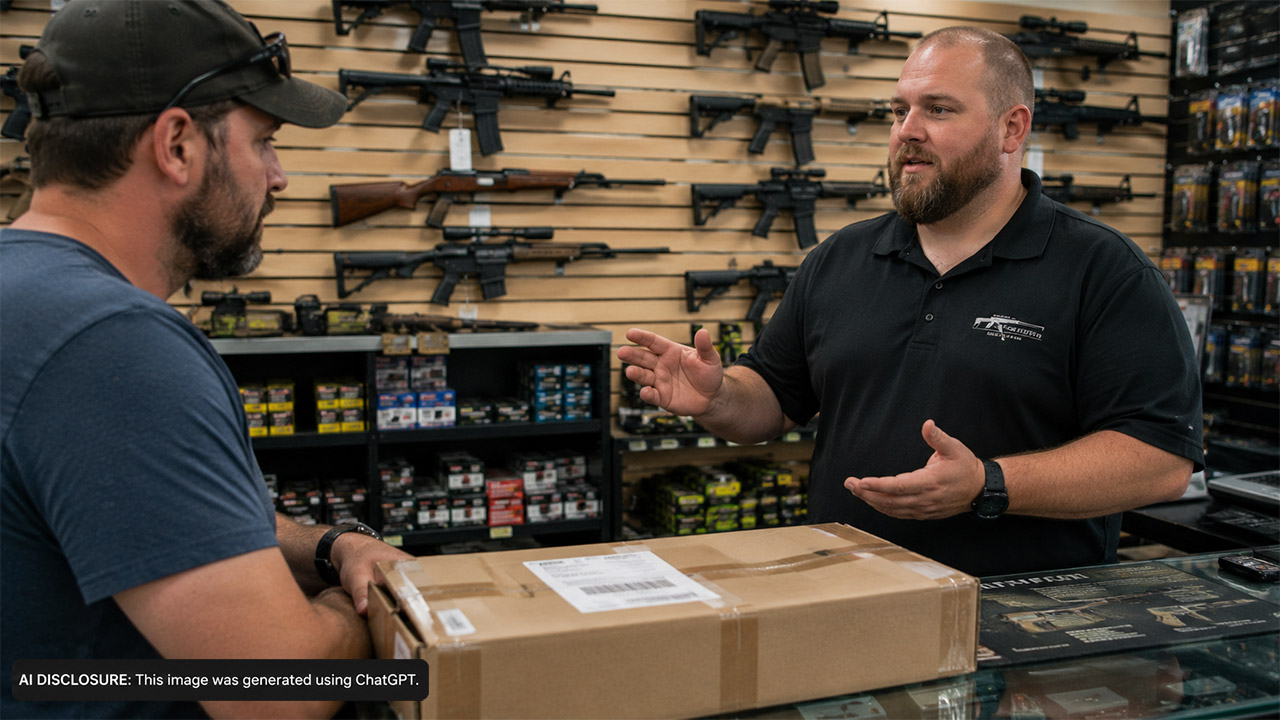
Photo credit: AI-generated image created using ChatGPT. Illustrative only
Most gun buyers have dealt with the waiting game: you find the one you’ve wanted for years, you hit “buy,” and then shipping and paperwork start moving at their own pace. For one Texas gun owner, that timing problem turned into a bigger question—could he have a firearm shipped to a dealer and let a buddy pick it up if he’d be gone for months?
In the original post, the buyer explained he had a narrow window to purchase a “dream gun,” but expected to be unavailable for several months by the time it arrived. He also believed that any dealer he shipped it to would eventually sell it if he didn’t retrieve it in time, so he was trying to find a way to make the purchase “with peace of mind.”
A common “shipping to an FFL” misunderstanding
Plenty of folks new to online gun purchases assume ordering is the hard part and pickup is just a formality. In reality, pickup is the transfer. That’s the moment the dealer has to follow federal rules on who takes possession of the gun.
When you buy a firearm online and ship it to a local FFL, the gun doesn’t become yours in a practical sense until the dealer transfers it to you. That transfer is tied to the person who is actually receiving the firearm. And that’s where “have my friend grab it for me” runs into trouble fast.
Why “my friend will pick it up” sets off straw-purchase alarms
The buyer’s idea was simple: if he’s going to be gone when the gun arrives, let somebody he trusts pick it up so it doesn’t get sold out from under him. But when a different person shows up to receive the gun—especially when that person wasn’t the one who ordered it—people immediately start thinking about straw purchases.
In plain outdoorsman terms, a straw purchase is when somebody uses their clean background check and paperwork to acquire a gun for someone else. Even when the intent isn’t criminal, the pattern looks the same: one person pays or arranges the buy, another person does the in-person transfer, and the gun ends up with the original person later. That’s why commenters said his description sounded like a straw purchase setup.
What the dealer is likely to do when the wrong person shows up
Even before you get into legal arguments, there’s the practical, real-world problem: most FFLs are not going to transfer that firearm to your friend simply because he’s your friend. The dealer is on the hook for the paperwork and the transfer process, and they can’t treat it like a package pickup.
If the firearm is addressed to the FFL for transfer to you, and your buddy walks in trying to complete the transfer instead, the dealer can refuse. In many shops, that conversation ends quickly, because they’ve heard every variation of it. The safest business move for the dealer is to only transfer the firearm to the actual purchaser who is completing the process.
The timing trap: storage policies and “we’ll sell it” fears
The buyer said he “know[s] any FFL I send it to will just sell it” if he can’t pick it up for several months. That fear isn’t coming out of nowhere. Shops have limited storage space, and guns sitting for a long time turn into headaches: inventory control, insurance, and time spent calling a customer who’s out of town.
That said, different dealers handle it differently. Some charge storage fees after a certain window. Some will ship it back to the seller if it sits too long. Some will work with you if you communicate ahead of time and put it in writing. The mistake is assuming there’s one universal outcome and trying to “solve” it by swapping in another person for the transfer.
What the buyer actually seemed to need: a legal way to hold the gun
Reading between the lines, this wasn’t about skirting a background check or sneaking a gun to a prohibited person. It sounded like a guy who finally found a grail gun and didn’t want timing to blow it up.
The clean solution in situations like this is usually about planning with the seller and the receiving FFL—not about changing who takes possession. Some buyers arrange delayed shipping. Others find an FFL willing to hold it for a set period with agreed-upon fees. And sometimes the best move is to accept that the deal isn’t worth risking a mess on the paperwork side.
If you’re in that spot, the most important thing is to talk to the FFL before you click “buy.” Ask their hold policy. Ask about storage fees. Ask how long they’ll keep a gun before they return it. Get it clear so you’re not trying to improvise once the gun is already on their books.
The practical takeaway for gun owners who buy online
This Texas buyer’s question is the kind of thing that comes up in deer camp and at the range all the time: “Can’t my buddy just grab it for me?” It feels like it should be as simple as picking up a set of tires. Firearms aren’t treated that way, and the transfer process is where the rules bite.
If you’re buying a dream gun and you know you’ll be gone, handle the timing on the front end—either by working with the seller on ship dates or finding an FFL that will hold it under a clear policy. Trying to swap in a friend at pickup is exactly the kind of move that gets people labeled with the “straw purchase” word, and that’s not a cloud you want hanging over a gun you’ve been chasing for years.
Like The Avid Outdoorsman’s content? Subscribe to our newsletter so you never miss an article.
Here’s more from us: