Photo credit: The Avid Outdoorsman
The gun owner thought he knew the condition of the shotgun.
That was the problem.
A firearm can look familiar, feel familiar, and sit in the same place it always sits, but none of that tells you whether it is loaded. The only thing that tells you is a deliberate check. Not memory. Not trust. Not what someone else said. Not what the gun was supposed to be.
A check.
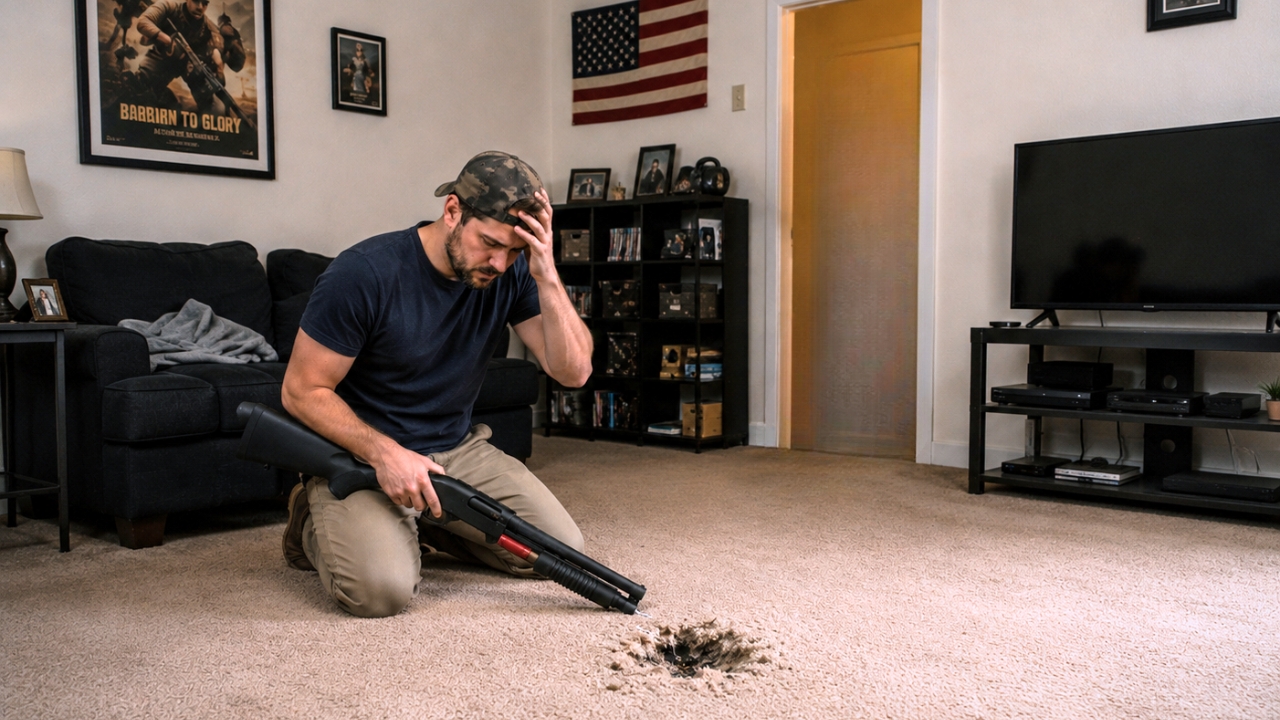
In a Reddit post, a gun owner shared a negligent discharge story involving a 12-gauge breaching round fired into the carpet of his apartment. The detail that made the whole thing worse was what he learned afterward: a friend had apparently chambered the shotgun without telling him.
That is the kind of detail that makes people angry and careful at the same time.
A friend chambering a round and not saying anything is wildly irresponsible. If someone changes the condition of a firearm, everyone who may handle that gun needs to know. Better yet, the person who picks it up should still check it himself because humans forget, assume, miscommunicate, and sometimes do dumb things that leave everyone else dealing with the consequences.
But that does not erase the owner’s responsibility either.
That is the hard part of the story. The friend may have created the hazard, but the person holding the shotgun still needed to verify its condition before doing anything with it. That is why the first safety rule exists. Treat every gun as if it is loaded. Not “treat it as loaded unless your friend said it wasn’t.” Not “unless it was unloaded earlier.” Every time.
The round that went into the carpet was a breaching round, which adds another layer of weirdness. Breaching rounds are specialized shotgun rounds designed for defeating locks, hinges, or doors in specific tactical contexts. They are not normal birdshot or buckshot, and they definitely are not something anyone wants going off inside an apartment.
An apartment carpet is not a backstop.
Neither is the floor under it, unless you know exactly what is beneath and the round cannot leave that space. In an apartment, that question gets scary fast. Who lives below? What is under the floor? Did the round stop? Did it fragment? Did it damage wiring, plumbing, subfloor, or anything structural? Did neighbors hear it? Did anyone call police?
A negligent discharge in an apartment is never contained to the shooter’s embarrassment.
Apartments are shared spaces. Thin walls, floors, ceilings, neighbors, pets, children, people sleeping, people walking around — all of it matters. A gunshot inside that environment is not just “oops.” It is a public safety failure that happened indoors.
The carpet may have taken the visible damage, but the real damage was trust.
Imagine being the person who realizes someone else had loaded the shotgun without telling him. That would be infuriating. But imagine being the friend who chambered it and then had to understand that his careless act helped set up a negligent discharge. There is plenty of blame to go around in a situation like that, but blame does not repair the hole or erase the shot.
It has to change the routine.
A shared firearm, a gun handled by guests, or a gun kept where another adult may touch it needs stricter controls, not looser ones. Nobody chambers a round “just because.” Nobody handles it casually. Nobody assumes someone else left it in a known condition. If the firearm changes hands, the condition is verified. If someone loads it, that fact is stated clearly. If the gun is stored, it is stored deliberately.
And if a friend cannot follow that, he does not handle the guns.
That may sound harsh, but a 12-gauge round into apartment carpet is already the warning. The next warning may not be as forgiving.
The owner’s handling process also needed a hard reset. If he picked up the shotgun and pressed the trigger without checking the chamber, that cannot happen again. If he thought it was unloaded because it usually was, that assumption has to die. If there was live ammo around during casual handling, that routine needs to change. If people were handling guns in an apartment without a safe direction and clear purpose, that stops.
A shotgun is not made safer by familiarity.
The scary thing about negligent discharges is how normal the moments before them often feel. Nobody thinks, “I am about to do something that will send a 12-gauge round into the floor.” They think they are checking something, showing something, dry-firing, testing the action, cleaning, or handling a gun they believe is unloaded.
Then the gun fires, because belief is not a safety device.
The friend chambering the round was a major failure. The owner not verifying was another. The apartment setting made both failures much more serious.
The best outcome from a story like this is that nobody was hurt and everyone involved became much more disciplined afterward. That is the only good way to use a scare like this. You do not laugh it off. You do not blame one person and leave every other bad habit intact. You trace the whole chain and break it in several places.
No unannounced chambering.
No casual handling.
No trigger press without a full clear.
No unsafe direction.
No live ammo mixed into dry handling.
No trust without verification.
A breaching round in the carpet is a brutal lesson, but it is still a lesson with everyone alive to learn it.
That is mercy.
Commenters mostly treated the friend chambering the shotgun as reckless, but they did not let the person holding the gun off the hook either.
Several people said anyone who loads or chambers a firearm without telling others has created a dangerous situation. If other people may handle that gun, changing its condition silently is unacceptable.
Others pushed hard on personal verification. Even if someone else did something wrong, the person who picks up the gun still has to check the chamber and magazine before handling it as unloaded.
A lot of commenters focused on the apartment setting. A 12-gauge round into a floor or carpet can still be dangerous, especially with neighbors below or nearby. Indoors, there are very few truly safe directions.
Some also said this kind of incident should permanently change who is allowed to handle firearms around you. A friend who cannot follow basic safety rules should not be around your guns.
The main lesson was simple: never trust memory, habit, or someone else’s word over a direct chamber check.