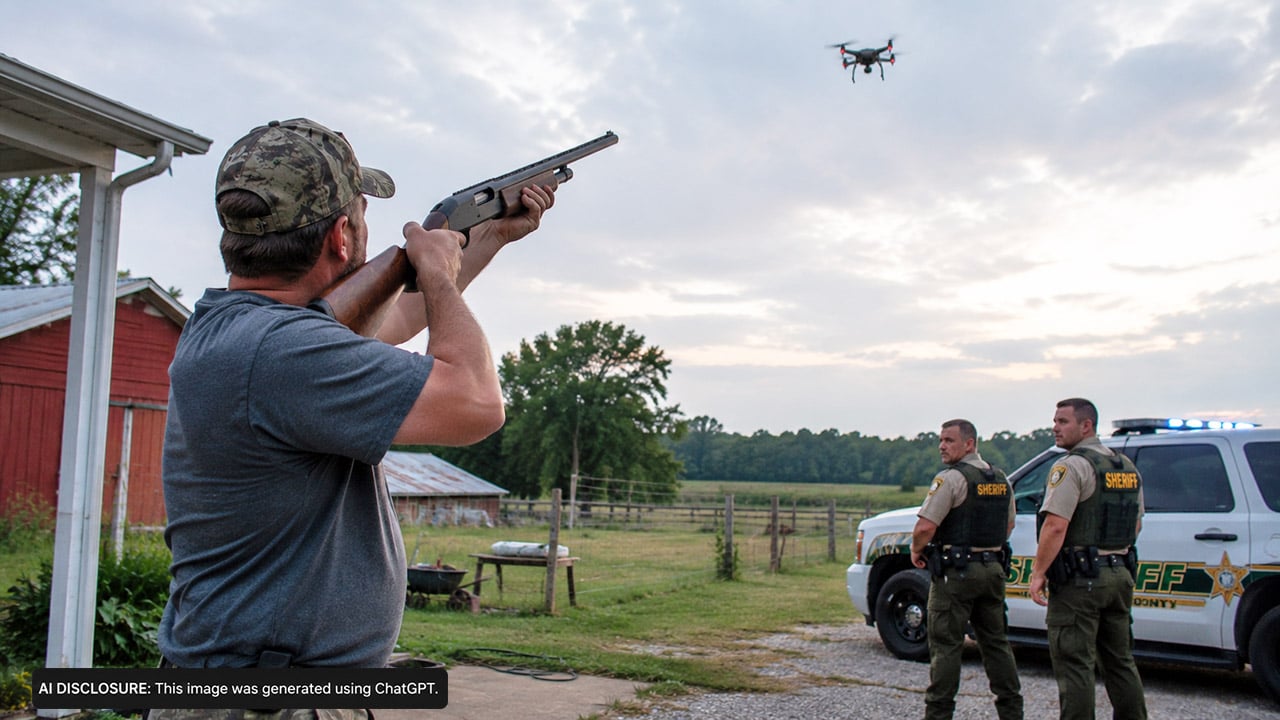
Photo credit: AI-generated image created using ChatGPT. Illustrative only
You don’t have to spend much time in the country to know how touchy people are about things flying over their place. Between trail cams getting stolen, trespassers cutting across pasture corners, and the steady buzz of consumer drones, a lot of landowners are already on edge.
But Wagoner County, Oklahoma, just delivered a reminder that not every drone is a nuisance—and taking a shot at one can turn into a criminal case in a hurry. In the original post, deputies say a man fired a shotgun at an emergency management drone that was being used to help search for a missing juvenile believed to be in danger.
What was happening on the ground when the shot rang out
Authorities say deputies with the Wagoner County Sheriff’s Office and Wagoner County Emergency Management personnel responded on April 13 to the 10700 block of South 353rd East Avenue to search for the missing juvenile. While that search was underway, emergency management personnel were actively operating a drone to cover ground and locate the child.
That’s a pretty standard tool now. Drones can scan big areas quickly, look into rough terrain without putting searchers into a bad spot, and keep the operation moving when daylight is burning off. When a kid is missing and believed to be in danger, speed matters more than anyone’s pride about “their airspace.”
Deputies say the shot was aimed at the aircraft
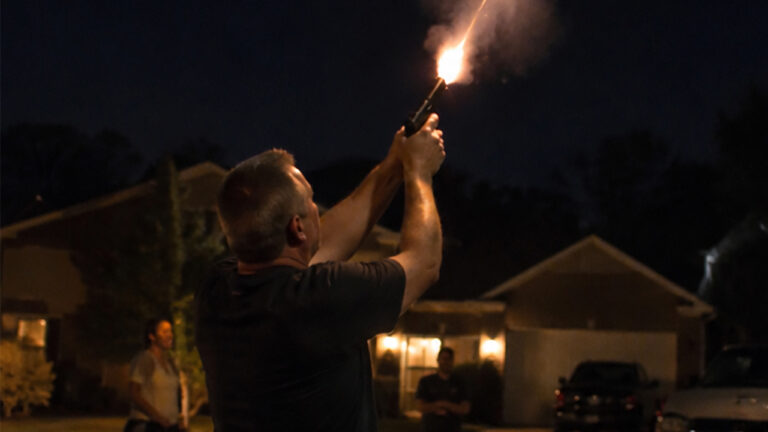
During the search, deputies reported hearing a gunshot southwest of their location. According to the report, witnesses—including deputies and emergency management staff—said the shot was directed toward the drone.
The drone operator identified the shot’s origin as a residence in the 36100 block of E. 111th Street South in Coweta. From there, it wasn’t a mystery or a “maybe it was just target practice” situation—investigators went to the residence and made contact.
The suspect’s explanation: he thought he had permission
Investigators said the suspect admitted firing a shotgun at the drone. He also told deputies he believed he had prior authorization to shoot at drones.
That detail is worth sitting with for a second, because a lot of folks have heard some version of that porch talk: “If it’s over my property, I can shoot it.” The deputies didn’t treat it like a misunderstanding that ends with a warning. They advised him that discharging a firearm at an aircraft, including an unmanned aerial system, is a serious criminal offense.
Authorities say Drucel Hall was arrested and charged with reckless discharge of a firearm.
Why this hits different than shooting at a “nosey” hobby drone
Out where most of us live, it’s not uncommon to hear about drones hovering over ponds, cruising fence lines, or poking around near a deer stand. That doesn’t make it okay to start slinging shot, but it explains why tempers flare. Folks worry about privacy, livestock getting spooked, and the general feeling that somebody’s watching.
This incident wasn’t that. Deputies and emergency management personnel were on an active search for a missing juvenile believed to be in danger. Sheriff Chris Elliott didn’t mince words, saying the drone was clearly being used in an emergency response and calling the act reckless and dangerous. He also emphasized those tools are critical to locating missing persons quickly and safely, and that actions like this put lives at risk.
From an outdoorsman’s angle, it’s the “lives at risk” part that matters. You fire a shotgun into the air, you’re responsible for every pellet that comes down. Add in responding deputies, volunteers, and equipment in the area, and you’ve got the kind of bad decision that can turn tragic fast.
What a landowner can do instead of reaching for the shotgun
There’s a hard truth here: even when you feel disrespected on your own place, gunfire is about the worst way to handle it—especially when you don’t know who is operating the drone or why it’s there.
If a drone is causing a real issue, the practical move is to document what you can safely (time, direction, any identifying markings if visible) and call the sheriff’s office. If it turns out to be a legitimate emergency operation, you’ve saved yourself a world of trouble. If it’s not legitimate, you’ve still handled it in a way that keeps you on the right side of both safety and the law.
And if it truly is an emergency response—search and rescue, wildfire, severe weather, missing person—give them room to work. You don’t have to like the noise, but you’ll like the alternative even less if the operation gets delayed.
The bigger lesson for gun owners: “I thought I was allowed” doesn’t travel well
Most responsible gun owners are careful about backstops, safe directions, and knowing exactly what they’re shooting at. This case is a reminder that “knowing your target” also means knowing what you’re shooting toward and what else is in the area—especially in a community response where multiple agencies are working.
It’s also a reminder that legal myths get people in real trouble. Believing you have permission or “authorization” to shoot at drones is not the same thing as having clear, lawful authority—especially when the drone is tied to public safety operations.
Outdoorsmen get painted with a broad brush when something like this happens. The best way to fight that stereotype is to keep our heads, use common sense, and remember that a firearm isn’t a tool for settling annoyance. In Wagoner County, deputies say one shotgun blast at the wrong time turned a missing-child search into an arrest and a reckless discharge charge—and that’s a road nobody wants to go down.
Like The Avid Outdoorsman’s content? Subscribe to our newsletter so you never miss an article.
Here’s more from us: