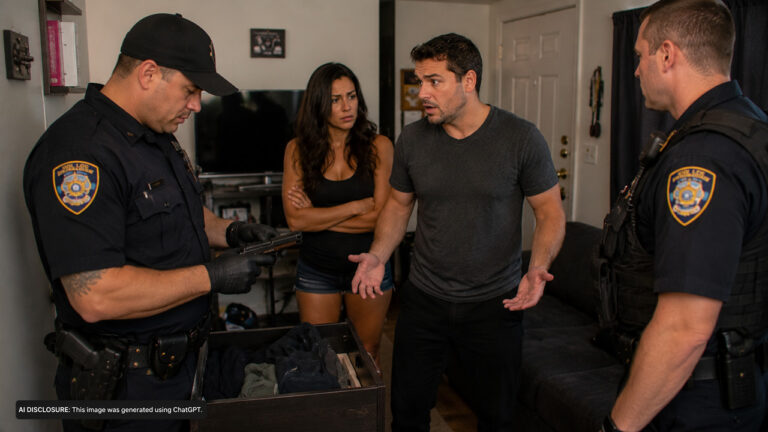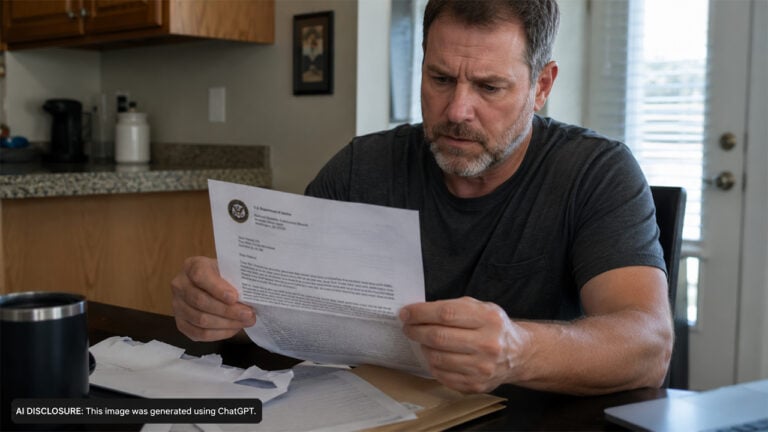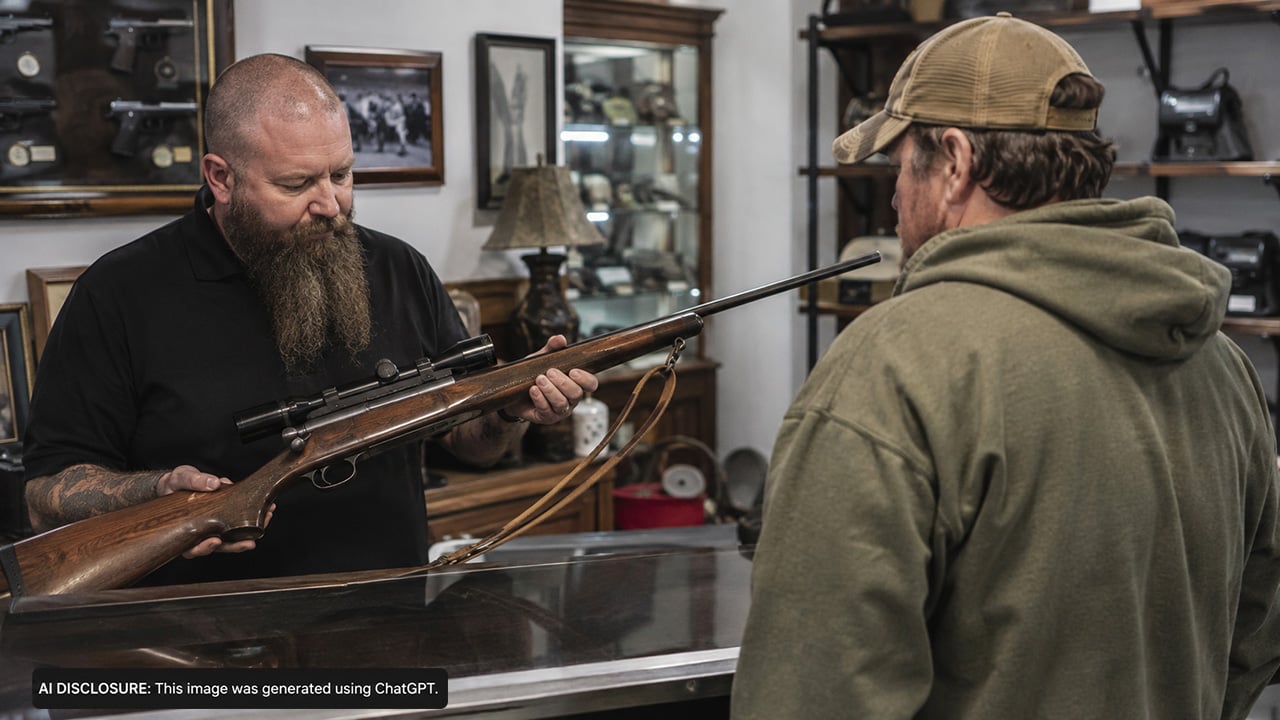
Photo credit: AI-generated image created using ChatGPT. Illustrative only
Most hunters I know don’t think twice about moving a rifle around the house, trading one off for something new, or dropping a gun at a shop on consignment. But once you’re a prohibited person—especially on felony probation—normal “gun guy” routines can turn into a court case in a hurry.
That’s exactly what happened in Linn County, Oregon, where an appeals court just tossed a conviction tied to a hunting rifle that was sold at a pawnshop in a way that never involved the defendant physically handling the gun. The details are laid out in the original post, and they’re worth reading if you’ve ever helped a family member offload firearms when they legally can’t possess them.
A hunting rifle, felony probation, and a pawnshop counter
The defendant, Chet Thomas Hamilton, 49, had prior felony convictions (coercion, identity theft, and tampering with a witness) and was on probation. In 2023, Linn County investigators charged him with unlawful possession of a firearm after his hunting rifle was sold at a pawnshop.
Hamilton’s basic claim was straightforward: his cousin had been storing the rifle for him, and his cousin handled the rifle and executed the sale while Hamilton watched. Hamilton said he never touched the gun during the transaction.
That might sound like a small detail to folks who don’t spend time around firearms, but in gun cases it’s often the whole ballgame. “Possession” doesn’t always mean a rifle is in your hands—sometimes the state argues “constructive possession,” meaning you had control over it even if you didn’t physically hold it.
Where the case turned: “Constructive possession” isn’t a vibe
The Oregon Court of Appeals overturned Hamilton’s conviction in a split 2-1 decision. The majority concluded the state didn’t prove Hamilton “constructively possessed” the rifle based on what was presented.
Appeals Judge Jacqueline Kamins wrote that “it is not clear that defendant exercised any custody or control over the rifle.” The decision also notes that the cousin stored the rifle in a way that was inaccessible to Hamilton, and that Hamilton never came into physical contact with it.
That’s an important distinction for outdoorsmen because “constructive possession” is often where prosecutors try to bridge the gap between “he didn’t touch it” and “he was still the gun’s owner.” Ownership and possession can overlap, but they aren’t always the same thing in court—especially when someone else is the one physically controlling the firearm.
The state said the sale itself showed control
Prosecutors argued there was enough evidence that Hamilton exercised control over the rifle because he asked his cousin to take it to the pawnshop and allowed the sale to happen. They also pointed to the fact that Hamilton was selling the rifle for money.
And there was one small moment at the counter that didn’t help Hamilton: when the pawnbroker asked if he was “good to go,” Hamilton responded “yep,” according to the ruling.
The state also suggested Hamilton could have left the pawnshop with the rifle if the sale fell through—another way of saying, “He was close enough and involved enough that he still had control.” But the appellate majority wasn’t willing to treat those arguments as proof beyond what the evidence actually showed about custody and access.
A dissenting judge saw it differently—and many gun owners will understand why
Judge Douglas Tookey partially dissented. He agreed the Linn County judgment should be reversed, but he emphasized facts that will sound familiar to anyone who has ever sold a gun: Hamilton reportedly told the pawnbroker he was the legal owner, stayed in the shop after his cousin left, and consented to the structure of the sale.
In Tookey’s view, “there was evidence that he was exercising dominion and control over the rifle when he sold it.” That’s the common-sense angle a lot of folks will latch onto. If you can authorize the sale and take the money, it feels like you “possess” the thing—at least in an everyday sense.
But courts don’t run on everyday sense alone. They run on definitions, elements, and what can actually be proved with the facts on the record.
What this means in the real world for hunters and gun-owning families
This case is a good reminder that the cleanest way to deal with a firearm someone can’t legally possess is to keep that person away from access and handling—period. In this situation, the court focused heavily on two things: the rifle being stored in a way that was inaccessible to Hamilton, and Hamilton not physically contacting it.
That doesn’t mean “be clever and you’ll beat the charge.” It means the law draws lines around possession and control, and if prosecutors can’t prove you crossed that line, convictions don’t always stick. But it’s also a reminder that a poorly handled transfer can still get everyone jammed up—especially if a prohibited person is present and participating in ways that look like control.
It’s also worth noting how high the stakes were. Hamilton was convicted in Linn County Court and sentenced to 15 months in prison and two years of post-prison supervision before the appeals court overturned it. Even when you ultimately win on appeal, the process itself is punishment.
The Oregon Department of Justice, through spokesperson Jenny Hansson, said the agency was reviewing the decision and considering options. The Linn County District Attorney’s Office and Hamilton did not immediately respond to comment requests, according to the report.
For hunters, this is one of those stories that reinforces a hard truth: if you’ve got family or friends who have become prohibited persons, “just get rid of the guns” can’t be a casual chore. The safest route is to make sure any transfer or sale is done in a way that leaves no doubt about who has access, who has custody, and who is actually in control of the firearm—because if it gets questioned later, those details are what the court will live and die on.
Like The Avid Outdoorsman’s content? Subscribe to our newsletter so you never miss an article.
Here’s more from us: