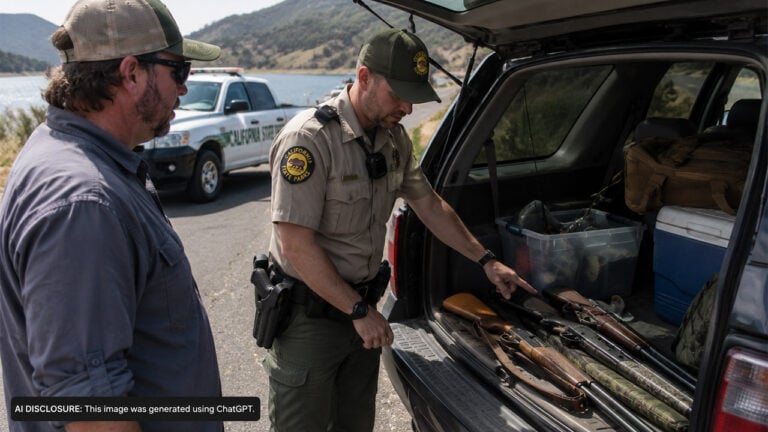
Photo credit: AI-generated image created using ChatGPT. Illustrative only
Most of us have been there in one form or another: you cross a line on a map, hit a familiar stretch of water, and realize a little too late that the paperwork in your pocket doesn’t match the place your boots are standing. One angler living near a state border found out the hard way when a sheriff’s deputy walked up while he was fishing out of state and asked for licenses he didn’t have.
He didn’t argue. He didn’t make excuses. He got two tickets—one for a county fishing license and one for the state license—and then did what a lot of folks would do: planned to pay the fine, show up to court, and move on.
But there was one detail that made this more than just an expensive lesson. The fisherman said he holds “low level” Department of Defense and Bureau of Prisons security clearances for work, and the state ticket may be a class 3 misdemeanor. Now he’s staring at a mandatory court appearance and wondering if a simple license mistake could ripple into his job.
A border mistake that can happen fast
According to the original post, the angler lives on the border and was fishing across state lines. That’s a situation a lot of outdoorsmen know well—your closest water might be in the next state, and after enough “quick trips,” it starts feeling like your backyard.
He said he didn’t realize he lacked both the county and the state fishing licenses until the deputy was already there. That’s a tough moment, because in most places it doesn’t matter whether you “meant to” or not. If you can’t produce the license, the officer is going to treat it as fishing without one.
Two tickets, one mandatory court date
This wasn’t described as a simple pay-by-mail citation. The angler said it’s a mandatory court appearance, and he expects the state ticket alone could run at least $500 because he’s an out-of-state resident. On top of that, he wasn’t sure what to expect from the county ticket.
That’s the part that surprises people who don’t spend much time outdoors. Fishing without a license can be treated like a minor issue in conversation, but on paper it can be a criminal offense. In his case, he believes the state citation is a class 3 misdemeanor—serious enough to make him pause before assuming it’s “just a fine.”
When a fishing citation bumps into a security clearance
The real tension here isn’t about the money. It’s about the record. The angler said he currently holds Department of Defense and Bureau of Prisons security clearances, and he’s worried because these tickets are “technically criminal offenses.”
If you’ve ever held a clearance—or worked around folks who do—you know how touchy it can feel. People get nervous about anything that looks like dishonesty, poor judgment, or a pattern of ignoring rules. Even when the underlying incident is small, the fear is that the “misdemeanor” label creates a problem down the road when forms get filled out, renewals happen, or background checks dig up old court entries.
And to be clear, this kind of worry isn’t just paranoia. A clearance is tied to trust, and trust is tied to documentation. A day on the water can turn into a paperwork trail that follows you longer than you’d think.
He bought the licenses after the fact—helpful, but not a time machine
After the incident, the fisherman did the responsible thing: he went and bought both the state and county licenses. He also planned on bringing them to court.
That’s smart in the sense that it shows good faith and an effort to get compliant. But it doesn’t change what the deputy encountered in that moment on the bank. The license you buy later doesn’t retroactively cover the day you were fishing. In a lot of jurisdictions, though, getting legal quickly can still matter when the court is deciding how hard to come down—especially if the judge or prosecutor sees it as a mistake instead of someone thumbing their nose at the law.
The question outdoorsmen always ask: do you need a lawyer for a fishing ticket?
He said he had no lawyer at this point and asked if he needed one. Outdoorsmen ask that same question all the time, because it feels ridiculous to hire an attorney over a fishing license. But the word “misdemeanor” changes the math.
When you’re dealing with a mandatory court appearance and a charge you believe is criminal, you’re no longer in the normal “mail it in and forget it” territory. Even if the penalty ends up being mostly financial, the way the case is handled—what you plead to, what gets entered, whether it can be reduced, whether it can be treated as a civil infraction in some places—can matter later. That’s doubly true for anyone whose job depends on staying squeaky clean on paper.
A lot of folks learn too late that paying a ticket isn’t always just “paying a ticket.” In many systems, payment is effectively an admission, and the record that results can be the real long-term consequence—not the fine.
The best lesson here is boring: know the lines and carry the proof
This is the kind of situation that turns into a campfire warning for everybody else. If you live near a border, treat that state line like a fence. Don’t assume the license you bought for your home water means anything a mile down the road. States, counties, management areas, and special regulations don’t care how close you live.
The other takeaway is to keep your licensing squared away before you wet a line, and keep proof handy. Most anglers are running digital licenses now, and most officers understand phones die, screens crack, and service drops. If your area still issues paper, don’t leave it on the kitchen counter. If it’s digital, save screenshots and keep your account info accessible so you’re not fumbling when someone in a badge is standing beside your tackle bag.
The fisherman in this situation wasn’t talking about poaching, sneaking onto private water, or trying to dodge anyone. He simply got caught fishing without the required licenses and then realized that a “simple” citation can collide with real-world adult responsibilities—like holding a federal security clearance.
Outdoorsmen tend to shrug off small stuff, and usually that’s healthy. But when the paperwork says “misdemeanor” and the court date is mandatory, it’s worth slowing down and handling it like it matters—because sometimes, it does.
Like The Avid Outdoorsman’s content? Be sure to follow us.
Here’s more from us: