Photo credit: The Avid Outdoorsman
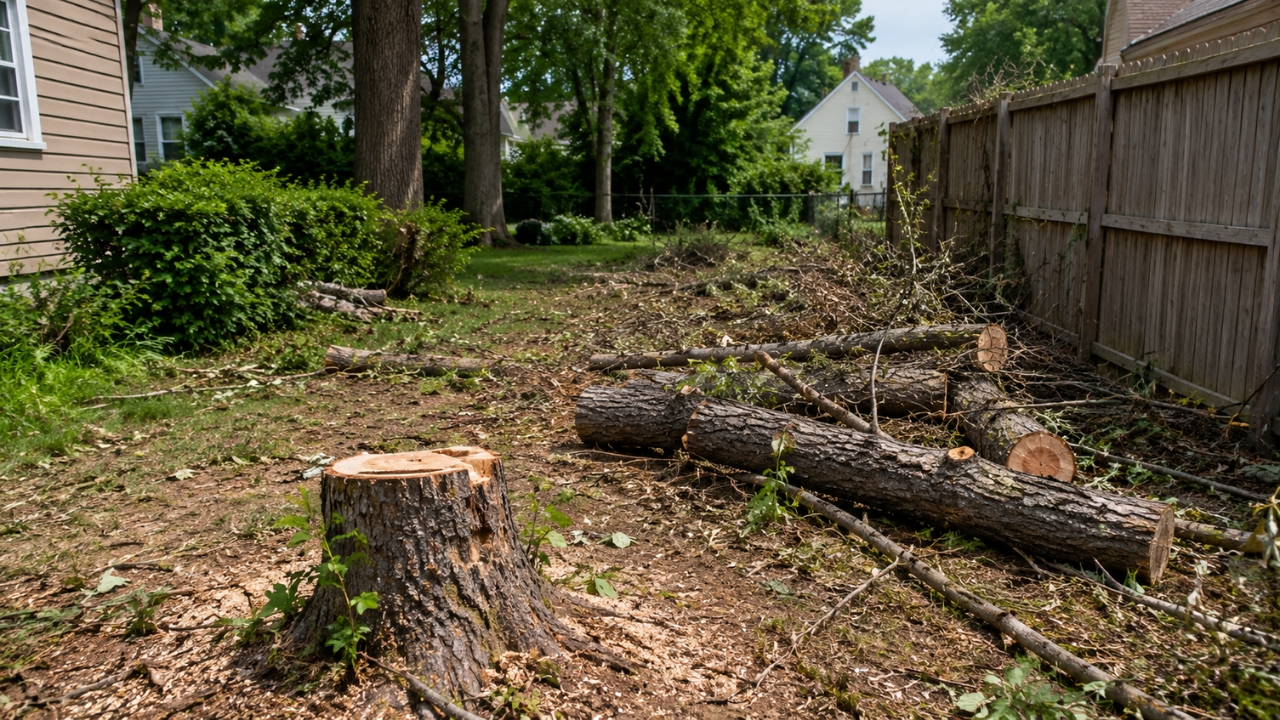
The homeowner knew there had been tree work happening nearby, but they did not realize how far it had gone until the damage was already done. According to the Reddit post, the neighbor had several trees cut down along the property line, including trees the homeowner believed were partly or fully on their side.
That turned a routine neighbor dispute into something much more serious. Trees are not like a fence panel you can replace in an afternoon. Once they are cut, they are gone, and the cost can climb fast depending on the type, age, and location.
The homeowner said they confronted the neighbor after seeing what happened. The neighbor allegedly admitted the trees were on the property line, but tried to justify the cutting by saying they were worried the trees might eventually fall. From the homeowner’s point of view, that did not answer the real issue. Concern about a tree does not automatically give someone permission to remove it from property they do not fully own.
The original Reddit post can be found here: https://www.reddit.com/r/legaladvice/comments/d719w6/neighbors_cut_down_my_trees/
The homeowner wanted to know what they could do next. They were not talking about a few branches hanging over a fence. They were talking about whole trees being taken down without their permission, with the neighbor already acknowledging that the trees sat on the boundary.
That detail mattered because boundary trees can be legally messy. If a tree is truly shared by two properties, one neighbor generally cannot just decide to remove it without the other owner’s approval. Even when a tree creates a nuisance, the usual answer is not to cut first and explain later.
The homeowner also seemed to understand that the next step could not be based on emotion alone. They needed to know whether the trees were actually on their property, on the neighbor’s property, or exactly on the line. Without a survey or other clear proof, the argument could turn into one person’s word against another’s.
Still, the neighbor’s alleged admission gave the homeowner a starting point. If the trees were on the line and the neighbor removed them anyway, the homeowner may have had a claim for damages. That could include the value of the trees themselves, the cost to replace them, or other property damage tied to the removal.
Commenters quickly pointed the homeowner toward documentation. Several people said the first step was to get a survey if they did not already have one. Without knowing exactly where the property line was, it would be hard to prove the neighbor crossed it.
Others told the homeowner to take photos immediately. That included pictures of the stumps, the cut area, the property line, and anything showing where the trees had stood before they were removed. If there were old photos of the yard, those could help too.
A number of commenters also brought up the value of mature trees. In these kinds of disputes, the replacement cost can be much higher than people expect. A grown tree is not valued the same way as a small sapling from a garden center. Depending on the state and the facts, tree damages can become expensive fast.
Some suggested contacting an arborist. Not just a landscaper, but someone who could identify the trees, estimate age and value, and explain whether the neighbor’s claim about danger made sense. If the neighbor was arguing the trees were hazardous, an expert opinion could matter.
Others said the homeowner should avoid trying to settle it casually at the fence line. Once trees are cut, the damage is permanent. Commenters encouraged the homeowner to gather proof, keep communication in writing, and consider speaking with a lawyer if the trees were valuable or clearly on shared property.
The post did not end with a dramatic confrontation or courtroom result. It ended at the stage where many neighbor disputes do: one person staring at a changed yard, another person acting like the damage was reasonable, and a property line suddenly becoming the most important strip of land on the block.
Like The Avid Outdoorsman’s content? Subscribe to our newsletter so you never miss an article.
Here’s more from us: