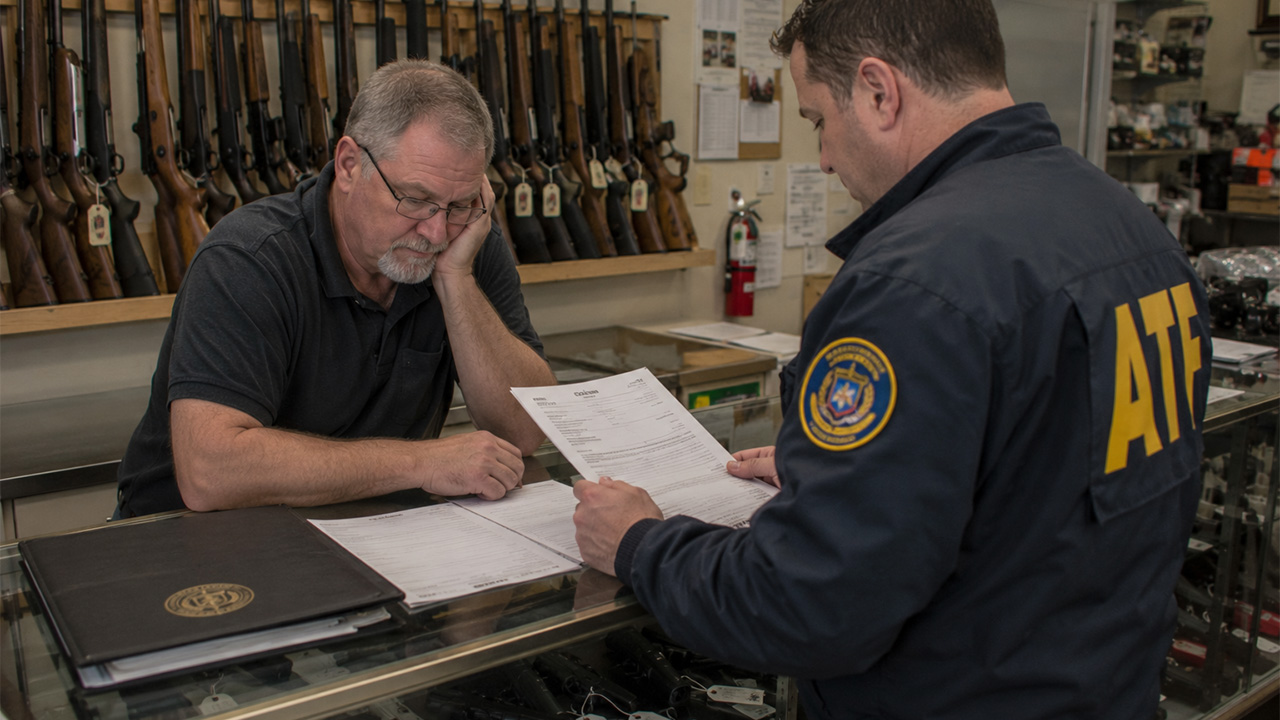
Photo credit: AvidOutdoorsman
In a lot of small towns, the gun shop isn’t just a place to buy ammo and swap lies about the one that got away. It’s where you run into your neighbor before deer season, where a kid gets fitted for a first .243, and where the old-timers still know how to spot a loose scope base from across the counter.
That’s why it hits different when a mom-and-pop shop can run a clean inspection, get told everything is in order, and then still end up losing its ability to do business over a single mistake on a federal form. Not a straw purchase. Not a missing gun. A typo.
A clean inspection, then the floor drops out
The shop in this situation had recently gone through a compliance visit that looked like what most dealers expect: bound book review, a sampling of 4473s, inventory checks, and the usual question-and-answer routine. The kind of thing that leaves the owner tired, but relieved, because the inspector didn’t find any violations worth writing up.
Then came the follow-up nobody expects. A separate review flagged one 4473 with a small, human error—something like a transposed digit, a wrong county abbreviation, or a date written in the wrong box. The sort of paperwork blemish that doesn’t change who the buyer is, what the gun is, or whether the background check was run, but still counts as an error on a regulated form.
From there the shop learned a lesson a lot of outdoorsmen don’t want to learn the hard way: passing one compliance check doesn’t necessarily mean you’re in the clear if the agency decides a single error fits a “zero tolerance” posture.
How a tiny 4473 mistake turns into a big problem
To folks who don’t live in the gun world, it sounds insane that a typo can threaten a business. But to the feds, the 4473 is the paper trail that ties the firearm to the transfer, the transfer to the buyer, and the buyer to the background check. It’s not just “store paperwork.” It’s regulated recordkeeping.
Here’s the part that makes people shake their heads: many errors on a 4473 aren’t about intent. They’re about mechanics—writing the NICS transaction number in the wrong field, marking “no” when you meant “yes” on a non-disqualifying question, an employee using an abbreviation the form doesn’t like, or an address line that doesn’t match the customer’s ID character-for-character.
That’s why shop owners tend to treat 4473s like landing a plane in bad weather. Slow down, read it twice, and don’t assume “close enough” counts. Because even if nobody is trying to do anything wrong, “close enough” can still become “noncompliance.”
The real-world fallout for hunters and regular customers
When a small dealer loses the ability to transfer firearms, it doesn’t just punish the owner. It hits the whole local pipeline. The guy who orders a rifle online now has to drive an hour to find another FFL. The kid who was going to put a shotgun on layaway for bird season has fewer options. Even simple stuff—like a same-day transfer for a ranch rifle before coyotes start working calves—turns into a scheduling problem.
In rural areas, that matters. Not because people can’t plan ahead, but because life doesn’t always cooperate. Trucks break down. Work runs late. A crop field gets hammered by pigs. You get a chance at a lease you didn’t expect. The local shop is the pressure valve that keeps all those moving parts from turning into a mess.
And there’s another quiet impact: once a shop loses its license, employees lose jobs. The reloader who came in every Friday and bought primers and powder might stop coming around. Accessory sales drop. A place that used to sponsor a youth shoot or donate to a local sportsman’s banquet disappears from the map.
What the shop likely tried to do once the letter arrived
When a license is on the line, most small dealers go into scramble mode. They pull every 4473 they’ve got, recheck serial numbers, review acquisition-and-disposition entries, and start documenting what training they provide staff. Many bring in counsel who understands firearms compliance, because this isn’t like arguing a speeding ticket.
Some dealers try to show the difference between a paperwork error and a public safety issue. If the background check was completed, the buyer was eligible, the firearm was properly logged, and the transfer is traceable, a lot of folks view a typo as something that should be fixable with corrective action—not a business-ending event.
But administrative systems don’t always move the way common sense moves. Agencies have policies, supervisors, and internal expectations. If the shop gets tagged under a strict enforcement approach, it can feel like the decision is made before the owner ever sits down at the table.
Commenters zeroed in on “gotcha” enforcement and paperwork reality
When stories like this circulate among gun owners, you can predict the themes. Some people immediately blame the shop—saying if you’re going to hold an FFL, you should treat every form like it’s going to be audited by a microscope. That camp isn’t totally wrong. Attention to detail is part of the job, and plenty of dealers do it without drama.
But the other camp points out something most of us understand from work, farming, guiding, or running equipment: humans make mistakes. If the system punishes minor errors the same way it punishes real misconduct, it creates an environment where small businesses can’t survive unless they operate like a full-time compliance office.
A lot of experienced folks also focus on the oddity of it all—how a business can be told “no violations” during one visit and still get hammered later. The takeaway in those discussions is usually the same: don’t assume an inspection is the end of the story, and don’t assume “minor” means “forgiven.”
The practical lesson for FFLs and for the rest of us
If you’re an FFL—or you work behind the counter—this is your reminder to slow the process down. Build a checklist. Do a second set of eyes on every 4473 when the shop is busy. Train new employees like you’re teaching firearm safety: the fundamentals first, repetition second, and no shortcuts when people are distracted.
If you’re a customer, you’ve got a role too. Bring the right ID. Use your legal name exactly as it appears on your documents. Don’t rush through the form because you want to get to the range. If something looks off, ask to fix it the right way before you leave. A clean transfer protects you as much as it protects the shop.
Out here, we depend on small businesses that understand our seasons, our land, and our needs. Losing one over a simple paperwork mistake is a hard pill to swallow. And whether you see it as necessary enforcement or an overreach, it’s a reminder that in the gun world, the difference between “fine” and “finished” can be as small as one wrong box checked on a single piece of paper.