Photo credit: The Avid Outdoorsman
A North Carolina homeowner said he found a problem on his land that went way beyond someone accidentally stepping over a property line.
According to the Reddit post, another neighbor alerted him that it looked like someone had been cutting out a spot to hunt from on his property. The homeowner said he owned roughly 13 acres where his house sat, and nobody had permission to be on the land.
He was already used to running hunters off both his land and a nearby neighbor’s land every year. But this time, someone had allegedly started cutting trees down.
The homeowner explained the situation in a Reddit thread and asked whether he should call the sheriff, talk to the neighbor, or get an attorney involved: https://www.reddit.com/r/legaladvice/comments/1osj9lf/i_have_a_neighbor_cutting_trees_down_on_my/
The first look happened after dark
The poster said his neighbor contacted him on a Friday night about what appeared to be a new cutting area.
By the time he got home, it was already dark, but he still went out to take a look. He found trees cut down, and it was not just one little spot. He said there was a trail, with trees of similar size cut along the way.
At that point, he thought he knew who might be responsible, but he wanted daylight before making any decisions.
When he came back in the morning, the situation looked worse. He said the trees appeared to have been cut with a hatchet, and he followed the trail toward a different neighbor’s property that backed up to his.
The trees were stacked by size
The detail that made the whole thing feel intentional was what he found near the neighbor’s place.
The poster said there were three stacks of trees sorted by size, with close to 50 trees total. Some may have come from the neighbor’s property, but he believed some clearly came from his land.
At first, he thought they were poplar trees. After looking again in better light, he edited the post to say they were maple trees and oaks.
That matters because tree damage is not always treated like a minor yard issue. Even small trees can have value, and intentional cutting can bring damages depending on the state and the facts.
For the landowner, the important part was simpler: someone appeared to be crossing onto his property, cutting trees, and carrying them back.
The property line was not hard to see
The poster was clear that he did not believe this was an honest mistake.
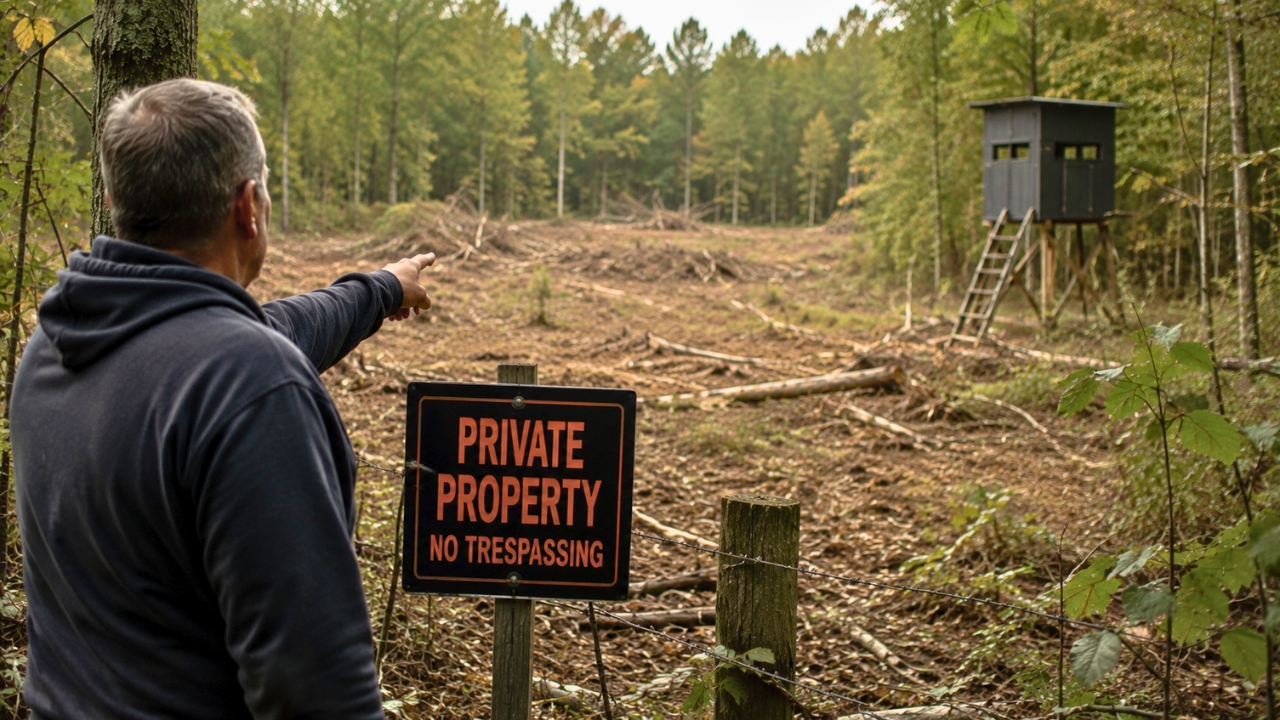
He said the property lines were marked and that corner pins had even been uncovered. In his view, whoever did it knew where the boundary was and had gone well past it.
He estimated the cutting reached at least 200 feet past the property line.
That is why commenters treated it differently from a neighbor trimming a branch or a kid wandering too far into the woods. If the line was marked and the cutting went that deep onto the land, it looked a lot harder to explain away.
The homeowner said he set up a trail camera near a tree that had already been started but not finished.
Commenters told him to document everything
A lot of commenters gave the same first piece of advice: take photos and document everything.
That meant pictures of the cut trees, the trail, the property line, the corner pins, the stacks of wood, and any signs showing where the cutting started and ended.
One commenter told him to do a video walkthrough while narrating what he was seeing. That kind of record can be useful because it preserves the scene before anything changes.
Others told him to call law enforcement and make a report. Even if the sheriff did not immediately treat it like a major case, having a report on file could matter if the problem continued.
Trail cameras came up again
As usual with rural property disputes, cameras were one of the most practical suggestions.
Commenters said he should put up wildlife cameras along the trail and near the damaged area. If someone came back to cut more trees, the camera could show exactly who was doing it.
That mattered because the poster suspected a neighbor but did not yet have direct proof.
A camera could also help separate possibilities. Was this an adult harvesting wood? A kid building something? Someone clearing a shooting lane? A hunter trying to set up a hidden spot?
Without evidence, those were guesses. With footage, the landowner would know what he was dealing with.
Some commenters said a game warden might care
Because the neighbor who alerted him thought it might be a hunting spot, several commenters brought up the game warden.
If someone was clearing a shooting lane or cutting trees to set up a hunting location on land they did not own, that could become more than a tree dispute. It could become a trespassing and illegal hunting issue.
One commenter said game wardens can be very good at sorting out stories around hunting access and property lines. Another said that if the person was cutting lanes for hunting, they did not get to do that on someone else’s property without permission.
That advice fit the situation because the poster already had a history of running hunters off the land. Even if this particular cutting ended up being something else, the hunting angle was not random.
Others warned that tree damage can get expensive
Several commenters focused on the value of the trees.
One person said many states have laws that allow landowners to recover multiplied damages for intentional tree cutting. Another suggested getting an arborist to evaluate the cut trees and establish a value.
That may sound extreme when the trees are only two to six inches across, but tree law can surprise people. Removing trees without permission is not the same as picking up fallen branches.
The poster said he was not necessarily trying to chase damages. If it turned out to be a kid, he wanted it to become a teaching moment, maybe with new trees planted. But if it was an adult, he said they should know better.
Talking to the neighbor actually worked
After thinking about it all day, the poster updated the thread.
He said he went over to the neighbor’s house and knocked on the door. He tried to be as calm and polite as possible.
At first, the woman he spoke with allegedly denied that anyone was cutting trees on his property. But when he mentioned that the cut trees were stacked behind the house, she wanted to go look.
Once she saw the stacks, the story changed. According to the poster, she said her boys had asked if they could cut some smaller trees on their own property, and she was disappointed they had gone farther than they were supposed to.
The poster told her he just wanted it to stop. He said that if it continued, he would have to call the law.
The weirdest part was the puppy offer
The update took a strange turn at the end.
After the conversation, the woman reportedly thanked him for coming to her directly. They talked a little more, and then she offered him a puppy.
He declined.
That detail made commenters laugh because it came out of nowhere, especially after a thread about trespassing, tree cutting, possible hunting lanes, and potential legal damages.
But the bigger point was that the neighborly approach worked, at least for the moment. The poster did not have to start with a sheriff’s report or a lawsuit. He made it clear he knew what was happening and that it could not continue.
The calm approach did not mean he should ignore it
Even though the conversation ended better than expected, commenters still told him to protect himself.
The smart move was to keep the trail camera up, post the property clearly, take photos of the damage, and keep notes about what happened.
That way, if the cutting stopped, great. If it started again, he would not be starting from zero.
The lesson was not that every landowner should avoid calling authorities. Some situations are too serious or too dangerous for a doorstep conversation. But in this case, the poster had enough confidence to talk calmly, and the neighbor seemed to respond.
Still, cutting trees 200 feet over a marked property line is not something to brush off. Whether it was for hunting, wood, or kids being kids, the landowner had every reason to make sure it did not happen twice.
Like The Avid Outdoorsman’s content? Subscribe to our newsletter so you never miss an article.
Here’s more from us: