Photo credit: AI-generated image created using ChatGPT. Illustrative only.
Renting a room in someone else’s house can feel like a good, simple arrangement—until you realize you’re living under another person’s rules. That’s where one Texas renter found themselves after asking whether a landlord can forbid them from having a gun in the part of the house they’re renting, saying they wanted a firearm “for safety.” The question was laid out plainly in the original post, and it’s the kind of situation plenty of hunters and gun owners run into when they downsize, take a temporary job, or just try to keep rent affordable.
On its face, it sounds straightforward: the homeowner owns the place, so they make the rules. But Texas law has some sharp edges on this topic, and one of them is a state statute that says certain “no firearms” lease clauses don’t carry legal weight the way some landlords think they do.
A room rental isn’t the same as crashing on a buddy’s couch
The renter’s setup matters here: they weren’t talking about a standalone apartment or a place with its own front door. They were looking at renting a room inside someone’s home. That arrangement blurs lines that are usually clear—your “home” is inside someone else’s “home,” and you share hallways, doors, and sometimes even a kitchen.
In real life, that can change how comfortable everybody feels. A homeowner might be fine with firearms in principle, but not fine with a loaded handgun sitting in a nightstand in a house where kids live, guests come and go, or where the owner doesn’t know the renter well yet.
What Texas law says about lease clauses banning firearms
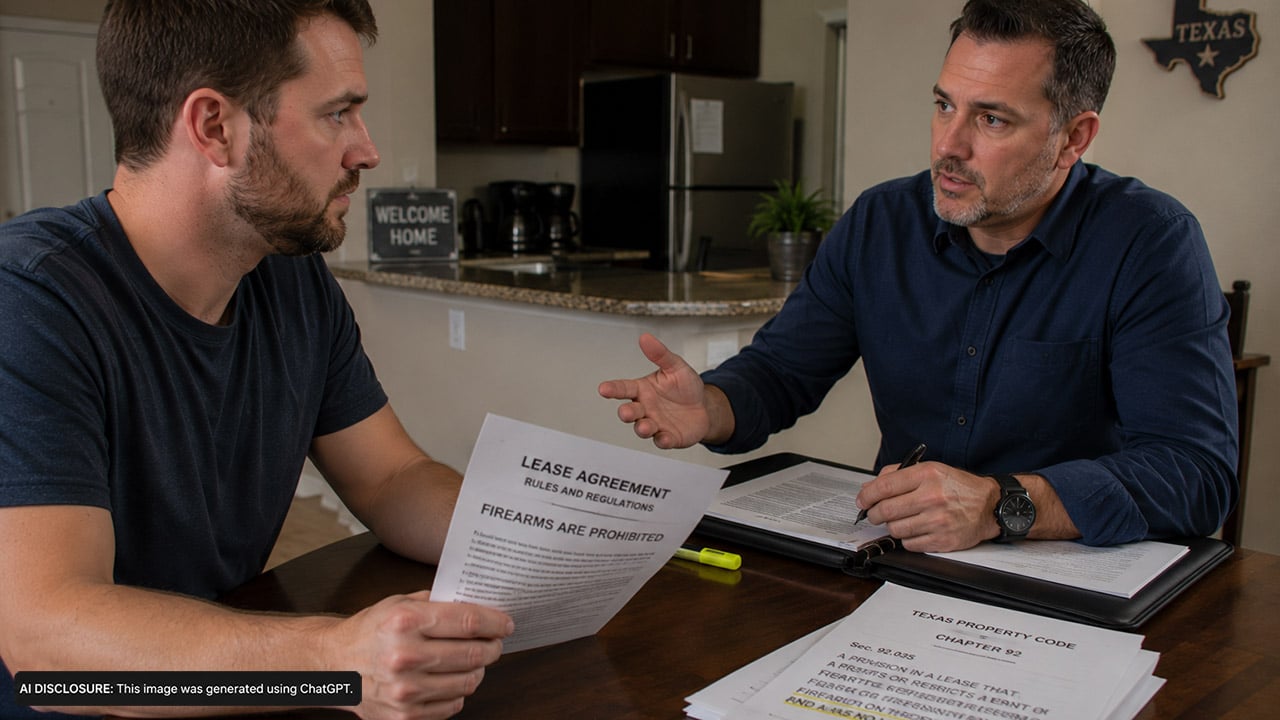
Texas has a statute that gets brought up in situations like this: it limits a landlord’s ability to use a lease to prohibit lawful firearm possession by a tenant. The key point folks lean on is that the state doesn’t let landlords write “no guns” into a lease and automatically turn lawful possession into a lease violation with legal teeth.
That’s where the headline angle comes from: a lease can say “firearms are banned,” but Texas law can say that kind of clause has no legal effect—at least in the way many people assume. In plain terms, the state has decided that lawful gun ownership in your rented dwelling isn’t something a landlord can simply erase with boilerplate.
There are still boundaries. Even in Texas, a lease can regulate behavior that creates real risk or disturbance—unsafe handling, negligent storage, firing a gun on the property, or brandishing and threatening people. A “no guns” sentence may be toothless, but “don’t endanger the household” absolutely isn’t.
Where the rubber meets the road: shared spaces and the homeowner’s comfort level
Even if the law is on the renter’s side regarding simple possession, a room-in-a-house deal is as much about the relationship as the paperwork. A homeowner who feels strongly about banning guns may not be a good match for a gun-owning renter, no matter what the statute says.
And that’s not just politics—it’s logistics. You’re sharing a roof, and the homeowner might worry about storage, access, and liability. If they’ve got kids in the house, they may want to know that any firearm is locked up properly. If they’ve had problems before, they may be jumpy about anything they see as a risk factor.
From the renter’s side, the “for safety” angle is real. If you work late, live in a rough area, or you’ve had a stalker or a bad breakup in your past, having a defensive firearm can be the difference between sleeping and staring at the ceiling. But living in someone else’s home means you’ve also got to keep the temperature down and avoid turning it into a standoff over who’s right.
The practical consequences if a landlord tries to enforce a “no firearms” rule anyway
Here’s the hard truth: a clause can be unenforceable and still cause a mess. A landlord can make life difficult—refuse to renew, nitpick other parts of the agreement, or claim other violations. Even if the renter ultimately has the law on their side regarding possession, the day-to-day friction can make the place unlivable.
That’s why this kind of dispute is rarely just about what’s “legal.” It’s about whether you can live there peacefully and whether you want to fight a battle every time you come home from the range or pull a lockbox out of your truck.
If a renter is trying to do things right, the smartest route usually isn’t an argument. It’s clarity up front. If the homeowner says “no firearms,” the renter needs to decide whether to walk away or whether the homeowner is open to a middle ground—like requiring a quality safe, keeping firearms secured, and setting clear expectations about guests and handling.
What people tend to focus on in situations like this
When Texans kick this topic around, the conversation usually splits into two lanes. One group focuses on rights and the statute—what a landlord can and can’t forbid in a lease, and how Texas protects lawful possession in a rented dwelling.
The other group focuses on common sense and living arrangements: “It’s their house,” “Don’t bring drama into somebody else’s home,” and “If you want full control, rent your own place.” That second lane isn’t always about the law—it’s about avoiding a bad fit that ends with everybody angry.
The original poster’s question landed right in the middle of those two lanes. They weren’t talking about showing off or causing trouble. They were asking if they have a right to keep a firearm where they sleep, in the portion of the home they’re paying for, specifically for personal security.
How a Texas renter can keep it safe, calm, and above-board
If you’re the renter in this kind of deal, the best move is to handle it the way you’d handle a good hunting lease: be straight, be predictable, and don’t create surprises. That means talking about it before money changes hands, not after you’ve moved in and the homeowner spots an ammo can.
It also means being serious about storage. In a shared home, a real lockbox or safe isn’t just a “nice to have.” It’s how you keep trust intact. The moment a homeowner believes a firearm is accessible to the wrong hands, it stops being a legal argument and turns into a safety crisis.
And if the homeowner is the one setting the rule, it’s worth knowing this: Texas law doesn’t always support a blanket ban written into a lease. A better approach is to focus on safety standards and clear house rules—no negligent handling, no unsecured guns, no threats, no firing on the property—things that protect everyone without trying to override state law.
At the end of the day, this isn’t just a question about what can be typed into a lease. It’s about living under the same roof without turning the home into a pressure cooker. If you’re a gun owner renting a room in Texas, know the statute, but also pick a situation where you don’t have to argue your way through every month of the lease.
Like The Avid Outdoorsman’s content? Subscribe to our newsletter so you never miss an article.
Here’s more from us: