Photo credit: AI-generated image created using ChatGPT. Illustrative only
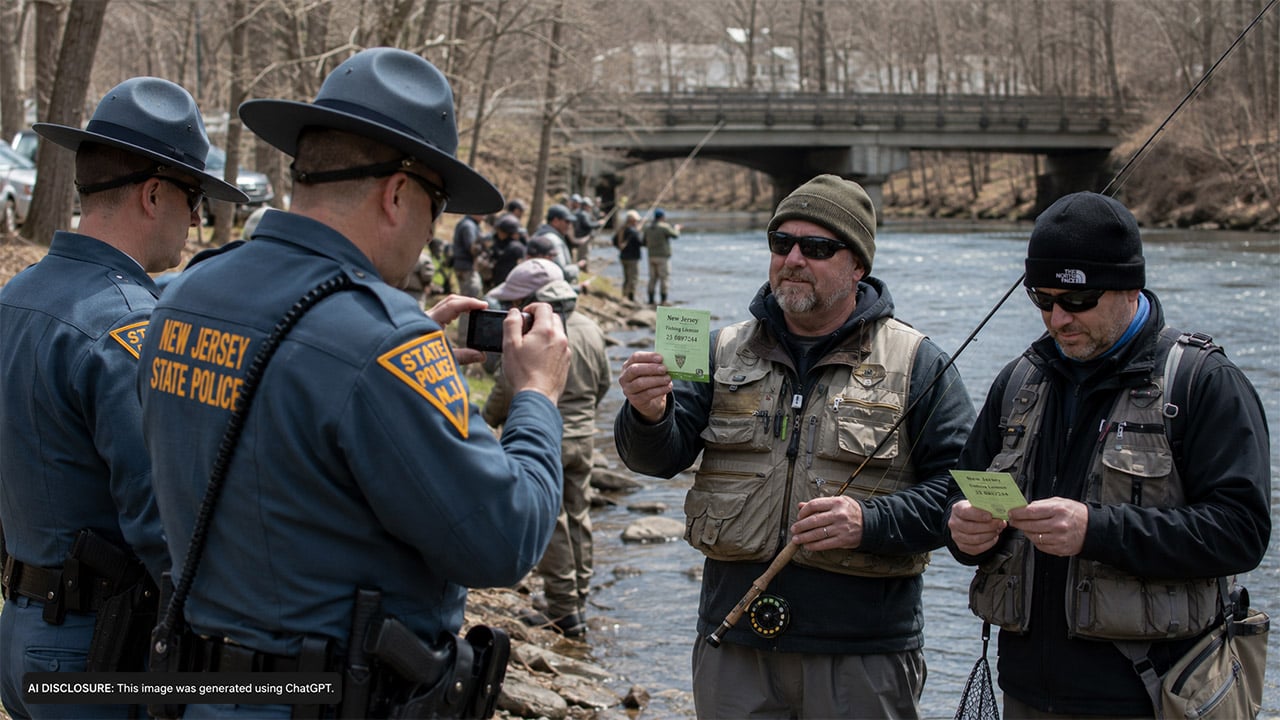
Trout opener mornings have a certain rhythm to them. Guys in waders moving quiet in the dark, kids bouncing on the bank, and the occasional conservation officer checking a license and moving on. But one Burlington County angler said this year’s opening day in New Jersey took a different turn when marked State Police units rolled up and started doing license checks—and then photographing anglers’ valid licenses.
In the original post, the angler described fishing a pond about an hour after legal time when two State Police officers arrived, walked around the water, and asked people to show fishing licenses. The angler said both he and his girlfriend had their licenses displayed, including trout stamps, and were legal. What bothered him wasn’t the check itself—it was the request to take a picture of each license.
Opening day, a stocked pond, and a visit nobody expected
The angler laid out a pretty normal opener scene: stocked trout day, Burlington County water, and a morning spent on the pond. Then the patrol car showed up. Instead of a Fish and Wildlife officer or a conservation officer, it was State Police.
That detail matters to a lot of outdoorsmen, because most of us are used to certain lanes. Game and fish handle game and fish. State troopers handle traffic, crashes, criminal calls, and general law enforcement. There’s overlap, sure—but most anglers don’t expect a trooper to be the one asking to see a trout stamp.
The license check wasn’t the issue—the photos were
According to the post, the officers eventually got to the angler and his girlfriend and asked to see licenses. Both were already out and visible. That’s about as cooperative and straightforward as it gets.
Then came the request that set off alarms: the troopers asked to take pictures of the licenses. The angler said he agreed because they were compliant—proper licenses, trout stamps, no drama—and he didn’t want the hassle of pushing back in the moment. Still, it “seems fishy,” as he put it, and a lot of folks reading the story will recognize that feeling: you did everything right, so why does this feel like you’re being documented?
Why a trooper might be doing a fishing check in the first place
Even without extra details, there are a few common-sense reasons a State Police unit might be checking anglers on opening day. A trout opener draws crowds. Crowds bring parking issues, disputes over space, occasional arguments, and sometimes other problems that have nothing to do with the fish.
It’s also possible Fish and Wildlife officers were stretched thin or focused elsewhere and another agency helped cover busy public areas. None of that makes the photo request feel any less odd—but it does explain how a trooper could end up doing the initial contact on a morning like that.
For the average angler on the bank, though, the question isn’t “can law enforcement ask for a license?” It’s “why are you photographing my personal document when I’m already showing you it’s valid?” That’s the part that makes people’s shoulders tighten.
What the photo request can mean for anglers in the real world
Outdoorsmen are used to being checked. Most of us have had a warden look at a license, glance at your cooler or creel, maybe check a length, and wish you luck. A photograph changes the vibe because it feels permanent—like you’re being entered into a file rather than simply verified on the spot.
From an angler’s standpoint, the practical concerns are pretty easy to understand. A license contains identifying information. A photo can be stored, shared internally, or attached to a report. Maybe it’s for documentation of compliance. Maybe it’s to speed up data entry. Maybe it’s to show a supervisor they did the check. Or maybe it’s just a habit some officers have developed.
But on the bank, you don’t know which one it is. You’re standing there with a rod in your hand trying to enjoy opening day, and suddenly you’re weighing whether saying “no” is going to turn a simple check into a long conversation.
The tight spot: complying to avoid trouble versus asking questions
The angler’s decision to allow the photos is one most people can relate to. When you’re doing nothing wrong, the easiest move is often to let it happen and get back to fishing. The downside is you drive home still wondering what exactly was taken, why, and where it ends up.
There’s also a bigger, unwritten reality here: tone matters. If an officer is calm and professional, some anglers will feel comfortable asking, “What’s the photo for?” If the interaction is clipped or rushed—two troopers walking bank-to-bank with a crowd watching—most folks will just nod and move on.
This is one of those situations where being respectful and staying non-confrontational is usually the smartest play, even if you plan to follow up later. A pond bank isn’t a courtroom, and opening day isn’t the time to turn a license check into a standoff.
Where anglers’ minds go when something feels off
The post didn’t include detailed reactions from others at the pond, but the fact the angler asked if it was “normal/legal” tells you what matters to everyday fishermen: expectations and boundaries. Most people accept that a warden can inspect licenses and gear. Fewer people expect a patrol trooper to do it. And fewer still expect the officer to photograph the license when it’s already displayed and valid.
For a lot of sportsmen, that kind of documentation feels like a step beyond a simple compliance check. It can also make people worry they’re being treated like a suspect when they’re just out there chasing stocked trout on a public morning.
It’s also worth noting the angler wasn’t trying to hide anything. He emphasized they had the right licenses and trout stamps. That’s part of what makes the story resonate with regular, law-abiding anglers: if this is happening to the folks doing everything right, it can happen to anyone standing on that shoreline.
In the end, this opener wasn’t remembered for the limit or the miss—it was remembered for the badge on the uniform and the phone camera pointed at a fishing license. And for New Jersey anglers heading into the next busy weekend, it’s a good reminder to keep your paperwork squared away, keep your cool during checks, and if something doesn’t sit right, handle the questions the smart way: politely in the moment, and through the proper channels afterward.
Like The Avid Outdoorsman’s content? Be sure to follow us.
Here’s more from us: