Photo credit: AI-generated image created using ChatGPT. Illustrative only
Out in rural country, most folks can live with gunfire. It’s part of the soundtrack—especially when you’ve got five-acre parcels, a backstop, and a neighbor who likes to shoot on weekends. But things change fast when the noise feels more like a blast wave than target practice.
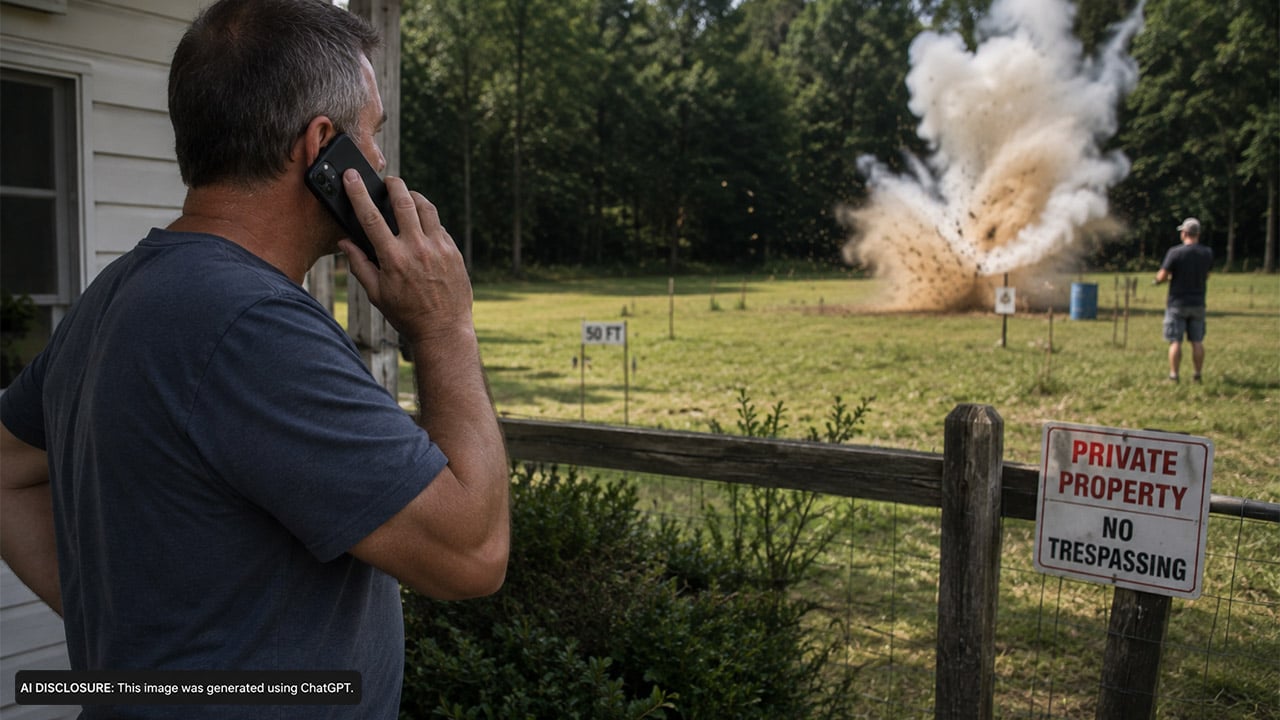
That’s where one Virginia landowner found himself after a neighbor set off legal Tannerite roughly 50 feet from the property line, rattling the house hard enough that he called 911. In the original post, he said the “loudest boom” shook the home, sounded like a bomb, and was followed by what he believed was automatic rifle fire. Deputies spoke with the neighbor—but didn’t take action.
A normal rural reality turned into a “house shook” moment
The landowner described a neighbor who shoots “lots of legal guns” on his five acres, which on its own is pretty common in many parts of Virginia. Plenty of rural folks sight in before deer season, run drills, or spend Saturday mornings turning money into noise. If it’s safe and legal, most people shrug and go about their day.
This time was different. Tannerite isn’t just “loud.” Even when used legally, the concussion can feel like a slap in the chest, and it carries farther than most people expect. When a blast makes the walls tremble, it doesn’t feel like recreation anymore—it feels like a safety problem.
Why Tannerite near a property line gets people on edge
The issue wasn’t simply that the neighbor was shooting. It was the combination of a legal explosive target and proximity—about 50 feet from the property line, according to the post. That’s close enough that any mistake, poor setup, or unpredictable fragment path becomes everybody’s problem.
Hunters and shooters know the difference between “loud” and “unsafe.” A rifle cracking off a berm is one thing. A concussive blast that shakes a nearby home is another, especially if you don’t know what direction it was aimed, what kind of backstop existed, or how it was set up. It also raises a reasonable question: even if it’s legal, is it being used in a way that crosses into reckless territory?
The 911 call didn’t lead to enforcement
After the blast and the follow-on gunfire, the landowner called 911. Deputies responded and spoke with the neighbor, but the poster said police “didn’t do anything about it.” That detail matters because it’s the moment many folks expect a clear answer—either “it’s fine” or “it’s not.” Instead, they got the gray area rural homeowners run into all the time.
Law enforcement on a noise-and-shooting complaint often ends up doing a quick check for obvious violations: Is anyone hurt? Is there an immediate threat? Is someone intoxicated? Is the shooter firing across a road or toward homes? If they don’t see a clean criminal angle right then, the response can turn into a warning or a conversation.
The local noise limit sounded like a path forward
One detail the landowner focused on was the county’s daytime maximum noise limit of 75 dBA. That’s the kind of rule that sounds straightforward—measure it, prove it, report it, done. But real-world enforcement is rarely that clean.
Noise ordinances often depend on where the measurement is taken, how it’s measured, how long the noise lasts, whether the sound is intermittent, and whether certain activities are exempt. Gunfire is sometimes treated differently than, say, a subwoofer or a construction crew. The poster’s instinct—record the dBA and report it—makes sense, but the hard part is whether that data would be accepted for enforcement or if the county requires an official meter and a specific protocol.
Documenting the problem without escalating the situation
The landowner asked if it’s possible to record the dBA and report it somewhere, and whether it could lead to a lawsuit. That’s a practical concern. Once you start collecting evidence, it can feel like you’re loading the chamber on a neighbor dispute—and in rural areas, you still have to live next to each other after the dust settles.
If you’re in that position, the “common sense” approach is usually: document what you can without trespassing or confronting anybody, keep notes on dates and times, and focus on impacts you can explain clearly—house shaking, disturbed animals, property damage if any, or shots that appear to be in an unsafe direction. If you do record audio or video from your own property, it’s less about playing detective and more about being able to describe the problem consistently if you end up talking to a supervisor, county code enforcement, or an attorney.
And it’s worth separating two issues that often get mixed together: noise and safety. Noise ordinances might be a code-enforcement lane. Unsafe discharge—depending on local rules and the specific facts—can become a law-enforcement lane. The post focused on noise dBA, but the “house shook” detail is what pushes many readers to think about safety distance, direction of fire, and backstop quality.
What outdoorsmen tend to focus on in disputes like this
In rural gun culture, most folks don’t want the government crawling into lawful shooting. At the same time, responsible shooters also don’t want Tannerite going off close to a property line with neighbors rattled and calling 911. That’s how everybody loses access in the long run—one reckless setup, one complaint too many, and suddenly there’s pressure for blanket restrictions.
The practical middle ground is usually a conversation—if it can be done calmly and safely—about moving the activity deeper onto the property, setting a clear backstop, and keeping explosive targets to a reasonable size and location. Not every neighbor is approachable, and the landowner in this case already felt brushed off by the initial police response, so it’s easy to see why he’d look for a formal path like decibel enforcement.
But experienced landowners also know that formal paths can be slow. Noise complaints can turn into “we’ll look into it,” and then you’re right back where you started—except now the neighbor knows you’re trying to build a case. That’s why the best outcome, when possible, is a change in behavior before it becomes a paper war.
At the end of the day, legal doesn’t always mean neighborly, and rural living comes with a certain tolerance—but it also comes with an expectation of safe, responsible shooting. When a blast shakes the house and the patrol response doesn’t bring relief, the next steps are usually about careful documentation, understanding local ordinances as they’re actually enforced, and deciding whether the issue is truly noise, truly safety, or both.
Like The Avid Outdoorsman’s content? Be sure to follow us.
Here’s more from us: