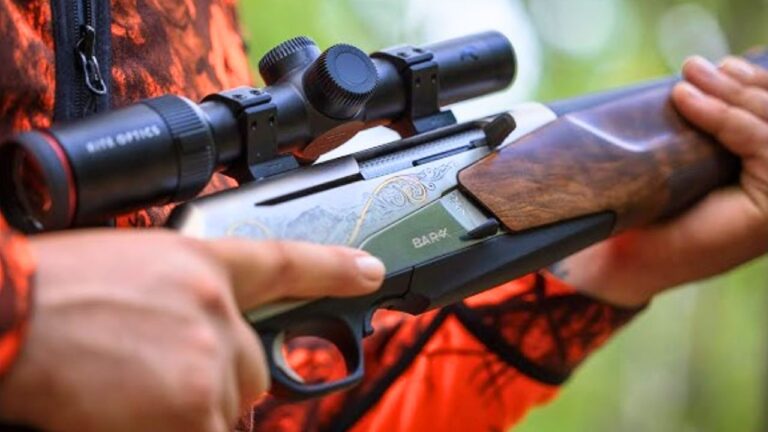
Photo credit: Savage Arms
Modern rifles are marketed like smartphones, with long feature lists that imply you are buying performance. In practice, most hunting and general-use rifles live or die on a small set of basics: a consistent barrel, a stable bedding interface, a predictable trigger, reliable feeding and extraction, and an optic setup that does not move. Many popular “must-have” features do not meaningfully change real-world outcomes for the average shooter, and some can even distract from the areas that actually matter. The result is a market where owners upgrade the wrong things, then blame the rifle when the real limitation is stability, verification, or fundamentals.
“Sub-MOA guarantees” matter less than repeatable cold-bore performance
A rifle’s marketing accuracy promise matters far less than what it does on the first shot from a cold barrel, because most hunting situations are decided by that shot. A rifle that prints a tight three-shot group after warmup but throws the first round 1.5 inches high and left is not “better” in the field than a rifle that holds a consistent first-shot impact every time. For many owners, chasing sub-MOA claims becomes a loop of ammo changes and accessory swaps while the real solution is confirming cold-bore point of impact, maintaining consistent torque on action screws and mounts, and learning what the rifle does across normal temperature and handling changes. This is also why some rifles that look great on paper feel unreliable over time; the owner never validates the rifle’s real, repeatable behavior under the conditions it is actually carried, bumped, and fired.
Adjustable stocks and chassis features matter less than basic rifle fit and stability

Adjustable combs, folding stocks, modular rails, and chassis features can be useful, but they do not compensate for a rifle that is unstable or poorly fitted to the shooter. Many hunters buy adjustability expecting it to fix inconsistency, then continue to shoot with an awkward cheek weld, a scope mounted too high, or a position that changes under recoil. Fit is the part that matters: consistent cheek weld, consistent eye relief, and consistent shoulder pressure. A basic stock that fits well will often outperform an adjustable stock set wrong, and it will do so with fewer screws, fewer moving parts, and fewer opportunities for something to loosen. The most practical “feature” is a rifle that returns to the same position on every mount and recoils the same way every time, because that is what produces repeatable hits when you are shooting off sticks, a pack, or an improvised rest.
Exotic muzzle devices matter less than controlling recoil through technique and rifle balance
Muzzle brakes and compensators can reduce felt recoil, but their real-world value is often overstated for the average hunter because they introduce tradeoffs that people do not plan for. Brakes increase blast and noise, which matters when hunting with partners, dogs, or in tight blinds, and they can turn a normal shot into a communication and safety problem if ear protection is not used. They also do not fix the root causes of poor recoil management, which are usually inconsistent shoulder pressure, poor body position, and a rifle that is too light for the cartridge. Many shooters would see greater performance gains by choosing a rifle that balances well, verifying stock fit, and practicing field positions than by adding a brake and hoping recoil disappears. If the rifle still shifts unpredictably under recoil, the muzzle device is not the limiting factor; the system and the shooter’s consistency are.
High-capacity magazines matter less than feeding reliability and practical reload behavior
Detachable magazines and higher capacity are useful in some contexts, but for most big-game hunting and many general-use roles, the priority is feeding reliability and consistent chambering under awkward handling. A magazine system that binds, pops rounds early, or shifts slightly in the well can create failures that do not show up on a clean range bench but appear when the rifle is carried all day, bumped on a sling, or loaded at an odd angle. Many hunters would be better served by a proven internal magazine system or a high-quality detachable magazine setup that has been tested for their specific rifle rather than chasing capacity for its own sake. In practical terms, you rarely need ten rounds in a hunting scenario, but you always need the first and second rounds to feed without drama, and you need extraction to be predictable if the chamber is dirty, cold, or slightly wet.
The features that actually matter are boring and mostly invisible
The rifle features that matter most are the ones people do not brag about: consistent bedding contact, action screw torque that stays put, a barrel that does not wander as it heats, a trigger that breaks cleanly at a weight you can control, and a scope mounting system that does not shift. Those fundamentals determine whether a rifle stays zeroed, whether it shoots the same after a season of carry, and whether it produces the same point of impact when you are tired and cold. A rifle that checks those boxes can be simple and still outperform a “feature-rich” rifle that looks modern but loses stability. For most shooters, the smartest money is spent on a reliable rifle setup, verified torque, good rings, a scope that holds zero, and enough practice to know exactly where the first shot lands. The rest is mostly noise.
Like The Avid Outdoorsman’s content? Subscribe to our newsletter so you never miss an article.
Here’s more from us: