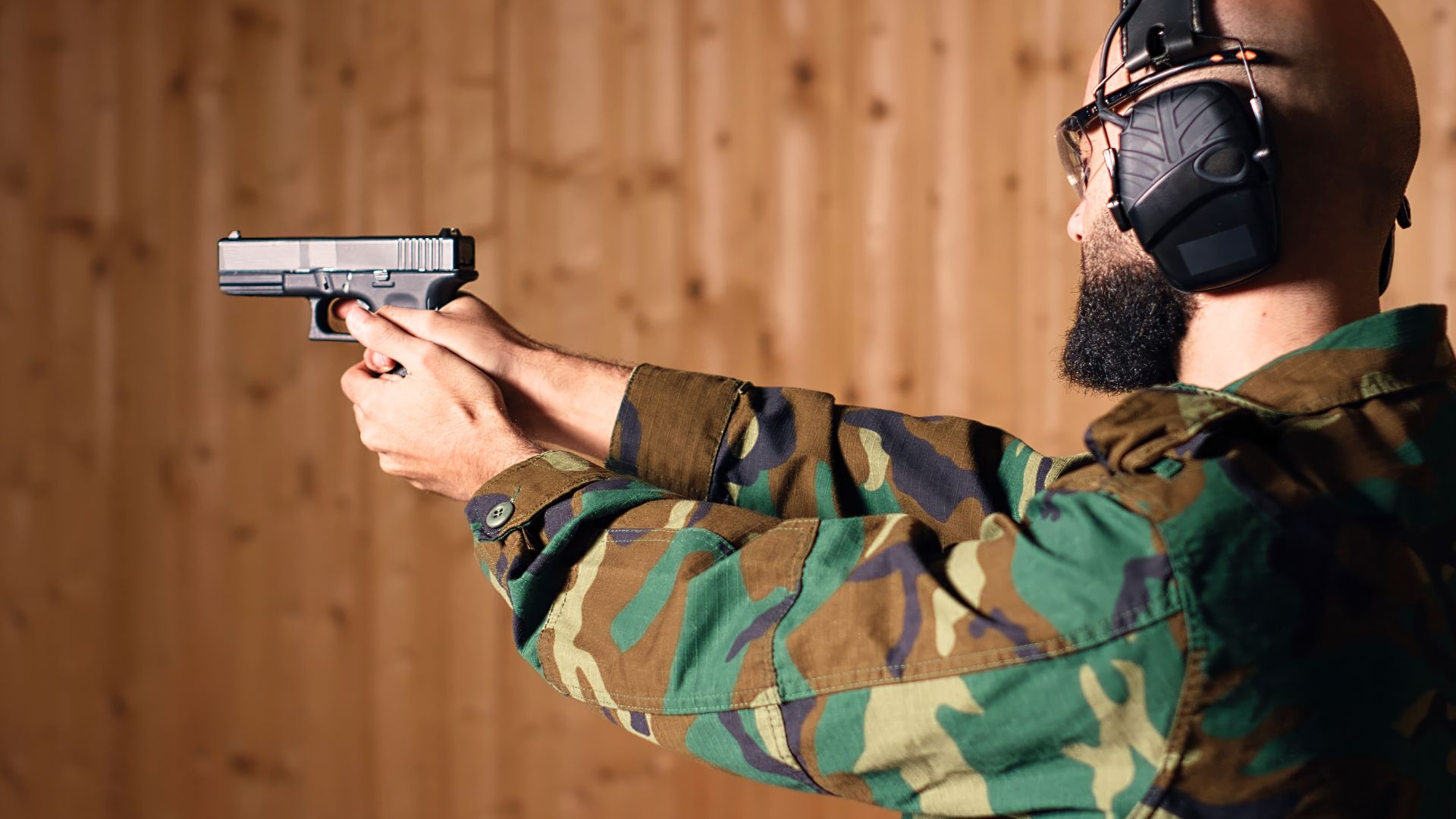
Photo credit: DC Studio/Shutterstock.com
New shooters don’t get “stuck” because they’re lazy or uncoachable. They get stuck because the range teaches them a story that sounds responsible, feels safe, and produces a nice little target they can take home—while quietly ignoring what actually makes a shooter competent. You’ve probably heard it a hundred times: “Accuracy first, speed later.” It gets repeated like it’s the Ten Commandments of marksmanship, and it sounds logical on the surface. The problem is that most people interpret it as “shoot slow forever,” which turns practice into a comfort ritual instead of skill-building. They never learn to manage recoil, track sights, or run the trigger at a pace that matches real shooting. They become good at one thing—making careful shots when nothing is happening—and average at everything else.
Here’s what that myth does in the real world. It convinces you that the only “legit” shooting is slow fire at 10–25 yards, usually from a perfect stance, on a clean lane, with unlimited time, and no need to solve problems. Then the first time you try to shoot faster, your hits fall apart, and you assume you’re not ready. You back off, go slow again, and the cycle repeats. Meanwhile, the mechanisms that control practical accuracy—grip pressure, recoil path, sight return, trigger reset timing, visual patience, and shot calling—never get trained. You don’t have to become a competitive shooter to break out of that loop, but you do have to stop treating speed like a forbidden fruit and start treating it like a measurable skill that can be built safely.
The myth survives because it’s half true and easy to teach badly
Yes, accuracy matters, and rushing shots is how people build terrible habits. But “accuracy first, speed later” gets taught like a binary switch instead of a sliding scale. New shooters hear it and think speed is something you add after you “master fundamentals,” as if fundamentals are only fundamentals at one pace. That’s backwards. Fundamentals are what let you shoot accurately at different paces, and you only discover where your fundamentals break by changing the pace and demanding more from them. If you never leave slow fire, you never test the parts that matter under recoil and time pressure, which is exactly where people fall apart when they finally try to shoot more than one shot every five seconds.
The safe way to learn isn’t to avoid speed. It’s to build it in controlled steps while keeping accountability on target. That means setting a standard like “all hits inside an 8-inch circle at 7 yards,” then slowly tightening the time or the split between shots while you watch what breaks. When your hits start drifting low-left (right-handed shooter), that’s not “proof you’re not ready.” It’s feedback that your trigger press is getting snatched or your grip is collapsing as recoil returns. The myth keeps people stuck because it labels that feedback as failure instead of information, so they retreat to the only pace where the problems hide.
Slow fire creates a false sense of control because recoil management is barely involved
A single careful shot gives you time to do everything “right,” even if you’re doing it inconsistently. You can rebuild your grip between shots, re-center your stance, and mentally rehearse the trigger press like you’re defusing a bomb. That’s fine for learning what a clean press feels like, but it’s not the same skill as keeping the gun stable through recoil and running the trigger without disturbing the sights. Recoil management isn’t just about tolerating recoil; it’s about directing it. The gun is going to move. Your job is to make it move the same way every time so the sights return to a predictable place. That only shows up when you shoot multiple shots with a consistent grip and cadence, because that’s when inconsistencies get punished.
You see this all the time with new handgun shooters at 10 yards. They can print a decent five-shot group if they take their time, but the moment they try a simple drill—two shots on one target, even with a full second between shots—the group turns into a vertical smear or scattered hits. That’s not because their “accuracy foundation” vanished. It’s because their grip isn’t actually stable under recoil, and their trigger reset timing is sloppy. The slow-fire-only approach never forces those issues into the open, so the shooter keeps polishing the wrong skill and wonders why progress stalls.
It teaches the wrong visual skill: staring at the target instead of reading the sights
Another reason the myth keeps people stuck is that slow fire encourages a kind of visual daydream. You line up the sights, you hold your breath, you press, you hope, and then you look for a hole to confirm you did it right. That’s not shot calling. Shot calling is knowing where the shot went before you see the paper, because you saw the sight picture at the break and you felt what your hands did. In practical shooting—whether you’re running a drill, shooting in the wind with a rifle, or just trying to be consistent—your eyes need to learn what “acceptable wobble” looks like and what the sights are doing during and after recoil. If you don’t train that, you’ll always feel like accuracy is a mystery you occasionally stumble into.
This is where structured cadence helps more than endless slow fire. At 5–7 yards, you should be able to see the front sight lift and return (or the dot track) and break the next shot when it returns to what you’ve defined as acceptable. That definition changes with distance and target size. At 7 yards on an 8-inch circle, “acceptable” is generous. At 15 yards, it tightens. If you only ever shoot slow, you never learn those visual thresholds, so you either shoot too slow forever or you shoot too fast and spray because you’re not actually waiting for anything you can describe. The myth keeps you trapped between those two extremes.
It hides the real culprit: trigger control under speed is about grip and prep, not “trying harder”
When new shooters finally push the pace and their hits go bad, they usually blame the trigger hand. They’ll say “I’m jerking the trigger” or “I’m anticipating.” That’s often true, but the mechanism is bigger than willpower. A lot of “trigger jerk” under speed is really a grip problem. If your support hand isn’t doing most of the work—high on the frame, crushing side-to-side, locking the gun into the web of your firing hand—then the firing hand starts trying to control recoil and press the trigger at the same time. That’s where you get sympathetic movement: the whole hand tightens and the muzzle dips or yaws as the shot breaks. You can’t “concentrate harder” out of that if the grip is wrong for the pace you’re attempting.
Trigger work at speed is also about prep and reset. The best shooters aren’t slapping the trigger; they’re taking slack out early, pressing straight through when the sights are acceptable, and riding the reset consistently so the trigger finger isn’t searching for the wall every time. You don’t learn that by firing one slow shot, coming off the trigger completely, and starting over. You learn it by running controlled pairs and short strings where you stay on the trigger, feel the reset, and keep the sights honest. That’s why the myth is so damaging: it teaches a practice style that actively avoids the exact trigger behaviors you need once you leave slow fire.
A better rule is “accountability first,” and it scales from 3 yards to 300
If you want a rule that doesn’t trap people, replace the myth with this: accountability first. You can shoot fast as long as you can explain your hits and keep them within a defined standard. That standard should match the drill and the distance. For a new shooter at 5 yards, an 8-inch circle is a fair standard. At 7 yards, keep it the same and start working on cadence. At 10 yards, tighten to a smaller circle or accept a slower cadence. The point is that speed isn’t the goal. The goal is controlled execution under a measurable constraint, because that’s what builds transferable skill.
A simple example that works: at 7 yards, start with one shot from a low-ready position and demand a clean hit in the circle. Then shoot two shots, aiming for two clean hits with a deliberate pause to see the sights return. Then shoot three. If you lose the sights, you slow down until you can see them again. That’s not “speed later.” That’s speed in context, tied to your ability to observe and control the gun. It also keeps practice honest. You’re not chasing tiny groups that only happen when you baby the trigger, and you’re not blasting without learning. You’re building a skill that scales: same process for a rifle at 100 yards, where accountability might be a 2-inch group from prone, and then a 4-inch group from kneeling under a time limit that forces you to manage breathing and position.
How to break out of the trap without getting reckless or building bad habits
The way out is not to turn every range trip into a race. It’s to structure practice so you touch both ends of the spectrum: slow, perfect shots that teach you what “right” feels like, and controlled faster strings that teach you how to keep “right” while the gun is moving. A good session can be as simple as this: begin with slow fire at 10–15 yards to confirm sights and fundamentals, then move to 5–7 yards and run controlled pairs focusing on seeing the sight lift and return, then finish by going back to 10–15 and proving you can still shoot accurately when you’re slightly fatigued. If your groups open late in a session, that’s valuable information about grip endurance and attention, not a reason to quit or to pretend it didn’t happen.
Most importantly, stop treating speed as a moral issue. Speed is not “spray and pray,” and slow is not “disciplined.” Discipline is doing the work that exposes your weaknesses and then fixing them. If you’re stuck, it’s usually because your practice avoids discomfort—either the discomfort of recoil and pace, or the discomfort of holding yourself to a standard you can’t currently meet. The myth that won’t die gives you permission to stay comfortable forever. Drop the myth, keep the accountability, and you’ll start progressing again in weeks instead of wondering why you’ve been “working on accuracy” for two years with nothing to show for it.
Like The Avid Outdoorsman’s content? Subscribe to our newsletter so you never miss an article.
Here’s more from us: