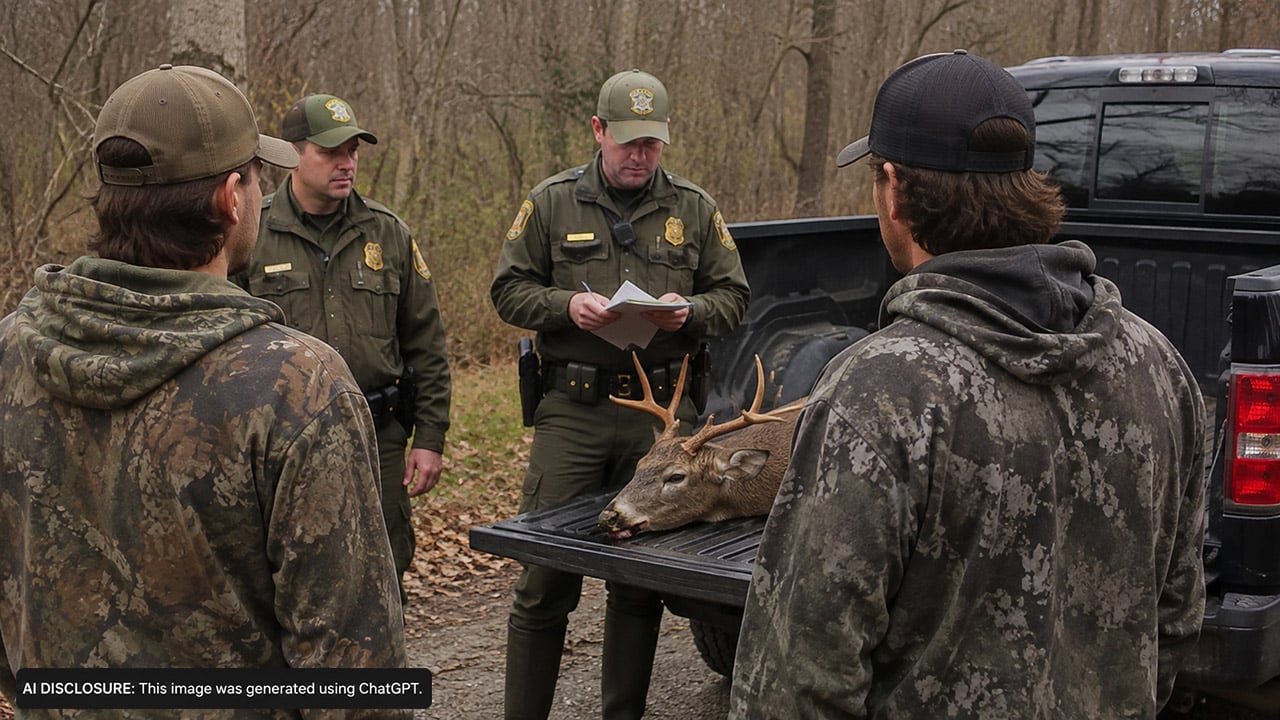
Photo credit: AI-generated image created using ChatGPT. Illustrative only
Most hunters work too hard for their deer—scouting, getting permission, checking the wind, and punching the right tags—to have any patience for guys who treat public ground like a free-for-all and then try to cover it up on camera. That’s why this central Ohio case hits a nerve: the state says two YouTubers told viewers certain bucks were taken in Kentucky, but officers later tied those deer back to illegal kills in Ohio.
In a year-plus investigation summarized in the source post, the Ohio Department of Natural Resources (ODNR) Division of Wildlife and Columbus and Franklin County Metro Parks laid out a long list of alleged violations involving William I. Bethel, 28, and Justin A. Booth, 23, both of Columbus. The two were known on YouTube as “Creek Kings Outdoors,” and their channel allegedly featured videos of poached whitetails.
A long-running pattern, not a one-off mistake
ODNR says the investigation uncovered evidence of poaching from 2019 through 2024, including activity in Three Creeks Metro Park and on other properties where the men didn’t have permission to hunt. That time span matters, because it doesn’t read like a paperwork slip or an honest boundary mix-up—this was described as repeated behavior across multiple years.
For the average bowhunter or gun hunter, the “permission” part is the bright line. If you don’t have it, you don’t hunt it. The case also highlights how quickly a pattern of small violations—trespass, tag issues, season issues—can stack into something that brings multiple agencies to the table.
The Kentucky story and how it unraveled
One of the more eye-catching details in ODNR’s summary is the claim that Bethel and Booth told viewers certain deer were harvested in Kentucky. Investigators concluded those deer were unlawfully taken in Ohio instead. That’s not just a flex gone wrong; it’s an attempt to create distance between the kill and the place where it actually happened.
Hunters know why someone might try that angle. Different states, different reporting systems, different seasons—if you can convince an audience a deer came from somewhere else, you might think you’ve erased the tracks. But wildlife officers don’t work off vibes. They build timelines, collect evidence, and compare what’s said publicly to what’s physically possible.
What they pleaded guilty to (and what it tells hunters)
ODNR says charges were filed in September 2025 at the conclusion of the investigation. In May 2026, each man pleaded guilty to 20 counts—40 guilty pleas combined—and the charge lists read like a checklist of what not to do.
Bethel’s 20 counts included hunting deer without a permit (three counts), hunting deer in the closed season (three counts), failing to game check deer, hunting with the aid of a motor vehicle, hunting without permission (three counts), possessing deer taken illegally (two counts), possessing untagged deer parts (four counts), and criminal trespass (three counts).
Booth’s 20 counts included hunting deer without a permit, hunting without permission (five counts), failing to game check deer (two counts), aiding a wildlife offender, possessing untagged deer parts (two counts), possessing a deer taken illegally (three counts), taking more than one antlered deer in a license year, obstructing official business, and criminal trespassing (four counts).
If you’ve been around hunting long enough, you can see the shape of it: no permit, wrong season, no game check, and deer parts without proper tags. Add trespass and “aid/obstruct” type charges, and it points to a situation where officers believed they weren’t just dealing with rule-breaking—they were dealing with rule-dodging.
The penalties: money, jail time, and lost privileges
The court-ordered restitution totaled $29,219.32 combined, and ODNR says total financial penalties reached $37,051.32 after fines, fees, and court costs. That’s the kind of bill that follows you around for a while, even if you never step into the woods again.
Both men were ordered to serve nine days in jail during the upcoming 2026–27 hunting season, with an additional 531 days suspended. They were each placed on five years of reporting probation and barred from Columbus and Franklin County Metro Parks properties during that probation period. On top of that, their hunting, fishing, and trapping privileges were revoked for five years.
That last piece is the real gut punch for anyone who claims to be an “outdoors” guy. Losing privileges for five years doesn’t just mean you miss a season—it means you miss half a decade of ruts, youth hunts, scouting summers, and everything in between.
What this means for regular hunters and landowners
There are two practical lessons here, especially for hunters who share ground with other hunters and for landowners who’ve dealt with trespass. First, public-facing bragging—videos, posts, and “where it came from” stories—can become part of an investigation if officers believe crimes are being shown or described. If you’re legal, that’s not a problem. If you’re not, it’s a paper trail you made yourself.
Second, if you manage property or have permission on private ground near high-traffic areas like parks, don’t ignore little red flags. Boundary issues, strange vehicle patterns, and repeated stand placements where they don’t belong are worth documenting and reporting. ODNR specifically notes that public input matters and points people to the Turn in a Poacher hotline (1-800-POACHER) for anonymous reporting, with the possibility of a reward if information leads to a conviction.
At the end of the day, ethical hunters aren’t asking for special treatment—just a fair season. Cases like this are a reminder that the rules are there to protect the resource and the reputation of everyone who does it right, whether they hunt a metro park edge with permission or a family farm that’s been in the same hands for generations.
Like The Avid Outdoorsman’s content? Subscribe to our newsletter so you never miss an article.
Here’s more from us: