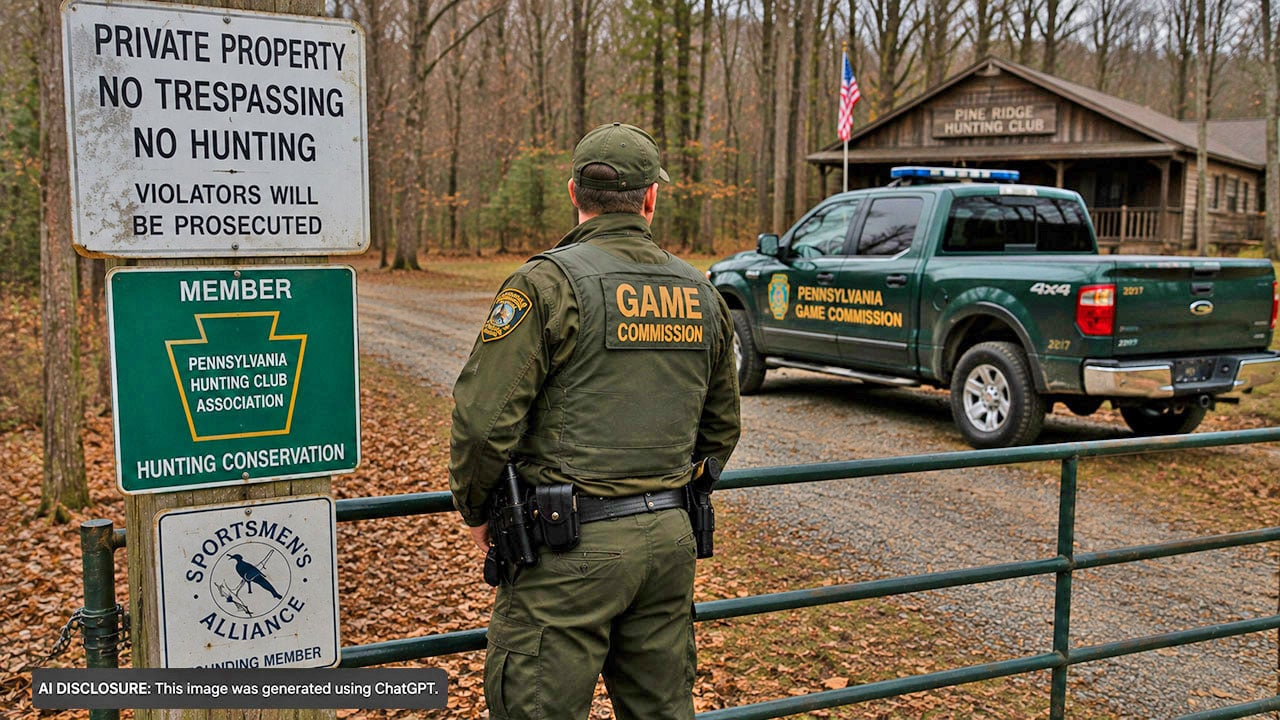
Photo credit: AI-generated image created using ChatGPT. Illustrative only
If you own posted ground in Pennsylvania—whether it’s a family farm, a timber parcel, or a hard-earned hunting club lease—you probably have a pretty simple expectation: it’s private unless you say otherwise. This week, the Pennsylvania Supreme Court backed that idea in a unanimous ruling that limits when game wardens can step onto private land without a warrant.
The case came out of two western Pennsylvania hunting clubs pushing back on warrantless entry by state wildlife officers, and the details are laid out in the source post that summarizes reporting by Peter Hall at the Pennsylvania Capital-Star. For landowners and the folks who hunt their own ground, the practical effect is big: “open fields” aren’t automatically fair game anymore when the property owner has taken real steps to keep people out.
Two clubs said “posted means posted”
The lawsuit was brought by the Pitch Pine Hunting Club and the Punxsutawney Hunting Club in Clearfield County. Both challenged two provisions in Pennsylvania’s Game and Wildlife Code that allowed state game wardens to enter private land—excluding homes and buildings—without getting a warrant.
Frank Stockdale, president of the Punxsutawney Hunting Club, framed it in plain terms: the club is a private place where members come to relax and find peace, and that privacy is what makes it special. The clubs were represented by the Institute for Justice, a public interest law firm.
What sparked it: days of watching, no citation, and a line crossed
This wasn’t just a theoretical argument about legal language. The reporting describes a summer 2013 incident where a state wildlife officer accused a Pitch Pine member of illegally feeding bears outside a cabin on the club’s roughly 1,100-acre property.
What got attention was the officer’s admission: he’d been watching the member and guests for several days trying to catch violations. In the end, he left without citing anyone, but the encounter—along with other interactions—pushed the clubs to sue.
If you’ve spent time around posted club ground, you know why that matters. When somebody is sitting back and “observing” for days on private property, it doesn’t feel like routine patrol. It feels like surveillance on land you pay for and manage.
The old rule leaned on the federal “open fields” doctrine
The Game and Wildlife Code provisions were enabled by a 1924 U.S. Supreme Court decision that created the “open fields” doctrine. In short, the Fourth Amendment’s protections against warrantless searches don’t extend the same way to open fields—like farm ground or woods far from a home—as they do to houses and certain areas around them.
That idea has been a thorn for rural landowners for a long time. You can post every boundary, hang every sign, chain every gate you’re allowed to chain—and still be told that because it’s “open fields,” a government official can come on without a warrant.
The clubs lost in Commonwealth Court in 2023. That wasn’t the end of it. They appealed to the Pennsylvania Supreme Court, and that’s where the ground shifted.
Pennsylvania’s Constitution gives more privacy protection on land
Justice Kevin Brobson wrote the lead opinion for the unanimous court, and the key point is this: Pennsylvania’s Constitution can—and in this case does—provide stronger privacy protections than the federal baseline.
The court focused on Article I, Section 8 of the Pennsylvania Constitution, which is similar to the U.S. Constitution’s Fourth Amendment. The language is close, but not identical. The Fourth Amendment protects people in their “persons, houses, papers, and effects.” Pennsylvania’s version uses “possessions” where the federal text says “effects.”
That single word mattered. In a prior decision—Commonwealth v. Russo (2007)—the Pennsylvania Supreme Court upheld these warrantless search provisions. Russo involved a hunter convicted of baiting bears after he reported killing a black bear within minutes of the season opener, and searches turned up evidence of baiting. In Russo, the court treated “possessions” like “effects,” meaning personal property rather than real property like land.
This time, the court said that reading was wrong. Brobson wrote that “slavish adherence” to Russo had to give way to the greater privacy and property protections under Pennsylvania’s Constitution, and that Russo “has not aged well.” The court said Pennsylvania law historically understood “possessions” to include land.
Bottom line from the ruling: when a landowner has shown a reasonable expectation of privacy by taking sufficient steps to exclude intruders, game commission officers and other government officials must get a warrant based on probable cause—or meet a recognized exception to the warrant requirement—before entering that property.
What this changes for hunters, clubs, and rural landowners
This decision doesn’t mean the Pennsylvania Game Commission can’t enforce game laws. It means there are now tighter constitutional standards for how they step onto private land when it’s clearly treated as private.
For the everyday outdoorsman, “reasonable expectation of privacy” isn’t just legal talk—it’s the stuff you already do when you care about your ground. Posting boundaries, maintaining gates, and making it clear the public isn’t invited becomes even more meaningful, because the court specifically tied protections to landowners who take “sufficient steps to exclude intruders.”
It also draws a sharper line for clubs that manage big acreage. A lot of clubs have camp areas, food plots, and interior roads that are nowhere near public access points. The ruling puts real weight behind the idea that posted private woods aren’t a free-roam zone for government entry without judicial oversight.
The decision also matters for anyone who has dealt with trespassers and wanted help. It’s a reminder that “private” needs to stay consistent across the board. If you want the law to treat your land like private space, treat it that way—signs, gates where legal, and clear boundaries.
The Game Commission’s response: disappointed, but moving forward
The Pennsylvania Game Commission said it was disappointed but would respect the ruling. In a statement, a spokesperson said the agency is confident officers will still carry out the mission of protecting wildlife and enforcing hunting laws within the new constitutional standards.
They also emphasized that laws protecting wildlife remain in place and that residents should expect the commission to remain committed to safeguarding wildlife and serving the public. The state attorney general’s office, which represented the Game Commission, declined to comment.
That’s a fair reality check: this isn’t a get-out-of-trouble card for poaching or baiting. It’s a boundary around how investigations start and how far an officer can go on posted land without a judge signing off.
For Pennsylvania hunters who do things the right way—buy the license, follow seasons, respect property lines—this decision reads like common sense catching up to the way rural people already live. Your posted land isn’t public property. And if the government wants to come onto it and “spy on you,” as the Institute for Justice attorney put it, the state’s highest court just said they need to bring a warrant—or a valid exception—along with them.
Like The Avid Outdoorsman’s content? Subscribe to our newsletter so you never miss an article.
Here’s more from us: