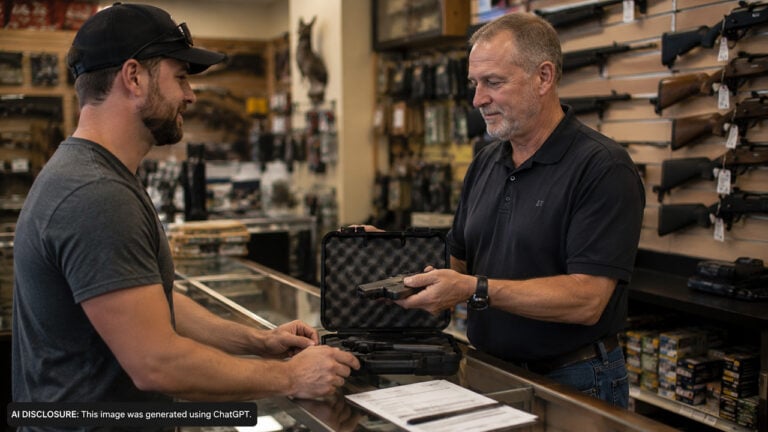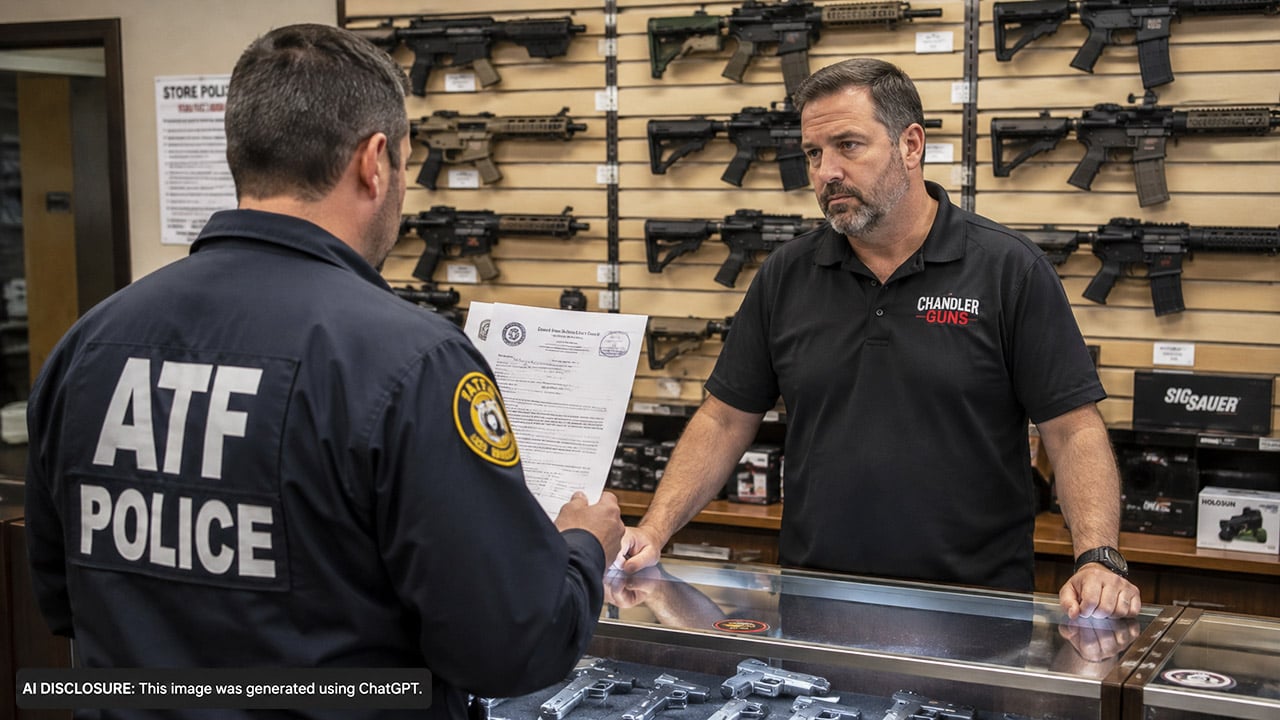
Photo credit: AI-generated image created using ChatGPT. Illustrative only
Most hunters and gun folks don’t think twice about the local gun counter. You walk in, handle what you’re buying, fill out the paperwork, and you go home knowing the rules are there for a reason.
That’s why a recent case out of the East Valley has people paying attention: a Chandler-area gun store owner has been federally indicted on multiple counts tied to alleged straw purchasing and cash-reporting issues, even as his shop continues operating. The details were laid out in the original post from AZFamily.
What federal prosecutors say happened at the counter
The U.S. Attorney’s Office for the District of Arizona says a federal grand jury in Phoenix returned an eight-count indictment on April 8 against Esteban Yanez, 34, of Gilbert. Prosecutors allege Yanez made a false statement during the purchase of a firearm, engaged in straw purchasing of firearms, and failed to file IRS forms related to cash received in a trade or business.
The indictment centers on three alleged incidents between October 2025 and February 2026. In those instances, prosecutors say Yanez aided and abetted people who knowingly made false statements at his shop when submitting background check forms—specifically misrepresenting who the actual purchaser of the guns was.
The shop named in the indictment is still doing business
Prosecutors identified Yanez as the owner of The Armory at Virtus Armament near Ray Road and Arizona Avenue. While the legal process plays out, the store remains open.
Yanez’s defense attorney, Jason Lamm, told AZFamily they’ve entered a plea of not guilty. Lamm also said, “This is not something that poses a danger to the community in any way. This is a gun dealer that is fully licensed by the federal government. They remain in good standing are they are open for business today.”
Why “straw purchases” are a big deal in the real world
Straw purchasing is one of those terms that can sound abstract until you put it in plain language: it’s when the person filling out the paperwork isn’t the true buyer. In the hunting and shooting world, that’s the kind of shortcut that can turn into a full-blown mess fast—because the entire point of the background check form is to identify who is actually taking possession.
In this case, prosecutors said that in two instances, the guns were being purchased for someone previously convicted of a felony. Federal law prohibits felons from possessing firearms. That’s where this goes from “paperwork problem” to a public-safety issue in the eyes of investigators—because the allegation is that firearms ended up routed toward prohibited possessors.
The other piece: cash reporting and IRS forms
The indictment isn’t just about who bought what. Prosecutors also allege Yanez failed to file IRS forms for cash firearm transactions of $10,000 or more.
Most everyday gun buyers won’t ever brush up against that threshold, especially if they’re grabbing a deer rifle and a couple boxes of soft points. But for higher-end purchases, multiple firearms, or certain trades, large-dollar cash transactions can come into play—and when they do, federal reporting requirements become part of doing business the right way.
ATF perspective: the “gray market” problem doesn’t go away on its own
AZFamily also included comments from Retired ATF Special Agent in Charge Bernard Zapor, who is a faculty associate at Arizona State University. Zapor said straw purchasing has been a problem for a while and is hard to address with current laws in place.
He also tied it to a bigger issue that gun owners have heard about for years: firearms getting diverted into a “massive gray market” connected to criminal elements. Whether you’re a bird hunter who only thinks about shot shells and chokes, or you carry daily, that gray market is what brings heat down on everyone—more scrutiny, more suspicion, and more pressure on lawful dealers and buyers.
What’s at stake if the charges stick
Federal cases like this can carry serious consequences. Prosecutors said that if convicted on all charges, Yanez could face up to 30 years in prison and fines of up to $1 million. The U.S. Attorney’s Office for the District of Arizona is handling the prosecution.
For everyday gun owners, this is also a reminder of how little tolerance there is—legally—for “helping someone out” when it comes to gun purchases. Buying a firearm for a prohibited person is a hard line. And even buying a firearm for someone who can legally own one can turn into trouble if the paperwork doesn’t match the reality of who’s actually purchasing and taking possession.
Plenty of folks will keep walking into gun shops, filling out their 4473 honestly, and heading to the range or the field without a second thought. That’s how it should be. But cases like this are a sharp reminder that the gun counter isn’t the place for wink-and-nod deals—because when feds believe straw sales are happening, the consequences can stack up fast, and they don’t just land on the buyer.
Like The Avid Outdoorsman’s content? Subscribe to our newsletter so you never miss an article.
Here’s more from us: