Photo credit: AI-generated image created using ChatGPT. Illustrative only
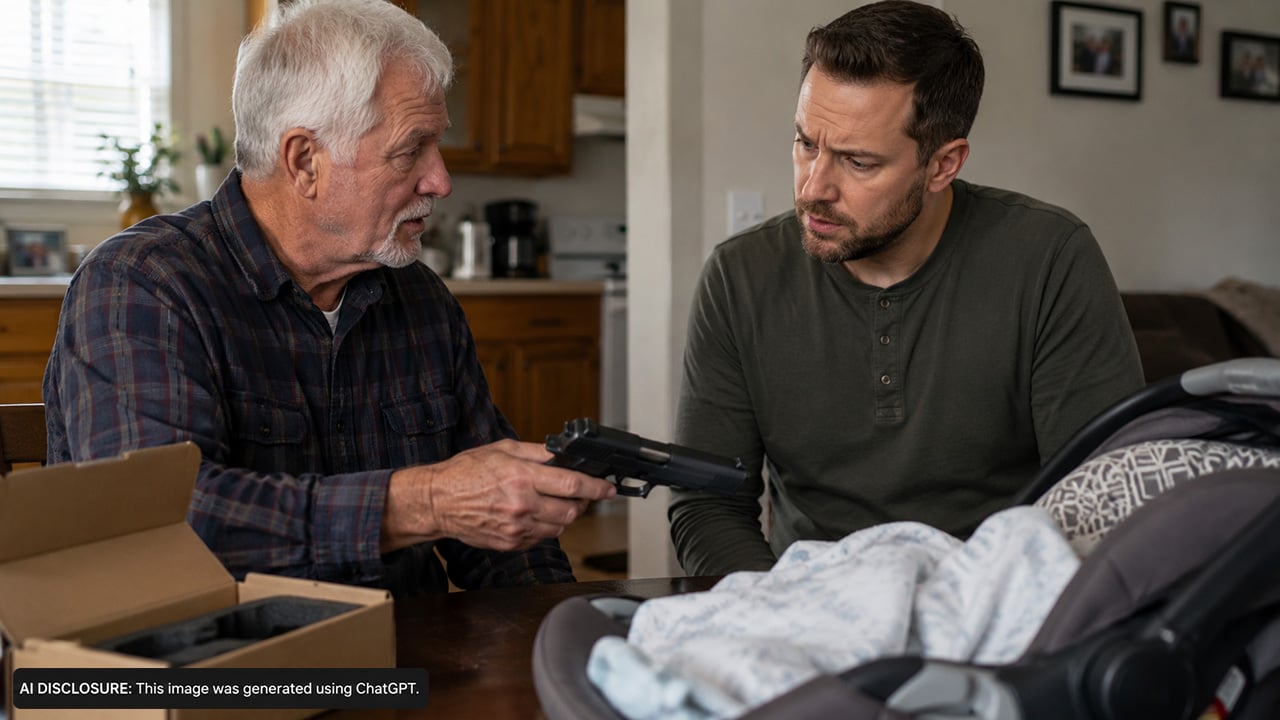
A new baby has a way of turning even average folks into security-minded adults overnight. In one Texas family’s case, that protective instinct came with an unexpected problem: a small handgun handed down by a father-in-law with a “shady” reputation—given with good intentions, but later suspected to be stolen.
The family laid it out plainly in the original post: the pistol showed up around the time their son was born, meant to help the husband protect his wife and kid. Later, they started connecting dots and realized there was a high chance the gun wasn’t clean. An update made it worse—someone told them it was apparently “used in a crime.” From there, it wasn’t about home defense anymore. It was about getting the thing out of the house without making the situation worse.
A “protect the family” gift turned into a liability
A lot of outdoorsmen understand the impulse here. A compact handgun is a common choice for a nightstand, a truck console, or a quick walk to the barn after dark. But that only works if the gun is lawfully owned and you can trust its background.
In this case, the father-in-law’s character was part of the warning label. The wife described him as a shady guy who occasionally showed sincerity. That’s a familiar type in plenty of families—someone who can be generous one day and trouble the next. The problem is that firearms don’t come with a “probably fine” setting. If a gun is stolen, it’s stolen, and possession can bring heat whether you meant to do anything wrong or not.
Once “likely stolen” entered the picture, the stakes changed fast
There’s a big difference between inheriting Grandpa’s old deer rifle and taking a handgun from someone who lives in the gray areas. The moment the family suspected the pistol might be stolen, it stopped being a useful tool and became potential evidence.
The update—“used in a crime”—is what really tightens your chest. Nobody wants a firearm in their house that may be tied to something ugly, especially with a newborn sleeping down the hall. And from a practical standpoint, it’s not just about morality; it’s about what happens if that gun ever gets discovered in a traffic stop, during a burglary report, or after a defensive incident where police take the firearm as part of the investigation.
If you ever use a gun defensively, you want everything about it to be boring and aboveboard: legal purchase, clean serial number, normal storage. Anything else is a complication you do not need.
The worst instinct was to “just destroy it”
The husband’s first thought was to destroy the handgun. That’s a common gut reaction when folks want a problem to disappear—same logic as cutting up an old trespasser stand instead of calling it in. But with a firearm that may be stolen or tied to a crime, destruction can create new problems.
For one, it can look like you’re trying to hide evidence, even if your intention was simply to get it out of your life. For another, it doesn’t fix the underlying issue that the gun came from somewhere it shouldn’t have. And finally, it’s just not safe. Trying to “break” a handgun without the right tools, training, and procedures can get someone hurt.
When a questionable gun shows up, the goal isn’t to outsmart the situation. It’s to handle it in a way that keeps your family safe and keeps you from stepping into a bigger mess.
The real priority: get it out of the home, safely and documented
This family’s stated goal was simple: “We don’t want it… we just want it gone without getting in trouble.” That’s the right goal, and it starts with treating the pistol like a live, potentially important item that needs a careful handoff.
From a safety angle, the first step is basic gun handling: keep it pointed in a safe direction, keep fingers off the trigger, and store it so kids and visitors can’t access it. With a newborn in the home, that matters even more. If the gun has to stay in the house for any amount of time, it needs to be secured—locked up, unloaded, and separated from ammunition as appropriate for your household setup and local best practices.
From a “don’t make this worse” angle, the other piece is avoiding moves that look like concealment—quietly dumping it, selling it, or passing it along. That’s how an already-bad situation spreads, and it can come back hard later.
What other gun owners zeroed in on: don’t carry it, don’t sell it, don’t play games
Even without a long comment thread included in the source material, you can predict what experienced gun owners and practical-minded folks focus on when a gun might be stolen: do not make it a carry gun, do not stash it in a vehicle, and absolutely do not try to sell it or trade it off like it’s just another used pistol.
Hunters and landowners tend to think in chains of custody. If you can’t account for where something came from, it doesn’t belong in your kit—same as bait you “found,” a deer you didn’t tag, or a piece of gear you “borrowed” from public land. A firearm is even more sensitive because serial numbers exist for a reason and because guns can be tied to incidents you know nothing about.
And for the folks who think, “Well, I didn’t steal it,” that may be true. But the legal and practical reality is that possession is what gets you talked to, searched, questioned, or detained. Nobody wants that while raising a young family.
A hard lesson for new parents: self-defense starts with clean decisions
This whole situation started with a father-in-law trying to help—or at least trying to look like he was helping—when a baby arrived. But “protection” isn’t just about having a handgun in the drawer. It’s about making sure every part of your home-defense setup is responsible: safe storage, familiar training, and equipment that won’t drag your family into legal trouble.
If someone hands you a gun and your gut says it might be dirty, listen to that. Don’t carry it. Don’t treat it like a family heirloom. Secure it, and take the steps necessary to get it out of your life the right way. A defensive firearm is supposed to reduce risk, not add a whole new kind of it.
Like The Avid Outdoorsman’s content? Be sure to follow us.
Here’s more from us: