Photo credit: AI-generated image created using ChatGPT. Illustrative only
Life on a couple acres in Georgia can feel quiet right up until the ground starts looking like it’s been disked by a tractor. One family says that’s exactly what happened when a sow and roughly 10 young pigs repeatedly pushed out of a nearby small farm and into their backyard, tearing up grass, wrecking pots, and cleaning out a garden.
In the original post, the family laid out a problem a lot of rural landowners recognize: you can call animal control and law enforcement, you can set cameras, you can try to identify the owner—but if the animals are gone by the time someone arrives, you’re still stuck with the damage. Then things escalated in the worst way, when the family dog chased the pigs into the woods and was later found shot twice with birdshot.
The pigs weren’t a one-time nuisance
According to the family, the pigs had gotten loose multiple times and were showing up on their mother’s 1.5–2 acres, much of it wooded. They’d been caught both on security cameras around the house and trail cameras in the woods, and the damage wasn’t theoretical—grass rooted up, garden plants destroyed, vegetables eaten, and pots knocked over and broken.
That kind of rooting is more than an eyesore. It can wreck a yard fast, undermine fences, and turn a pleasant little homestead setup into a constant repair job. Add in neighboring properties—with a neighborhood nearby and some folks keeping chickens, rabbits, and other small animals—and the “just pigs” situation starts looking like a wider safety and property issue.
Proving ownership and getting help wasn’t straightforward
The family suspected the pigs belonged to the small farm bordering their woods, but they hadn’t been able to confirm it on their own. They hadn’t noticed ear tags, and that uncertainty matters because “someone’s livestock” and “feral hogs” can put you in two very different lanes when it comes to what you can legally do.
They’d reached out multiple times to local law enforcement and animal control, but the response was frustratingly familiar to anyone who has dealt with roaming livestock: officials would only come out when the pigs were physically present, and by the time anyone arrived, the pigs were already back in cover. Later, the family clarified that animal control had cited the small farm for the pigs, suggesting the authorities also believed they had an owner.
A morning in the backyard turned into gunshots in the woods
The turning point came during an already tense morning. The family said their dad took their sister’s dog outside to use the bathroom, and the pigs were again present—this time after destroying “new stuff” in the yard and then moving into the wooded area.
The dog got off the leash and chased after them into the woods. Not long after, the dad heard three to four gunshots. The family couldn’t find the dog and, understandably, panicked. The mother called 911, and over the next four hours police and animal control responded, visiting both the family and the pig owners.
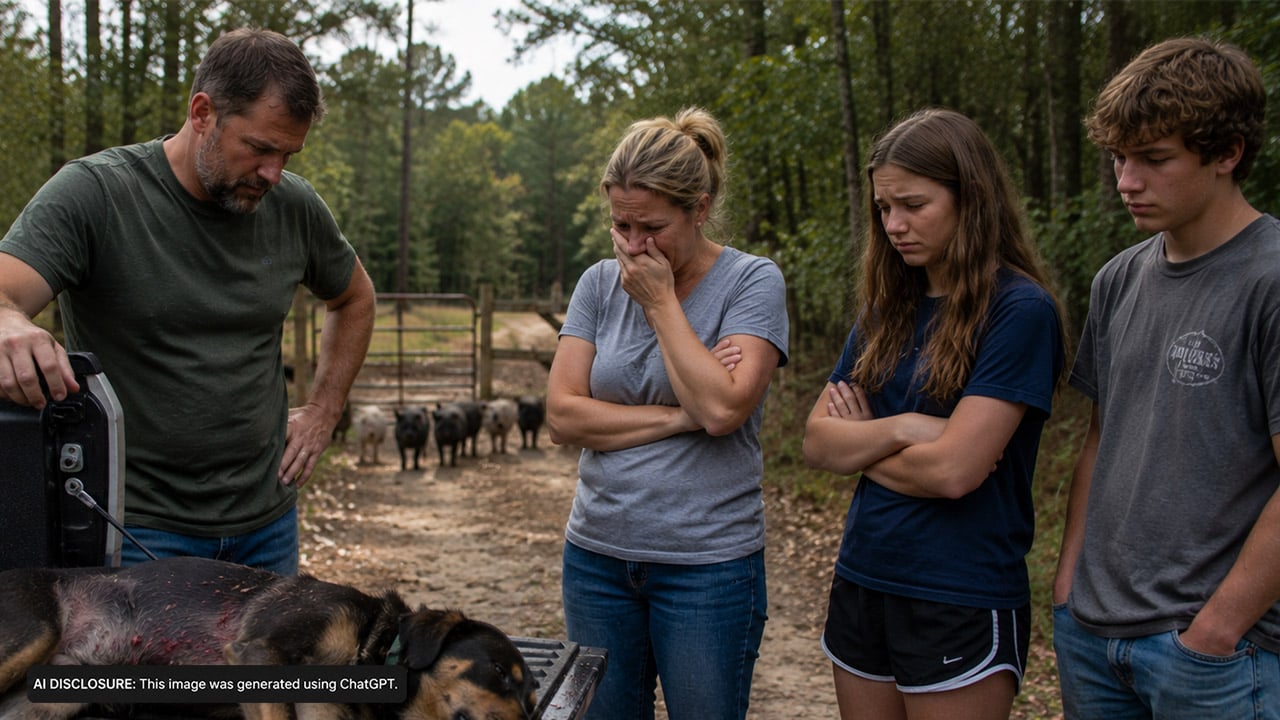
Eventually they found the dog. It had been shot twice with birdshot. The family took it to the vet for antibiotics, and while the dog was stressed, they said it was going to be okay.
Animal control cited the pig owners again, but the shooting went nowhere
After the response, the family said the pig owners were cited again and told they had 30 days to get rid of the pigs. If they didn’t, they’d have to go to court. That’s real movement, but it doesn’t erase the weeks or months of damage—or what happened to the dog.
On the shooting, the family said animal control and local law enforcement told them there was nothing they could do because there was no proof who shot the dog. That’s a hard pill to swallow, but it’s also a lesson for landowners: even when everyone “knows” what likely happened, proving who pulled the trigger is a different thing entirely.
And from an outdoorsman’s perspective, the detail that it was birdshot matters. Birdshot is often used as a “light” load, but at close range it can still seriously injure or kill a pet. It’s also the kind of thing people sometimes reach for when they’re trying to “run something off” without thinking through where those pellets go or what they hit.
The family shifted to cameras, civil claims, and keeping things on their side of the line
After the dog was found and treated, the family said they were most likely going to file a civil suit for compensation for the property damage. They also planned to ask the pig owners to pay to put up a fence in the woods unless the pigs were removed entirely, hoping that cost would motivate a permanent fix.
They also stated they intended to shoot at any pigs that came into their yard with a compound bow, and that they’d informed some local bowhunters that they were welcome to hunt pigs on their land and keep the meat—asking only for a few pork chops in return. That part reads like pure rural problem-solving, but it comes with a big asterisk: when pigs may be owned livestock and not feral hogs, it’s wise to be crystal clear on state and local rules, seasons (if applicable), and what “permission” looks like for anyone hunting your property.
What they already did right—whether they realized it or not—was document the problem. Trail cam and security cam footage can help establish patterns, timing, and damage. And in a civil dispute, that kind of paper trail (and photo/video trail) is often the difference between a complaint and a case.
What outdoorsmen tend to focus on in situations like this
When a neighbor’s animals are tearing things up, most landowners’ minds go to the same places: fences, liability, and the risk of a confrontation. The family’s experience shows how fast it can jump tracks. One moment you’re talking about garden damage; the next you’re talking about gunshots and a wounded dog.
The practical, boots-on-the-ground approach usually comes down to a few themes: keep documenting every incident, keep communication as official and calm as possible, and avoid taking matters into your own hands in a way that creates more problems than it solves. Letting authorities cite the suspected owner, pursuing compensation through civil channels, and improving barriers like fencing all tend to stand up better over time than a back-and-forth feud across a property line.
At the same time, the family’s story highlights an uncomfortable truth: you can do a lot “right” and still not get justice for what feels obvious. Without proof of who shot the dog, law enforcement said they couldn’t move forward on that piece.
Out in the country, neighbors’ animals can turn into your problem fast. This Georgia family dealt with repeated property damage, then watched the situation go from nuisance to dangerous when their dog chased the pigs and ended up peppered with birdshot. They may ultimately get relief through citations, court pressure, fencing, and civil claims—but the biggest takeaway is that once gunfire enters the picture, the priority has to be safety, documentation, and staying on the right side of the law while you push for a permanent fix.
Like The Avid Outdoorsman’s content? Be sure to follow us.
Here’s more from us: