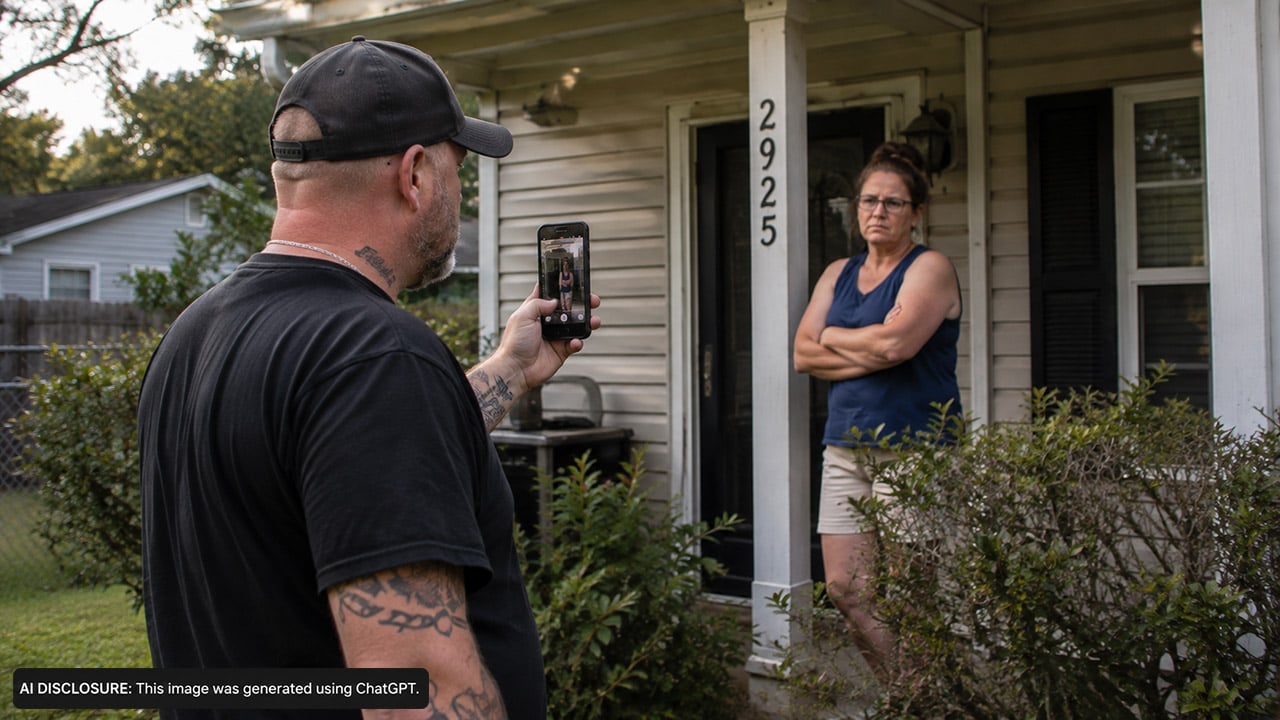
Photo credit: AI-generated image created using ChatGPT. Illustrative only
Most country folks understand the difference between a neighbor running cameras for security and a neighbor running cameras to send a message. One Georgia homeowner says that line got crossed hard—especially after a prior gun case—and now they’re dealing with daily filming aimed straight at their house and yard.
In the original post, the homeowner explained that the neighbor was convicted of pointing a gun at them and of felony possession of a firearm during the commission of a crime. Even with that history, the neighbor has allegedly continued a steady pattern of recording the homeowner’s property, and police have repeatedly told the homeowner it isn’t a crime if the filming is done from the neighbor’s own land.
A gun conviction didn’t end the conflict—it shifted it
According to the homeowner, the filming started after the gun incident but before the conviction. The neighbor reportedly turned existing security cameras to face the homeowner’s house and also stood in the yard using a phone to record them “daily.”
When the homeowner reported it, officers allegedly said the neighbor could have as many cameras as he wanted, and that there’s no reasonable expectation of privacy in a front yard. One officer saw the behavior as stalking and tried to get a warrant, but the judge denied it. That detail matters because it shows the homeowner wasn’t just blowing off steam—they’d already tried the normal law-enforcement route and hit a wall.
Probation, a violation, and then a treatment court program
The neighbor was convicted and placed on probation, but the homeowner says he violated probation by posting a photo of the homeowner’s house on Facebook with a hashtag related to the original case. From a practical standpoint, that’s the kind of thing that makes people in the country start checking locks twice and keeping their head on a swivel.
The homeowner says the neighbor is now in Veterans Treatment Court. They reported the situation through a victims advocate, and the program addressed one part of the harassment by ordering the neighbor to stop filing code enforcement complaints. But the homeowner says there’s currently no order from that program that prevents the neighbor from continuing to record them from his yard.
Twenty recording incidents in eleven days—and a buried camera
This is where the story shifts from “annoying neighbor” to “ongoing pattern.” The homeowner reviewed their own security footage and documented 20 separate instances of the neighbor filming their house and yard in the last 11 days. They said it happens every day, multiple times per day, and they stopped reviewing after 11 days—meaning the count isn’t complete.
They also discovered what they described as a buried security camera aimed at their property, visible through their own security cameras. A buried camera isn’t typical “I’m watching my own driveway” behavior. It suggests concealment and intent, even if it’s sitting on the neighbor’s side of the line.
Why law enforcement may be reluctant to act on “surveillance” alone
If you’ve ever dealt with property lines, trail cams, and nosy neighbors, you know the law often feels lopsided when the person doing the watching is standing on their own ground. In general terms, if someone is recording from a place they’re lawfully allowed to be, and they’re capturing what’s visible from that vantage point, it can be hard to turn that into a clean criminal charge—especially when it’s the front yard, driveway, or areas plainly visible from a public or neighboring viewpoint.
That appears to be the lane local police are staying in here. The homeowner says every report gets the same answer: the neighbor can record whatever he wants from his property. And even with an officer recognizing stalking behavior, the judge previously denied a warrant.
From an outdoorsman’s perspective, this is the frustrating part. We think in common sense: “This guy already threatened someone with a gun, now he’s fixated on them daily—how is that not a problem?” But the legal system often demands very specific boxes be checked: threats, contact, trespass, prohibited communications, or court orders that get violated.
Code enforcement complaints, false names, and building a paper trail
The homeowner also says they learned, through a contact familiar with the department, that the neighbor filed at least four fraudulent code enforcement complaints under false names. Whether or not that’s ultimately proven, it fits the pattern the homeowner is describing: not just watching, but using systems—social media, complaints, cameras—to apply pressure.
The good news, if there is any, is that the homeowner is doing the one thing that matters in these drawn-out neighbor messes: documenting everything. They’ve got extensive video evidence from their own security system, dates and counts of recording incidents, and a history that includes conviction, probation, and an alleged probation violation. In rural disputes, solid documentation is what separates a “he said, she said” from something a judge or prosecutor can actually act on.
options a rural homeowner typically looks at next
The homeowner asked what legal options they have and whether they should push for a protective order or go back to the original prosecutor. Those are the same forks in the road most folks hit when law enforcement says, “It’s not illegal,” but your gut says, “This isn’t safe.”
One common move in situations like this is pursuing a protective/restraining order based on a course of conduct—especially when there’s a prior violent or firearm-related conviction between the same two parties. Another is looping the original prosecutor back in, because prosecutors often have a better handle on whether probation conditions, victim protections, or prior case facts can support additional restrictions. The homeowner has already engaged the Veterans Treatment Court through a victims advocate, and that channel may be the most direct route to ask for tighter conditions—because treatment court participants are often under program rules that can be stricter than what patrol officers can enforce on the street.
Beyond court action, most experienced landowners also think about the “don’t feed it” side: tightening up routines, improving lighting and camera coverage, and avoiding direct confrontation. Not because you’re backing down, but because a person who’s already been convicted of pointing a gun and is still fixated on you is not the person to meet at the fence line.
The homeowner’s situation is a reminder that being “legal” and being “normal” aren’t the same thing. Sometimes the only way to stop behavior that lives in that gray area is to stack clean documentation, work through the court channel that already has leverage, and keep your own home security squared away while the system catches up.
Like The Avid Outdoorsman’s content? Subscribe to our newsletter so you never miss an article.
Here’s more from us: