Photo credit: AI-generated image created using ChatGPT. Illustrative only
Life in the country usually comes with an unspoken agreement: folks mind their business, you keep things safe, and everybody gets along just fine. But for one Tennessee family, that quiet rhythm got replaced with flashing lights and repeated calls to law enforcement after new neighbors moved in.
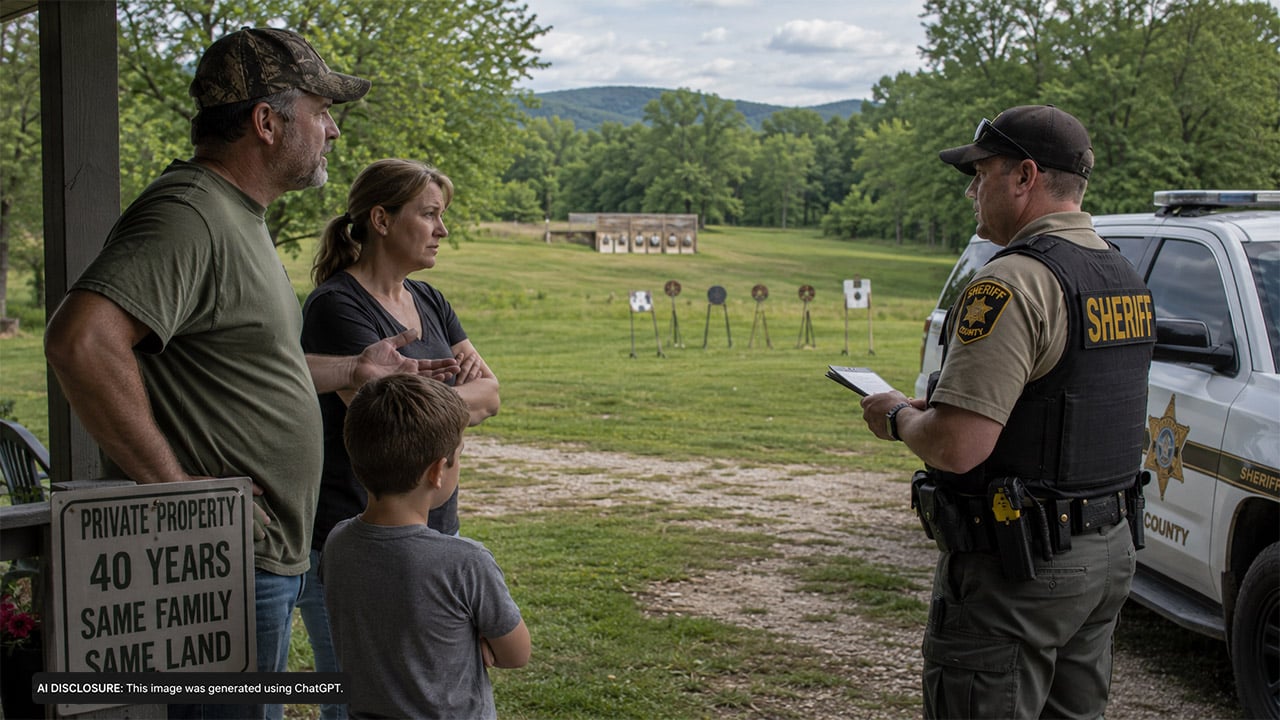
In the original post, the family says they’ve owned their land for 40 years and never had problems with nearby homeowners. Now they’re dealing with police being called three days straight—first over gunfire from target practice, then over “suspicious activity,” and most recently over an accusation that the head of household crossed onto the neighbors’ property and cut a line after the street lost power.
Forty years of normal rural living, then the calls started
According to the family, target practice on their own property wasn’t new. They describe being out in the country, and they note that other neighbors never complained about noise—some even joined them before. That’s a pretty common setup in rural Tennessee: if you’ve got the land, a safe backstop, and you’re doing it responsibly, shooting on your own place is just part of life.
The problem wasn’t the shooting itself so much as what happened after. The family says the new neighbors began calling law enforcement repeatedly, including three days in a row. Once that starts, even when you’re doing everything right, it changes how you feel just stepping outside.
When legal gunfire turns into a “problem,” the stress piles up fast
Plenty of outdoorsmen have dealt with this kind of friction: someone moves from town, hears gunshots, and assumes the worst. Even if the shots are legal and safe, the caller may be treating it like an emergency every time. The family’s post suggests that’s exactly how it’s going—one complaint about gunshots after target practice, followed by repeated reports of “suspicious activity.”
That’s the part that wears on you. It’s not just one misunderstanding. It’s the feeling that normal chores—walking your property, checking fences, loading gear—might trigger another call and another cruiser rolling up the driveway.
The accusation shifted from noise to alleged wrongdoing
Things escalated beyond “I don’t like gunshots.” The family says the neighbors accused the head of household of coming onto their property and cutting the line after the street lost power. That’s a serious claim, because it’s no longer about annoyance—it’s implying criminal conduct and trespass.
And in rural areas, property-line issues can get messy in a hurry. People make assumptions about where the boundary sits. They confuse utility easements with private property. Sometimes they’re simply looking for a reason to build a paper trail against you. Whatever the motive, an accusation like that can put a landowner on the defensive even when they’ve done nothing wrong.
Real-world consequences: you start living like you’re under a spotlight
The family sums it up in a line that’ll hit home for anyone who’s ever dealt with a hostile neighbor: they can’t even be outside without worrying about police pulling up. That’s not just inconvenience. It’s stress, distraction, and the constant concern that a normal day could get twisted into something else.
It can also create safety concerns. Law enforcement responding to repeated calls doesn’t always know the history when they’re dispatched. If an officer arrives expecting a dangerous situation because of the way a complaint is described, it raises the temperature before anybody even speaks. Even when everything stays calm, that repeated interaction is a burden on the family and on local resources.
What practical options a rural landowner typically considers
The family asked if there’s any legal recourse. The post itself doesn’t include outcomes or advice received, but from a boots-on-the-ground landowner perspective, there are a few practical steps people commonly look at when repeated nuisance calls start happening.
First is documentation. If the sheriff’s office is showing up over and over, you want your own notes: dates, times, what the deputy said the call was about, and what you were actually doing. If you’re target shooting, it also helps to have your safety practices squared away—clear direction of fire, a reliable backstop, and shooting only when it makes sense for your property and surroundings.
Second is communication—careful, calm, and preferably with a witness or through a neutral channel. Some neighbor disputes can be solved with a straightforward conversation about when you shoot and how you keep it safe. But once someone is making accusations like cutting power lines, a lot of folks decide it’s smarter to keep distance and let everything go through official channels.
Third is to ask law enforcement what the appropriate next step is for repeated unfounded complaints. In many places, agencies can note the address and the pattern of calls. Nobody wants to discourage legitimate reporting, but repeated false or harassing calls are a real issue, and it’s reasonable for a homeowner to ask what can be done to stop a neighbor from using 911 or non-emergency lines as a weapon.
Staying safe and squared away while the situation plays out
If you’re the one being called on, the goal is simple: keep your behavior so clean and consistent that there’s nothing for a complaint to stick to. That doesn’t mean you stop living your life on your own land. It means you tighten up anything that could be misunderstood.
When it comes to shooting, that’s basics—know your local rules, don’t shoot across roads or toward occupied areas, and be mindful of times and conditions. It’s also smart to keep firearms handled and stored responsibly, especially if you know law enforcement may arrive unexpectedly. Nobody wants a misunderstanding at the driveway because a neighbor decided today was the day to make another call.
And for property disputes, it pays to know your lines. You don’t have to turn into a surveyor overnight, but having a clear understanding of boundaries and access points can keep you from accidentally stepping into the middle of someone else’s narrative.
For rural families, owning a piece of ground for decades usually means you’ve already earned your place there. When new neighbors show up and start treating normal country living like a crime scene, it’s frustrating—but the best path is steady, documented, and calm. In the long run, the truth holds up better than noise, and a landowner who keeps things safe and squared away is in the best position to shut down repeat allegations.
Like The Avid Outdoorsman’s content? Be sure to follow us.
Here’s more from us: