Photo credit: AI-generated image created using ChatGPT. Illustrative only
Most folks who live out in the country understand the unspoken rules: you handle your own problems, you respect your neighbors, and you don’t take reckless shots—especially anywhere near somebody’s home. That’s why this Georgia neighborhood story is the kind that sticks with you, because it isn’t about a clean, honest “had to do it” moment. It’s about a family pet left dead in a front yard, and a shooter whose explanation kept shifting.
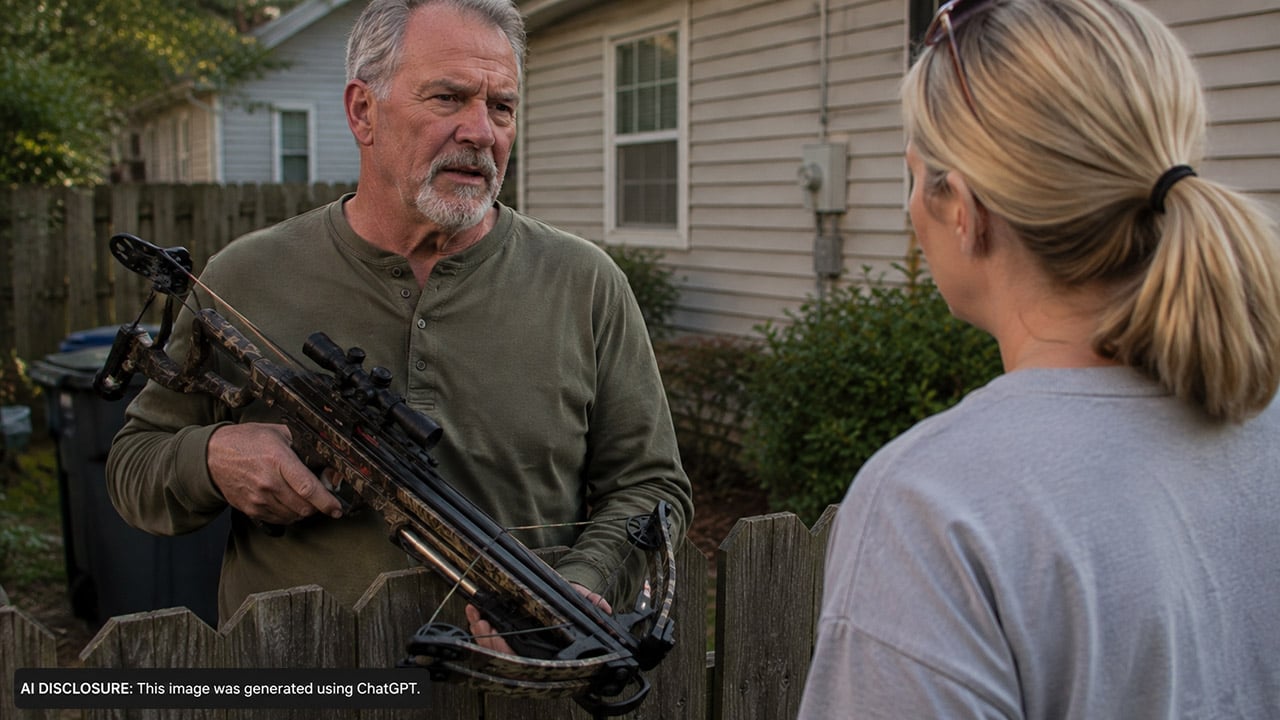
The account comes from the original post, where a third-party neighbor laid out what happened between two nearby households: one family that lost a cat (N1), and another family (N2) whose father allegedly shot it with a hunting crossbow.
A cat found in a front yard with a bolt in it
According to the write-up, the cat was found in N1’s front yard, impaled with a hunting bolt. That detail matters, because it’s not a “caught in the act in the chicken yard” kind of scene. A front yard is a place where kids, mail carriers, and neighbors are supposed to feel safe.
And from an outdoorsman’s perspective, the location raises hard questions. If the cat was shot elsewhere and made it home, that means the animal suffered. If it was shot near the house, that means somebody loosed a bolt in a residential area. Either way, it’s not a normal, neighborly outcome.
The shooter’s explanations didn’t add up
The family dealing with the loss wasn’t just grieving—they were trying to make sense of a story that kept changing. One version was that the cat was “going after our chickens.” But the person sharing the story said the cat was a well-fed house cat, and also claimed N2 didn’t even have chickens at the time and only got them later.
Another version was “I thought it was a raccoon.” Anybody who spends time outdoors knows you can misidentify an animal in bad light, but that explanation still lands poorly when the end result is a neighbor’s pet dead with a broadhead-tipped bolt in it. Add in the alleged chicken claim, and it sounds less like an honest mistake and more like someone trying on different reasons to see which one sticks.
Bragging early, no apology later
One of the most telling details in the account is that the father of N2 allegedly bragged about shooting the cat to N1’s mother early on. That’s a far cry from, “I’m sick about this, I made a mistake, how do I make it right?”
Even after the family was devastated, the poster said the shooter never tried apologizing or making amends and acted like it wasn’t a big deal. In rural communities, relationships matter. When someone won’t own a bad decision—especially one involving a weapon—people don’t just get mad. They get wary.
A year of paperwork, evidence, and still no action
N1’s family, according to the post, spent roughly a year gathering what they could: evidence collection, an autopsy, “various other things,” all with the goal of building a case strong enough to hold the shooter accountable. That’s not casual effort. That’s a family trying to turn grief into something that at least resembles justice.
But after all that, they were reportedly told there wasn’t enough evidence to do anything about it. The writer also noted N2’s family is extremely wealthy and suggested that fighting a long legal battle without “damning evidence” would be difficult.
From a practical standpoint, that’s the gut punch in stories like this. Folks assume that if something is obvious in the driveway, it should be obvious in a report. In reality, proving exactly who fired the shot, from where, under what circumstances, and with what intent is often the whole ballgame.
Why this hits a nerve for hunters and landowners
Most hunters I know take weapon use seriously because they’ve seen what carelessness can do. A crossbow isn’t a toy, and a hunting setup is designed to kill. In the wrong hands—or even in the right hands with a bad attitude—those tools become a neighborhood safety problem fast.
This is also where the “chickens” angle matters. Lots of rural folks keep birds. Predators happen. But the responsible play is prevention first: secure coops, good fencing, locking birds up at night, motion lights, maybe a livestock guardian dog where legal and appropriate. Lethal force is a last resort, and even then you’d better be sure of target and backdrop.
If the story as told is accurate, this wasn’t a controlled, necessary dispatch of a proven predator in the act. It was a pet killed, found in a front yard, followed by a rotating set of explanations.
The uncomfortable part: what options are left when the system stalls
The person who shared the story wasn’t even the cat’s owner, and you can feel the frustration: watching a neighboring family stay hurt while the alleged shooter walks around like nothing happened. They also mentioned concerns about the shooter’s past behavior—claims of having shot dogs before and multiple arrests for drunk driving with kids in the car—though those points were presented as background rather than something tied to this specific incident.
Practically speaking, when a case goes nowhere, families usually pivot to the things they can control. That often looks like documenting everything going forward, tightening up outdoor pet habits, and improving home security. In a tense neighbor situation, cameras—especially ones that cover driveways, yards, and property lines—can change the entire conversation the next time something happens.
It also means being smart about personal safety. This is not the kind of scenario where marching over and trying to “settle it” in the yard ends well. When weapons, tempers, and property lines mix, the best move is often distance, documentation, and letting whatever official channels are available do their job—even if it takes time and even if the results aren’t satisfying.
At the end of the day, this is one of those ugly reminders that the outdoorsman code—know your target, respect life, respect your neighbors—only works when people choose to live by it. When somebody doesn’t, the damage isn’t just a dead pet. It’s the trust in a community, and the sense that your own front yard is still your safe place.
Like The Avid Outdoorsman’s content? Subscribe to our newsletter so you never miss an article.
Here’s more from us: