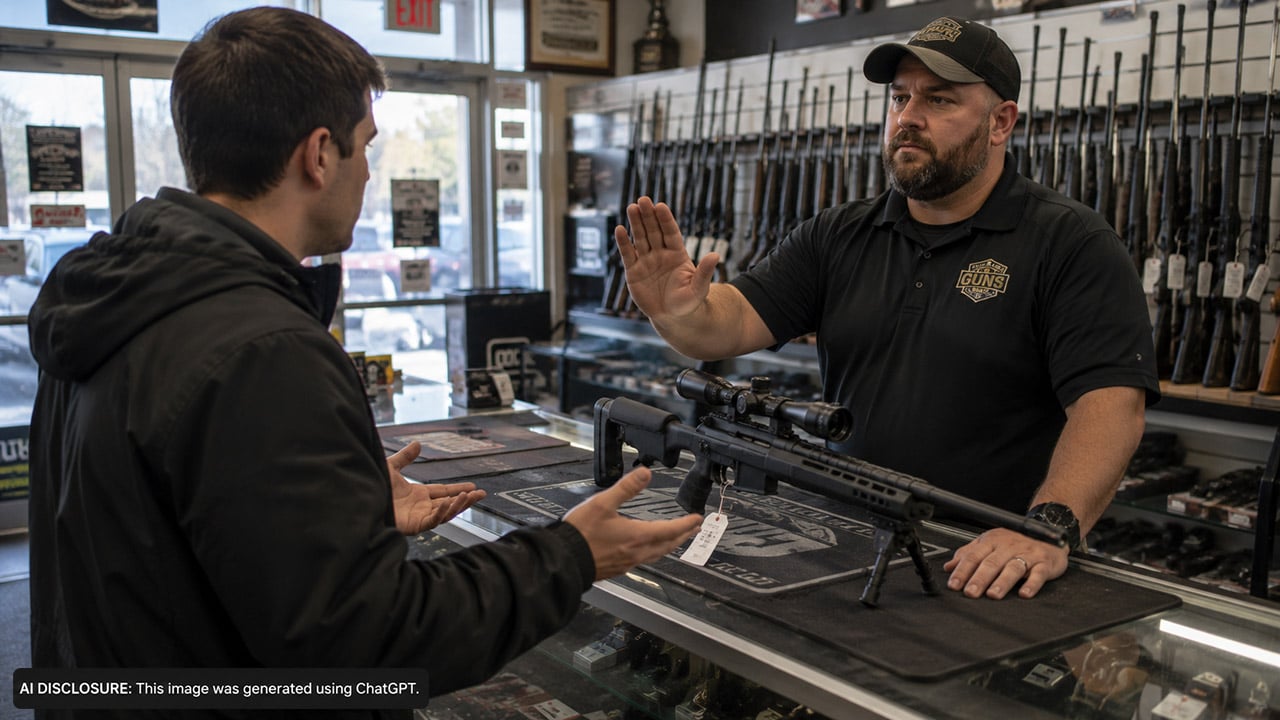
Photo credit: AI-generated image created using ChatGPT. Illustrative only
A first-time stop at a new gun shop should be pretty straightforward: handle a few rifles, pick what you like, fill out the paperwork, and head home with something you can trust for the range or the woods. But one customer says his trip took a sharp turn right at the finish line—after he’d already passed a background check and was moments from paying for a .22 LR rifle.
In the original post, the customer describes being blocked from buying the rifle on the shop’s opening day because the manager suspected a straw purchase. Then, according to the account, the same manager immediately offered to continue the transaction for ammunition—ultimately selling him about 2,500 rounds across .22 LR, 5.56, and 9mm.
How the sale unraveled at the register
Based on the customer’s description, the purchase wasn’t stopped at the counter because of a failed NICS check or an incomplete 4473. He says he passed the background check and went through “the whole process besides paying.” That’s the part that’ll make most gun owners pause, because it suggests the shop had already decided he was legally allowed to buy a firearm—until someone higher up stepped in.
The customer says the manager intervened right before payment and told him they couldn’t finish the rifle sale due to suspicion he was buying for someone else. No mention is made of another person being present, whispering answers, hovering over the gun choice, or anything like that—just that the manager believed it looked like a straw purchase.
The strangest part: ammo was still on the table
After shutting down the rifle sale, the manager allegedly asked if the customer still wanted the ammo. The customer says he was then sold roughly 2,500 rounds of mixed calibers: .22 LR, 5.56, and 9mm.
That’s where the logic starts to wobble. If a store truly believes a customer is attempting a straw purchase, it’s common sense to slow everything down, not just the serialized item. Ammo may not require the same federal paperwork in many places, but it’s still a component for shooting, and it’s still a product that responsible shops watch carefully—especially in big quantities.
What “straw purchase” suspicion usually looks like in real life
Gun shops are under pressure—sometimes heavy pressure—to spot and refuse straw purchases. A straw purchase is when someone buys a firearm for another person who can’t or won’t buy it themselves, and it’s one of the fastest ways a dealer can end up in serious trouble.
In the day-to-day world, the red flags stores tend to look for aren’t mystical. It’s usually things like a second person directing the purchase (“Get the Glock 19, not the 17”), someone else paying, the buyer admitting it’s “for my buddy,” or a buyer who can’t answer basic questions about what they’re purchasing because they didn’t choose it. The customer in this situation says the manager gave him three different reasons for the suspicion, and he felt all of them “made no sense.”
That matters because consistency is part of credibility. If an employee says, “We can’t proceed because of X,” and then it becomes X, Y, and Z, it starts to look less like a clear policy decision and more like somebody backpedaling to justify a gut feeling.
Why this matters to hunters and range folks who just want to buy a .22
A .22 LR rifle is about as normal as it gets for a lot of outdoorsmen. It’s a small-game tool, a farm rifle, a trainer, and a way to get kids on steel without burning through centerfire money. When a shop refuses that sale after a clean background check, it puts the buyer in a bind—especially if it’s a local store you’d like to support.
There’s also the practical side: opening day inventory can be limited, and a customer who’s already invested time in paperwork and waiting may have passed up other options. Getting told “no” at the last second wastes time and can sour a relationship with a shop that’s supposed to be part of the local shooting community.
But the ammo sale changes the tone. Many shooters will look at that and think, “If you’re confident enough to sell me cases of ammo, how confident are you really that I’m doing something illegal?” It reads like a shop trying to play both sides—avoiding the higher-risk firearm transfer while still ringing up a big ticket.
The customer’s big question: is it legal to sell ammo if you suspect a straw buy?
The customer makes a fair point: selling ammunition to a suspected straw purchaser isn’t the same as transferring a firearm. In many states, you can walk in and buy ammo with no background check and no federal form. But “not the same” doesn’t automatically equal “smart,” especially from a business that just claimed the customer raised a serious trafficking concern.
From a common-sense standpoint, if a store genuinely thinks someone is trying to buy for a prohibited person, the clean move is to stop the whole transaction and document the refusal. Even if ammo sales don’t carry the same federal paperwork in that location, a shop that prides itself on doing things right will typically choose consistency over convenience.
Just as important: customers should remember that a dealer can refuse a sale for any lawful reason. You can be 100% legal and still get a “no” if the shop thinks something is off. The flip side is that dealers earn trust by being consistent and professional about how they apply those judgments.
What other gun owners tend to focus on in situations like this
No additional comments were included in the source material, but experienced gun owners usually lock onto a few practical points when they hear a story like this. First, they ask what the alleged “reasons” were—because real red flags are typically specific, and vague explanations don’t help anyone learn or correct a misunderstanding.
Second, they focus on the timing. If the manager truly believed it was a straw purchase, why wait until the very end—after the background check and paperwork—to stop it? If it was something a clerk noticed earlier, that should have been addressed before a customer invested that much time.
Third, they’ll talk about the uneven risk tolerance. Refusing the gun but selling a pile of ammo looks inconsistent to a lot of folks, and inconsistency is exactly what makes customers wonder whether a shop is acting out of caution or out of impulse.
In the real world, the best gun counters are calm, predictable, and clear. If they refuse a sale, they don’t spin up a handful of shifting explanations. They simply say they’re not comfortable with the transaction and leave it at that.
For most outdoorsmen, the lesson is simple: pick a shop that treats you like a neighbor, not a problem—while still taking the law seriously. If a store shuts down a clean rifle purchase at the last moment but is happy to sell cases of ammo right after, it’s worth thinking hard about whether that’s the kind of place you want to do business with when you need help with something that actually matters, like warranty work, a hunting setup, or a time-sensitive transfer.
Like The Avid Outdoorsman’s content? Subscribe to our newsletter so you never miss an article.
Here’s more from us: