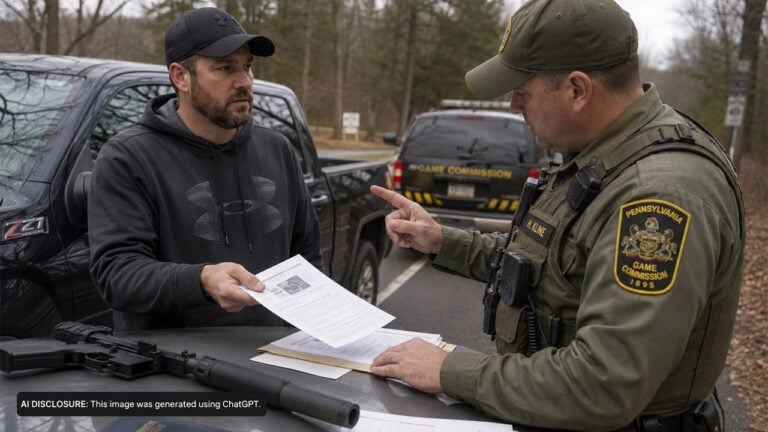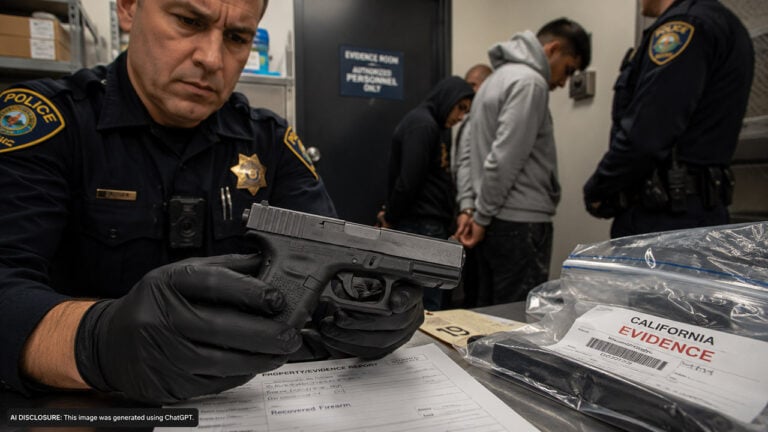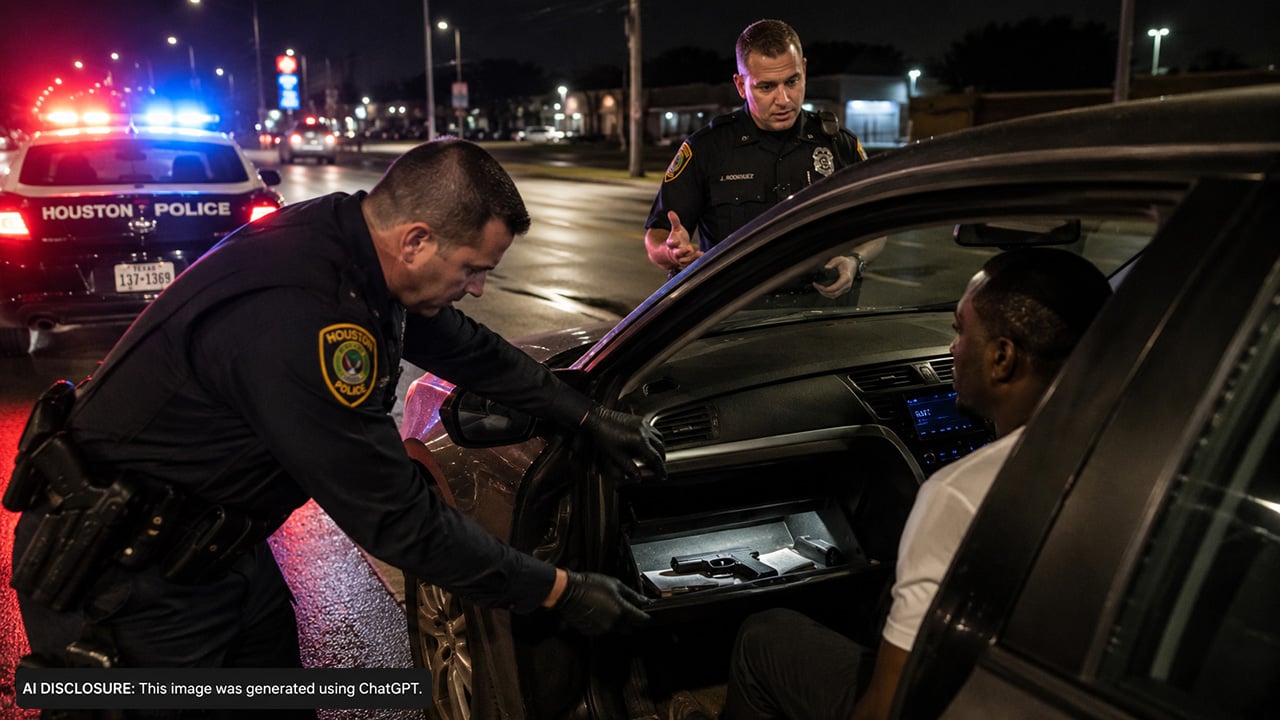
Photo credit: AI-generated image created using ChatGPT. Illustrative only
A traffic stop can turn into a life-changing mess fast when a firearm enters the picture—especially if you’ve got a prior felony on your record. In a Houston-area legal Q&A, one driver said he was pulled over, asked if there was a gun in the vehicle, and answered no. He also said he didn’t have a key to the glove box when police asked for it.
According to the source post, officers opened a locked glove box anyway, found a pistol inside, and then charged the driver with felon in possession of a firearm. The driver claimed he didn’t know the gun was in there, but once the pistol was on the hood, the situation was already past the point of “explaining it away.”
How a locked glove box became the center of the stop
The driver’s version is simple: the glove box was locked, he didn’t have the key, and he says he didn’t know a pistol was inside. That’s the kind of scenario that makes a lot of outdoorsmen shake their head because it sounds like a borrowed truck problem, a recently bought used vehicle problem, or a “somebody else stashed it” problem.
But from street level, a locked compartment in a vehicle is still part of the vehicle. If law enforcement gets into it and finds a gun, the next question becomes who “possessed” it and whether that person is legally allowed to have it. If you’ve got a felony conviction, the stakes jump from inconvenient to serious in about two seconds.
The hard truth about “I didn’t know it was there”
Outdoors folks understand the difference between actual ownership and simple presence. A rifle in a buddy’s case isn’t “yours” just because you’re standing near it at deer camp. But vehicles don’t always work like camp rules, and legal terms like “possession” can be broader than what most people mean in normal conversation.
The driver in the post says he told officers there was no gun. If he truly didn’t know, that answer makes sense from his point of view. The problem is that once the gun is found in a compartment associated with the driver’s reach and control—like a glove box—law enforcement may treat that as possession anyway, and then it becomes something you fight out in court, not on the shoulder of the road.
For anyone who hunts or travels with guns, this is the nightmare scenario: a firearm you didn’t intend to have, stored in a place you didn’t open, ends up being treated like it’s yours the moment it’s discovered.
Why the search matters as much as the gun
One of the first things that jumped out of the attorney response was what wasn’t said: why the driver was pulled over and why the car was searched. That’s not a minor detail. In cases like this, the legality of the search and the steps leading up to it can be just as important as the firearm itself.
The driver said police asked about a gun, asked for the glove box key, and then went into the locked glove box and found the pistol. Whether officers had legal grounds to open it is the kind of issue that can make or break a case, and it’s also the kind of issue where tiny details—what was said, what was observed, what was consented to—matter a whole lot.
That’s why trying to “DIY” your way through something like this is so risky. Once charges like felon in possession are in play, you’re not dealing with a simple citation or an argument you can win with common sense.
The only advice given: get a lawyer and start there
The attorney who answered didn’t wander into hypotheticals or try to solve it in a comment box. She pointed out the missing pieces—why the stop happened and why the search happened—and told the driver to retain a lawyer.
That’s not a brush-off. It’s a recognition that this kind of charge can carry serious consequences, and the facts needed to defend it aren’t going to fit in a short online question. A lawyer can dig into the reason for the stop, the reason for the search, what authority was used to open a locked compartment, and how the state is trying to prove possession.
If you’re a gun owner, it’s also a reminder that “I don’t have the key” isn’t a protective shield by itself. The legal fight often isn’t about whether you had a key in your pocket; it’s about what the state can prove you had control over, and whether law enforcement followed the rules getting to the evidence.
This is where the outdoorsman angle gets real. A lot of us swap trucks with family, borrow a rig for a weekend, or buy a used vehicle and don’t think twice about the glove box, console, or under-seat storage. But if you’re legally prohibited from possessing firearms, you cannot afford to assume “it’s probably empty.” One forgotten pistol can become a felony charge.
Even if you’re not prohibited, loose guns in vehicles are bad business. They get stolen, they get forgotten, and they turn routine encounters into high-stress situations. The safer, smarter move is to know what’s in your vehicle before you roll, keep firearms secured in a lawful way for your area, and avoid letting other people use your vehicle as a storage locker for their carry gun.
And if you’re the one lending a vehicle, be the adult about it. Don’t leave a firearm behind in a glove box—locked or not—and assume the next driver will “figure it out.” That’s how good people end up in a bad spot, and it’s how guns end up in the wrong hands when vehicles get broken into.
In the end, this Houston driver’s story is a reminder that a traffic stop doesn’t have to be dramatic to turn serious. A locked glove box, a pistol, and the wrong legal status can stack up fast. When that happens, the smartest step isn’t arguing on the roadside or hoping an online answer fixes it—it’s getting proper legal help and letting a professional sort out the facts.
Like The Avid Outdoorsman’s content? Subscribe to our newsletter so you never miss an article.
Here’s more from us: