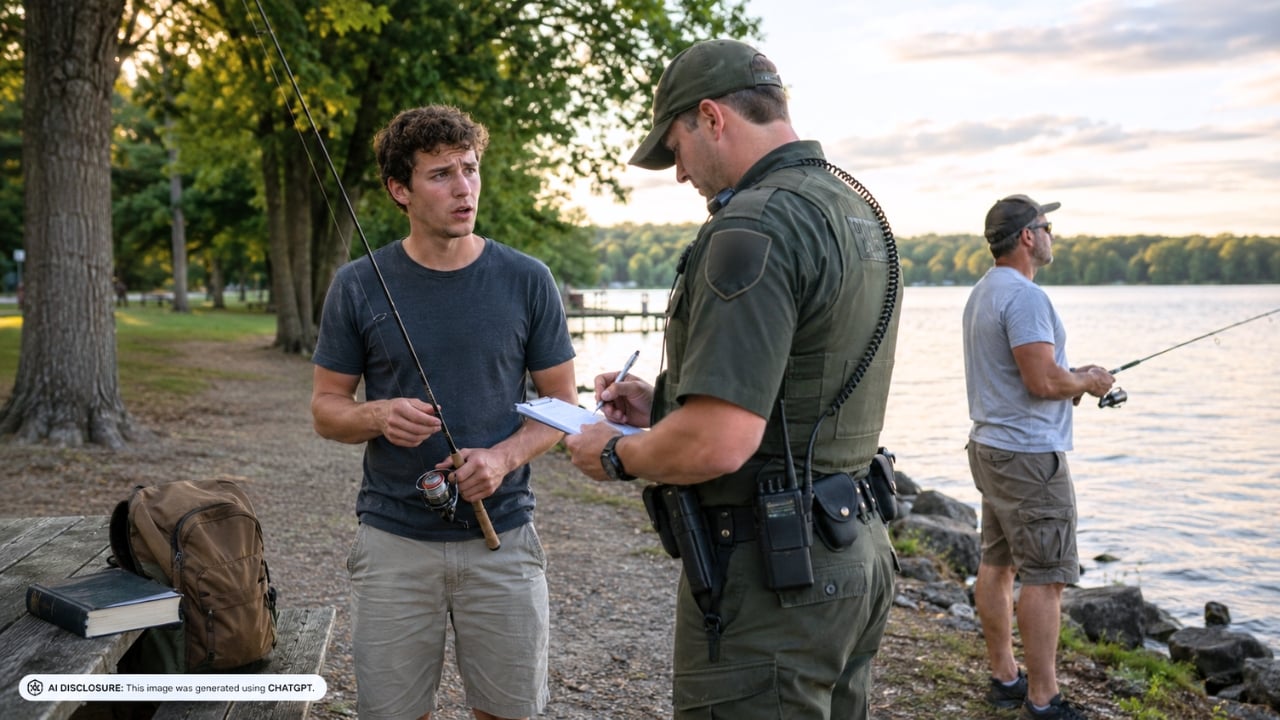
Photo credit: AI-generated image created using ChatGPT. Illustrative only
A lot of outdoor trouble starts the same way: “I’m not even really doing it.” One Michigan worker tagged along while a coworker fished after the day wrapped up, planning to sit back with a book and kill time. A couple hours later, boredom won, he picked up a rod, made a few casual casts—and that’s when a DNR officer showed up.
In the original post, the man admits he isn’t much of an angler and says he “stupidly decided to make a few casts” while visiting a local park. The officer cited him for fishing without a license, and the word “misdemeanor” printed on the ticket is what really set the hook. He’d never been in trouble beyond a traffic ticket and wanted to know what kind of mess he’d stepped into.
Boredom turned “just hanging out” into a ticket
If you’ve spent any time around lakes and rivers, you’ve seen this exact setup. One guy fishes, the other guy watches, talks, maybe snaps a photo, maybe helps net a fish. Most of the time, nobody thinks twice about it—until the non-licensed buddy decides to “just try a couple casts.”
That’s the moment the situation changes. In Michigan, “fishing” isn’t defined by whether you keep a fish or whether you’re any good at it. If you’re casting, you’re participating. And when you’re participating, you’re expected to be licensed just like the guy who planned to fish all along.
Game wardens don’t need much to call it “fishing”
Outdoorsmen sometimes talk like there’s a gray area: “I wasn’t targeting anything,” or “I was just practicing,” or “I didn’t even have bait on.” In the real world, the line is usually simpler than people want it to be. If you’re actively trying to catch fish—casting, jigging, trolling, whatever—an officer can treat that as fishing.
That’s why this story feels like it happened so fast. The poster didn’t describe a long encounter or an argument. It was just a few casts, then a DNR officer arriving, then a citation. A lot of enforcement contacts go exactly that way when you’re in a public park: the officer sees a rod in your hands, checks licenses, and sorts it out right there.
That “misdemeanor” word scares people for a reason
The man’s biggest concern wasn’t the embarrassment of getting popped or even the fine. It was seeing “misdemeanor” on the citation and immediately wondering if he’d just damaged his future—jobs, background checks, the whole thing.
That reaction is normal. In everyday language, “misdemeanor” sounds like you’re one step away from being labeled a criminal. In the fish-and-game world, though, plenty of basic violations are classified that way on paper even when they’re handled like a straightforward ticket. The key detail is that a citation is not the same thing as being hauled off in cuffs, and “misdemeanor” on a form doesn’t automatically mean you’ll have a record that follows you forever in the way people imagine.
Still, it’s not something to ignore. A court date, a failure-to-appear issue, or letting paperwork slide can turn a minor mistake into a real headache. The poster seemed to understand that part and was looking for a clean, responsible way to put it behind him.
What the practical consequences usually look like
From the details provided, this was a simple “no license” situation: he was in Michigan, fishing in a local park, and didn’t have the license that his coworker presumably had. He didn’t claim the officer was out of line. He owned the mistake and just wanted to know what comes next.
In situations like this, the usual consequences are financial and administrative. You can expect some combination of a fine and costs, and you may have to appear in court or handle it through the local court system depending on how the citation is written. The big practical lesson is that the state treats fishing licenses like a permission slip you need before the first cast, not after you decide you’re having fun.
The other consequence is the one nobody talks about until it happens: time. Tickets take time. Phone calls, maybe a court appearance, paperwork, waiting for the system to do its thing. That’s a lot to swallow over what started as killing time after work.
The best way to avoid this is to treat a rod like a loaded tag
If you’re a hunter, you already understand the mindset. You don’t carry a deer gun into the woods and tell yourself you’re “just going for a walk,” because you know how it looks and how it’s interpreted. Fishing is the same way. If you’re holding the rod and making casts, you should already be legal.
There are a few common scenarios where people get burned: borrowing a buddy’s setup “just for a minute,” taking a kid or coworker along and letting them try it, or assuming a spouse’s license covers both people. Most of those mistakes come from not thinking of a license as tied to the individual. In nearly every place anglers travel, the license follows the person, not the gear and not the group.
The cheapest move is to buy the license before you head to the water. Even if you’re “not really into fishing,” the minute you start participating, you’ve crossed into the same rules as everyone else on the bank.
And if you truly want to just hang out? Do it. Bring the book, take photos, help carry gear, even watch the bobber. Just don’t make the casts.
When it’s worth getting help—and when it’s not
The poster asked the questions most people would ask: Will employers see it? How much is this going to cost? Do I need a lawyer? Without adding facts that aren’t in the account, the most grounded advice is simple: read the citation carefully and treat it like an official court document, because that’s what it is.
If the ticket requires a court appearance, if you’re unsure how to plead, or if you have a job where any offense matters (certain professional licenses, security work, jobs with strict background requirements), it may be worth talking to a local attorney for peace of mind. On the other hand, plenty of folks handle straightforward fish-and-game citations by following the instructions, showing up if required, paying what’s owed, and moving on—especially when there’s no dispute about what happened.
Either way, the worst move is pretending it will disappear. Outdoors citations have a way of becoming bigger problems when someone misses deadlines or ignores instructions.
This story is a good reminder that conservation officers aren’t just out there checking coolers full of fish. They’re looking at participation and compliance. If you’re tempted to “just make a few casts,” take the extra two minutes to get legal first—or keep the rod in the truck and stick with the book.
Like The Avid Outdoorsman’s content? Be sure to follow us.
Here’s more from us: