Photo credit: AI-generated image created using ChatGPT. Illustrative only
Most hunters will never lay hands on a true “trophy-class” buck, which is exactly why the rules around seasons, bag limits, and legal shooting hours matter. When somebody decides those rules are for everyone else, it doesn’t just short other hunters—it chips away at the resource and the trust that keeps hunting on solid footing.
That’s the backdrop for a nearly two-year case out of southeast Pennsylvania that ended with dozens of charges and a pile of seized antlers. The Pennsylvania Game Commission laid out the details in the original post, and it reads like the kind of long-running poaching operation that takes patience—and good leads—to unravel.
A tip turned into a long investigation
The Game Commission said the case started with a tip about the unlawful taking of large whitetail bucks over a span of years. Anyone who’s spent time around deer camps knows tips don’t usually come in with perfectly organized evidence—just enough smoke to make wardens start looking for fire.
From there, the agency ran what it described as a nearly two-year investigation focused on alleged poaching activity in Chester and Delaware counties. That timeframe matters. Cases like this don’t get built on one photo or one rumor; they get built by connecting dots, season after season.
Who is charged, and how serious are the counts?
Three Chester County residents—a father and his two adult sons—were charged: Carroll Nelson IV, 44, of Downingtown; Carl Nelson III, 70, of West Chester; and Mark Nelson, 40, of West Chester.
The charge totals are significant on their own: Carroll Nelson IV faces 11 charges, Carl Nelson III faces 35 charges, and Mark Nelson faces 25 charges—71 charges altogether. The Game Commission also noted the potential severity: both Carroll Nelson IV and Carl Nelson III face charges including a first-degree misdemeanor punishable by up to five years in prison and a $10,000 fine, while Mark Nelson faces charges including a third-degree felony punishable by up to seven years in prison and a $15,000 fine.
How the alleged poaching happened: out of season, at night, and over the limit
What’s laid out in the filing isn’t a “gray area” dispute over a boundary line or a misunderstanding of tag rules. The Game Commission said the charges involve deer allegedly taken out of season, at night, and/or over the limit of one buck per hunter per year.
Those are the big three for a reason. Out-of-season kills undercut wildlife management. Night hunting for deer raises safety concerns in a hurry—especially in mixed farmland/suburban edges like parts of southeastern PA. And blowing past the buck limit is the kind of thing that turns a legal hunt into a numbers game.
Wardens seized nearly 50 mounts and antler sets
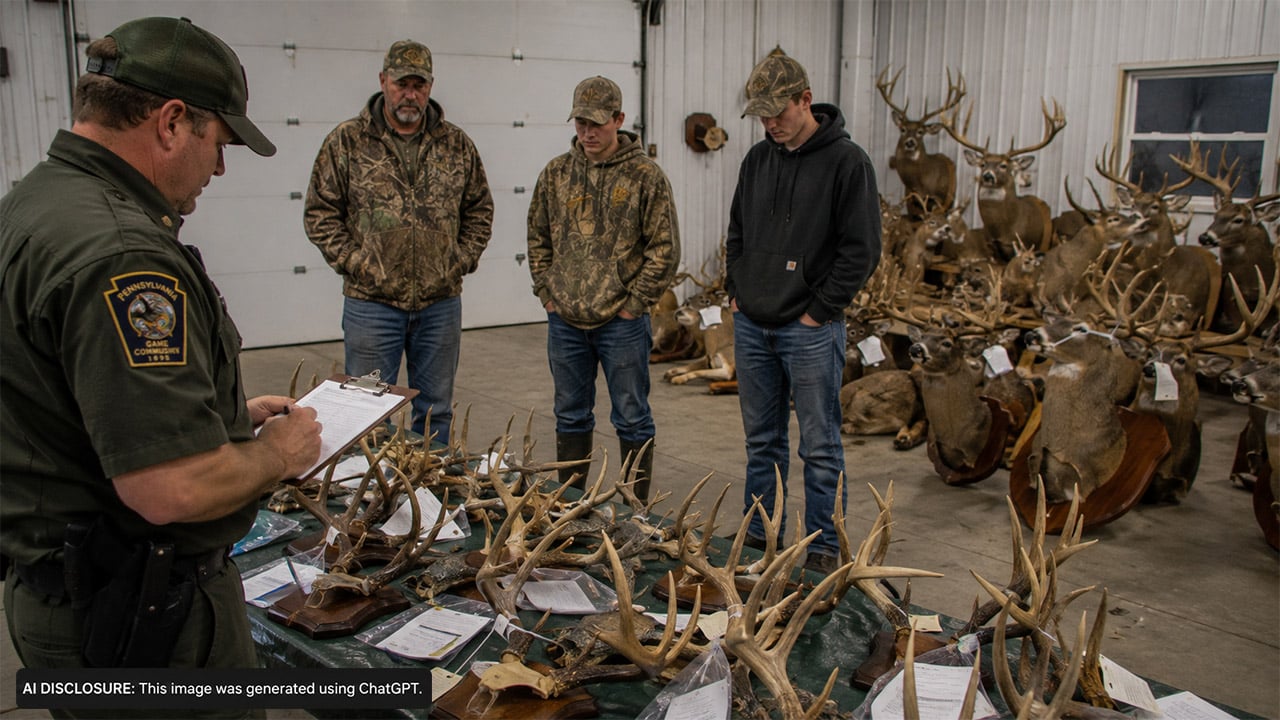
If you want a snapshot of the scale investigators are talking about, this is it: the Game Commission said nearly 50 mounts and antler sets were seized from the three defendants, and that most were “trophy class.” That’s not one lucky season, and it’s not a couple of mistakes.
For the average hunter, a shoulder mount is a once-in-a-while expense tied to one special buck and one clean story. When the wall is stacked with antlers that investigators say were taken illegally, it becomes evidence—plain and simple.
Restitution, license revocations, and an investigation that isn’t over
Beyond the court side—fines, costs, and potential incarceration—the Game Commission said all three defendants also face restitution. That’s the part a lot of folks overlook. In wildlife cases, restitution can be a real financial gut punch because it’s tied to the value of the animal, and trophy-class deer can bring higher amounts.
The agency also noted the men are facing extensive hunting license revocation if convicted. That’s another piece people tend to shrug off until it happens. Losing your ability to buy a license doesn’t just cost you a season—it can erase your place in camp, your traditions, and your time outdoors with family.
And this part matters for anyone assuming the book is closed: the Game Commission said the broad investigation remains open to determine whether additional people are involved. In long-running poaching rings, the unlawful kill is sometimes only one layer. Where the deer were taken, who knew, who helped, and how the trophies were handled can all become threads worth pulling.
The practical lesson for hunters and landowners in PA
This case is also a reminder of what works when something doesn’t feel right. The Commission specifically credited the start of the investigation to a tip, and it highlighted how many personnel were involved on the enforcement side—numerous State Game Wardens and Deputy State Game Wardens from the Southeast Region, plus assistance from the Pennsylvania Fish and Boat Commission and Chester County detectives.
If you’re a landowner dealing with nighttime shots, strange vehicle tracks, or a neighbor who always seems to have a “new” big buck, the smart play is documentation and distance—trail cameras on your own property, notes on dates/times, and reporting what you see instead of trying to handle it face-to-face. The Game Commission is blunt about it: “Poachers are thieves.” They’re stealing a public resource, and they’re often willing to bend other rules, too.
The agency is asking people to report poaching and wildlife crimes through its 24-hour dispatch center at 1-833-PGC-HUNT (1-833-PGC-WILD) or the Operation Game Thief hotline at 1-888-PGC-8001. If you care about the future of deer hunting—especially the kind where a legal, daylight, in-season buck means something—that phone call is one of the few tools regular folks have that actually moves the needle.
At the end of the day, big antlers don’t impress anyone when they come with handcuffs and evidence tags. The resource belongs to everybody, and cases like this show Pennsylvania’s wardens are still willing to do the slow, unglamorous work to protect it.
Like The Avid Outdoorsman’s content? Subscribe to our newsletter so you never miss an article.
Here’s more from us: