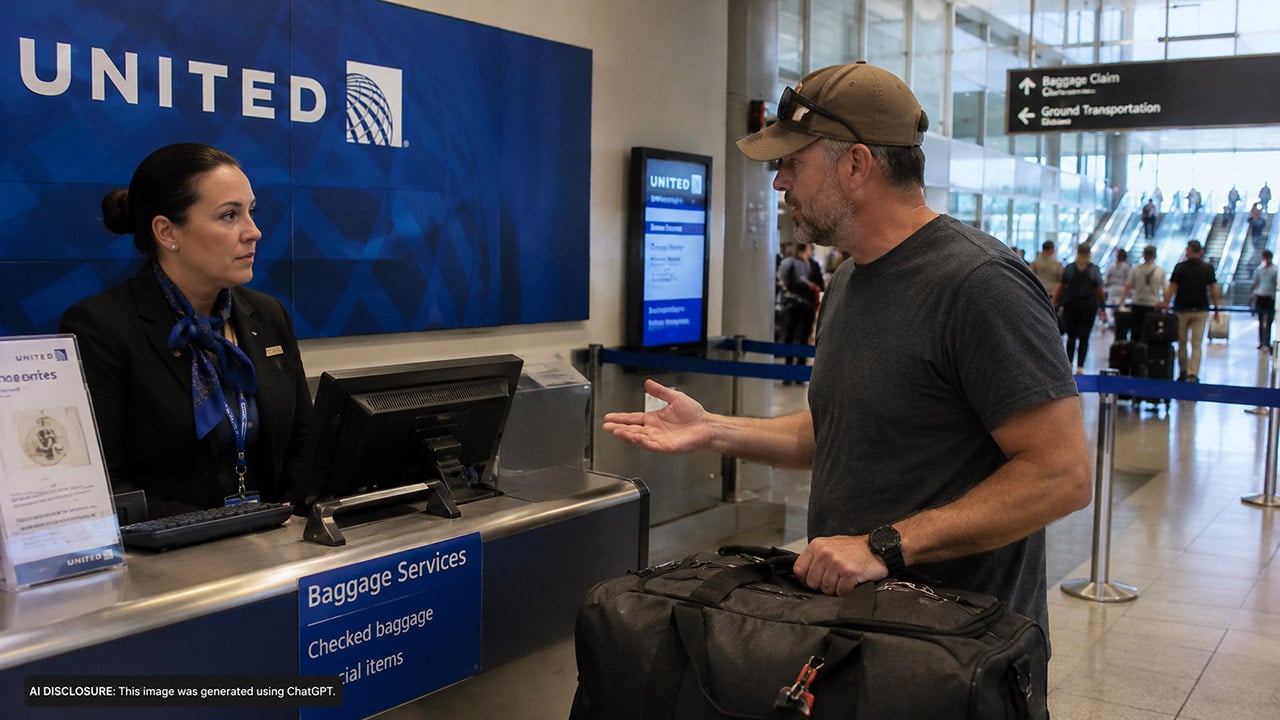
Photo credit: AI-generated image created using ChatGPT. Illustrative only
Checking a firearm for a flight is supposed to be a boring, by-the-book process: unloaded, locked case, declared at the counter, and you pick it up at the other end. For one traveler flying from Chicago O’Hare (ORD) to Denver (DEN), it turned into a long couple of days after United routed his declared, checked handgun to the wrong airport—Los Angeles (LAX)—and then couldn’t immediately account for it at baggage claim.
The account, shared in the original post, reads like every gun owner’s travel nightmare: a serial-numbered firearm temporarily “missing” inside the airline baggage system, police involvement, and the traveler being questioned about potential negligence—despite following the declaration process at check-in.
How it started: declared, checked, and then sent the wrong way
The traveler said he properly declared an unloaded gun in checked luggage for a flight from ORD to DEN. But when he arrived in Denver, the bag with the firearm wasn’t there. United’s tracking showed it had been put on a different plane and routed to LAX instead.
That’s already a problem for any traveler. With a firearm involved, it becomes a different kind of problem—because it’s not just “lost luggage” anymore. It’s a controlled item with a paper trail, serial numbers, and a whole set of procedures that tend to get conservative and rigid once something goes sideways.
The airline’s initial answer: “Go to LAX and recheck it yourself”
At the Denver airport, the traveler said a counter agent told him the only way to get the firearm back was for him to travel to LAX and then recheck and redeclare the gun to the final destination. United, he said, wouldn’t cover airfare to and from LAX and told him it was his responsibility, citing federal regulations because it was a gun.
Put yourself in those boots for a second. You did everything right—declared the firearm, checked it legally, got on your flight—and the airline’s proposed fix is essentially: spend your own money, take time out of your schedule, fly to the airport where they mistakenly sent it, and restart the process.
From an outdoorsman’s perspective, it’s not just the hassle. It’s the pressure. When your serial-numbered property is bouncing around airports, you want it secured, documented, and handled by people who know the process—not sitting on a carousel like a normal suitcase.
Then the situation got worse: baggage scans showed it hit a carousel and vanished
After pushing the issue further, the traveler said a baggage supervisor in Denver contacted a supervisory baggage handler at LAX to locate the firearm. According to the traveler, United’s baggage tag scan data showed the case was routed to a baggage claim carousel at LAX—and when an airline handler went to retrieve it, it was no longer there.
That’s the moment the tone changes. A misplaced duffel bag with clothes is frustrating. A checked firearm that appears to have reached a public baggage carousel and then disappears is a serious security issue, and it can put the legal spotlight on the owner even when the owner didn’t do anything wrong.
The traveler said he filed a police report and that the gun’s serial number was marked stolen. He also stated he was being investigated by local authorities to determine whether any negligence was involved, and he paused updates while that was ongoing.
Why this hits gun owners differently than “lost luggage”
Airlines misroute baggage every day. Hunters and shooters who travel enough have all had that one trip where a bag took the scenic route. The difference is that firearms are traceable items, and once there’s a report and a serial number attached to a “missing” status, you’re dealing with a higher-stakes paper trail.
Even when you follow every rule—unloaded firearm, locked hard-sided case, declaration at the counter—the owner’s name is still attached to that gun. If it’s not where it’s supposed to be, you can get dragged into explanations, reports, and interviews that have nothing to do with anything you did intentionally.
And there’s a second issue hunters understand immediately: timing. A delayed bag can ruin a trip. A delayed bag with a firearm can ruin a trip and create legal and logistical headaches that follow you home.
Law enforcement got involved—and the gun was located by X-ray
In a later update, the traveler said that after involving local authorities at both airports, police located his case. He said an X-ray showed the gun was still inside. Police secured it for pickup at a police station at LAX, and he was told officers would meet him and stay with him while he rechecked it.
That’s an important detail. Once a firearm is in limbo, having it placed directly into law enforcement control—and kept there until it’s properly checked again—may be the cleanest way to protect both public safety and the owner’s interests. It creates a clear chain of custody and takes “who had access to it” out of the gray zone.
Even after the case was found, the traveler said United still refused to cover airfare to and from LAX, and he planned to deal with that part later.
The final handoff: police custody, TSA hand-carry, and a clean arrival in Denver
In his final update, the traveler said he went to LAX and was not in any trouble. Police held onto the gun, and he was able to recheck it with law enforcement endorsement from the police department. He emphasized that the firearm did not leave police possession throughout the interaction.
He also noted a TSA agent carried the case instead of putting it on the conveyor belt after check-in. Ultimately, the firearm made it to Denver and he got it back.
United offered him 10,000 miles as compensation, but he said he declined.
For folks who travel with guns for hunting, competition, or backcountry trips, this story is a reminder that doing everything right doesn’t always prevent a mess. But it also highlights what tends to matter when things go wrong: push for documented tracking, file a report quickly when a firearm is unaccounted for, and insist the handoff be done in a way that keeps chain-of-custody tight. When your property is a firearm, you don’t want “we think it’s somewhere” to be the final answer.
Like The Avid Outdoorsman’s content? Be sure to follow us.
Here’s more from us: