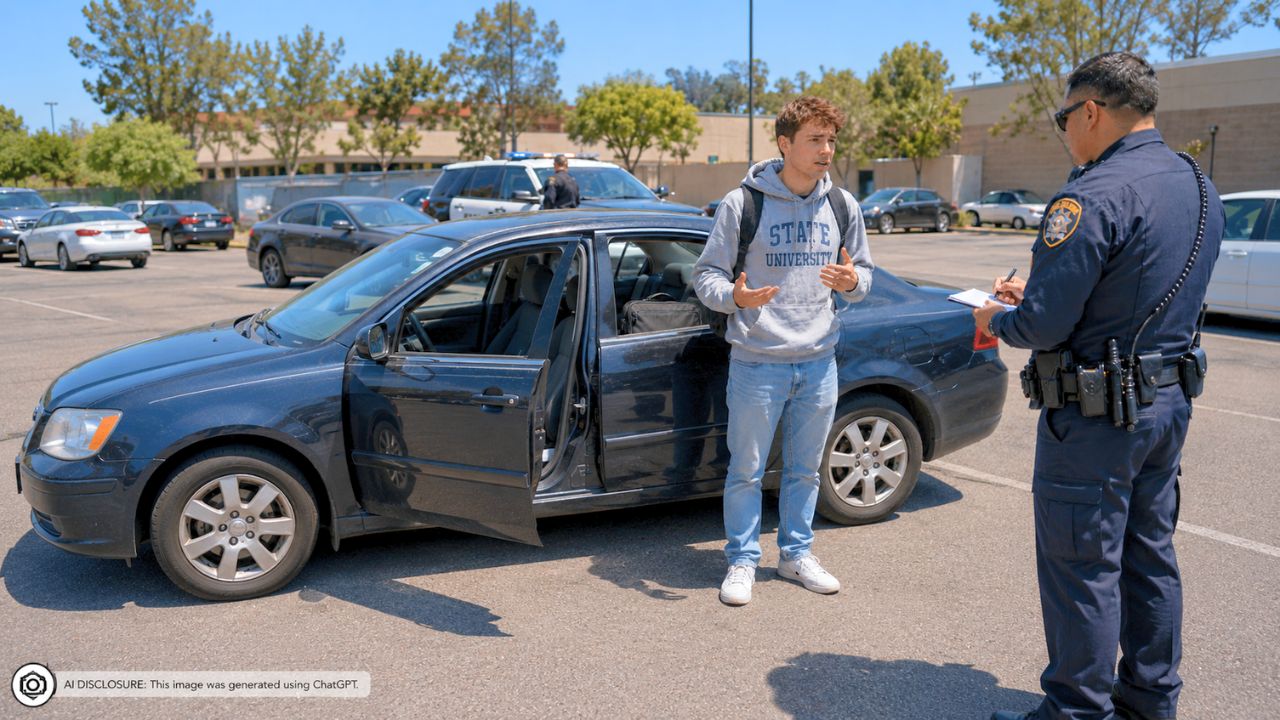
Photo credit: AI-generated image created using ChatGPT. Illustrative only
It’s one thing to misplace a set of keys. It’s another thing entirely to open your center console and realize your handgun isn’t where it’s supposed to be. That’s the situation one college student found himself in after noticing the pistol he normally keeps locked in his vehicle was suddenly gone—and the whole thing felt off because there were no busted locks, no ransacked cab, and even a laptop bag sitting untouched in the back seat.
In the original post, the driver explained he’s allowed to store a firearm in his vehicle on campus as long as it’s locked up and he has a concealed carry permit. He does have the permit. The last solid sighting of the gun was the previous Tuesday, when his dad borrowed the truck for a dump run and saw it in the console while grabbing hand sanitizer. Now, the handgun is missing, and the owner is left trying to figure out what to do—fast—because a lost or stolen firearm isn’t just “property.” It’s a public safety problem.
The timeline didn’t look like a typical smash-and-grab
The details matter here. The owner said he hasn’t had anyone else in the vehicle for the past two weeks, and he’s searched everywhere without remembering taking the gun out. There were also no obvious signs of forced entry, which is what makes a lot of gun owners’ stomachs drop: if the door wasn’t pried and the window wasn’t smashed, how did somebody get in?
He also pointed out something that doesn’t fit the usual “quick theft” pattern: there was a bag with a laptop and an iPad in the back, and that didn’t get taken. Anybody who’s dealt with vehicle break-ins knows thieves usually grab easy electronics first. A missing handgun with other valuables left behind can mean a few different things, but none of them are good, and it’s exactly why documenting the situation quickly is important.
Campus parking and “locked in the vehicle” rules can create a false sense of security
A lot of campuses allow firearms to be stored in vehicles under specific conditions, and folks take that to mean “I’m covered.” Legally, you might be. Practically, a vehicle is still one of the most commonly targeted places for stolen guns, because cars are predictable: they sit in the same spots at the same times, and thieves know people store things in consoles, glove boxes, and under seats.
The owner said he normally locks the vehicle, though he couldn’t say with 100% certainty that he did every time. Most of us have been there—running late, juggling gear, thinking about a test or a work shift. But that little bit of doubt is exactly why a missing gun turns into a stressful spiral. If you can’t prove when it disappeared or how, your next best move is to get it on record and stop the bleeding.
The immediate question: who do you call, and how fast?
The driver’s instincts were solid: call law enforcement. He just didn’t know whether that should be a local police department, the county sheriff, state law enforcement, or even the ATF. He also wondered whether he should wait for normal business hours or make the call immediately.
From a boots-on-the-ground perspective, the first call is usually whoever has primary jurisdiction where the theft likely occurred. If the vehicle was on campus, that might mean campus police first (if they’re a real law enforcement agency) or the city/county agency that covers that area. If you’re not sure, call the non-emergency number for your local agency and explain that you need to report a stolen firearm and you’re unsure where it happened. If you believe the gun was just taken or there’s an active threat, that’s when you treat it as an emergency—because a stolen firearm in the wrong hands can turn a normal day into something worse.
Why the serial number becomes the whole ballgame
Here’s where the rubber meets the road, and it ties directly into that headline angle: a lot of theft reporting hinges on having the firearm’s make, model, and serial number correct. The owner in this case was trying to do the right thing and get ahead of it, but the fear many gun owners have is real—if you don’t have that serial number handy, you can run into pushback, delays, or a report that’s missing the key identifier that actually helps recover the gun.
That’s why experienced gun owners keep records in a safe place: purchase receipt, pictures, and a written list of serial numbers stored somewhere other than the vehicle. If you’ve ever thought, “I’ll do it later,” this is the reason not to wait. A serial number is what gets entered into systems that can flag the firearm if it’s recovered, pawned, or shows up during an investigation. Without it, you’re basically describing a “black polymer pistol” or “compact 9mm,” and that’s not a strong hook for recovery.
Even so, if your gun is missing and you reasonably believe it was stolen, you still want to contact law enforcement. You can often follow up with the serial number once you locate your paperwork, contact the dealer, or check any documentation you may have at home. The key is creating that initial paper trail and getting guidance from the agency taking the report.
The fear behind the report: “Am I on the hook if it shows up at a crime scene?”
The owner asked the question every responsible gun owner thinks about but hates to say out loud: what happens if the handgun turns up on someone’s person, or at a crime scene? Would he face legal trouble just because it’s connected to him?
No one wants to imagine it, but that possibility is exactly why reporting matters. If a firearm is recovered and traced back to you, investigators are going to ask how you stored it, where it went missing, and whether you reported it. A prompt report doesn’t guarantee you’ll never be questioned, but it does show you recognized the problem and tried to address it. Waiting, minimizing it, or “hoping it turns up” can look bad later, especially if timelines start to matter.
He also asked whether he would be notified if it’s found. That depends on agency procedure and how the firearm is recovered, but generally speaking, if it’s entered correctly and comes back to you, you have a better shot at getting the call. Another reason those identifiers—and a clean report—matter.
What gun owners can do right now to avoid this exact mess
This situation is a hard reminder that “locked in my vehicle” is not the same thing as “secure.” If you have to store a handgun in a vehicle, the best practice is a dedicated lockbox that’s secured to the vehicle, not just tucked in a console. And don’t leave paperwork or anything with your home address right next to it—if the vehicle gets hit, you don’t want to hand someone a roadmap.
Also, keep your firearm info where you can reach it when you’re stressed: a photo of the serial number stored securely, a copy of the receipt, and the make/model written down. If you ever have to make that call, you’ll be able to give law enforcement what they need without tearing your house apart at midnight.
The ugly truth is that stolen guns don’t just disappear—they move. They get traded, sold, ditched, and sometimes used. If you’re staring into an empty console right now, the best time to start creating a record and getting guidance is immediately, not after you’ve “checked one more place.”
Like The Avid Outdoorsman’s content? Be sure to follow us.
Here’s more from us: