Photo credit: AI-generated image created using ChatGPT. Illustrative only
A guy in Pennsylvania thought he was doing everything right. Eight years ago he caught an ungraded felony for drug delivery, then got his life straight—steady, clean record, nothing worse than a speeding ticket lately. Now his wife wants a handgun for home and self-defense, and he’s trying to figure out if having that firearm under the same roof could put him right back in the crosshairs.
In the original post, he explained that he and his wife own their home together—both names on the deed and mortgage. That detail matters because it’s not like he can just “not live there” on paper. His question was simple and practical: is a gun in the house legal if he’s a felon, and if so, what has to happen to keep it legal?
A home-defense purchase turns into a felony-risk question
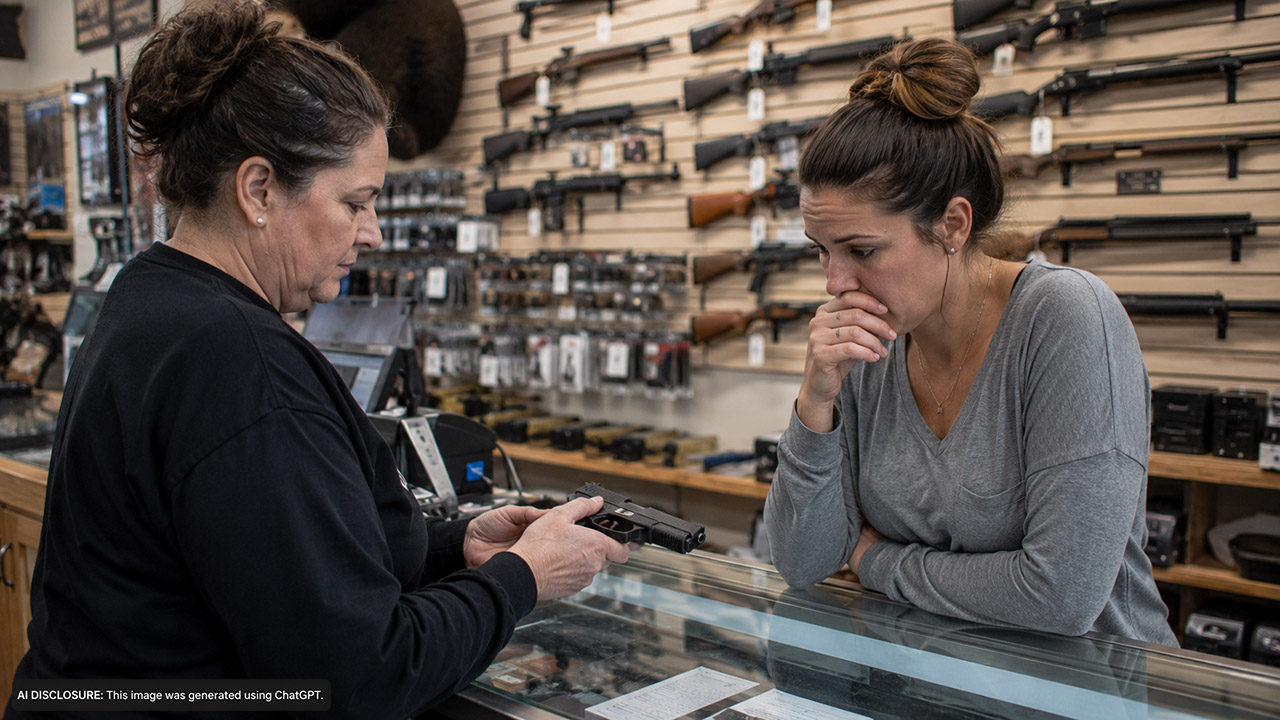
Plenty of folks keep a pistol around for the same reasons his wife is considering one: a bump in the night, a long police response time, or just wanting a fighting chance if something goes sideways. For most households, the decision is about training, safe storage, and picking a reliable handgun.
But when one person in the home is prohibited from possessing firearms, the whole conversation changes. It’s no longer just “should we buy it?” It becomes “could this create criminal liability even if it isn’t mine?” That’s the tight spot this Pennsylvania homeowner is staring at.
Why “it’s her gun” doesn’t automatically solve it
The gray area he’s sensing is real life colliding with legal definitions. In everyday talk, people think possession means “it’s in my hand” or “it’s mine.” In the legal world, possession can include having access to it or the ability to control it—even if you never bought it and never intended to use it.
That’s why lawyers and experienced gun owners tend to warn against casual setups like “it’s in the nightstand but it’s my spouse’s.” In a shared bedroom, shared closet, or shared safe where both people know the combo, a prosecutor can argue the prohibited person had access. And access is often where things go from harmless to handcuffs.
Living in the same house can still mean “possession” in the wrong situation
He asked the key question: does it have to be locked away with him having no access to it? For households dealing with a prohibited possessor, that’s usually the direction serious legal advice points—secure storage that the prohibited person cannot open, cannot access, and cannot be reasonably said to control.
The risky scenarios are the common ones: a pistol left in a drawer, a loaded handgun kept on a shelf, a bedside quick-access safe where both spouses know the code, or a “hidden” gun that isn’t really hidden from anyone living there. If a firearm is anywhere he can freely get to it—especially in areas he has equal rights to use—authorities may treat it as constructive possession.
And constructive possession cases don’t always start with someone “doing a gun crime.” They can start with a routine call: a domestic dispute, an EMS run, a welfare check, a burglary report, or even something like a probation-related contact if that applies. Guns have a way of becoming visible when uniforms show up.
Shared ownership of the home adds another wrinkle
He and his wife share ownership of the house, and that’s part of what makes this feel like a trap. In a typical family home, there’s no clean line between “my area” and “your area.” The kitchen is everyone’s. The bedroom is everyone’s. Closets, nightstands, and dressers are shared in a lot of marriages.
That shared space is exactly what can complicate a defense like “it was my wife’s gun and I had nothing to do with it.” If the gun is stored in a common area, in an unlocked container, or anywhere it looks like it’s there for “the household,” the argument that he had the ability to control it gets easier for the government to make.
Even a well-meaning setup—like keeping it accessible for home defense—can work against him. The whole point of a defensive handgun is quick access. But quick access for the wife can accidentally mean quick access for him, too, and that’s where the legal risk lives.
The most practical advice is usually the least convenient: hard separation
When prohibited-person households do this safely and legally, it often looks like hard separation and strict routines. The firearm stays under the exclusive control of the lawful owner. Storage is locked. Keys or combinations are not shared. And the gun isn’t left out “just this once,” because “just this once” is exactly what gets remembered when something happens.
There’s also the human factor: if the wife is away and the husband is home, what happens to that gun? If it’s in a place he can access while she’s gone, that’s a problem. If she’s the only one with access, that’s safer legally, but it may change the home-defense plan in a big way—because now the gun isn’t a household tool, it’s her tool, secured to her control.
That’s why folks in this situation are often urged to get real, case-specific legal counsel before buying anything. Not because the internet loves making things complicated, but because one bad assumption—like sharing a safe code—can create exposure under federal law and state law.
A clean record since the conviction doesn’t erase the firearm prohibition
One part of his post will sound familiar to a lot of readers: he turned things around. He’s been a productive member of society, and in eight years he’s only had a speeding ticket. In the outdoors world, that’s the guy you run into at the range or the bait shop who’s doing his best to keep his head down and live right.
But firearm disability doesn’t necessarily track with “how you’ve been doing lately.” It often tracks with the conviction itself and whether rights have been restored through the proper legal process. Without that restoration, the law can still treat firearm access as a serious violation, even if he’s otherwise stayed out of trouble for years.
That’s the hard reality: you can rebuild your life and still be one bad storage choice away from a new federal problem.
If you’re in a similar boat—prohibited person in the home, spouse wants a defensive firearm—the smart move is to slow down. Think through access like an investigator would, not like a homeowner would. Secure storage, exclusive control, and a real attorney’s guidance can mean the difference between a safer home and a life-altering charge.
Like The Avid Outdoorsman’s content? Subscribe to our newsletter so you never miss an article.
Here’s more from us: