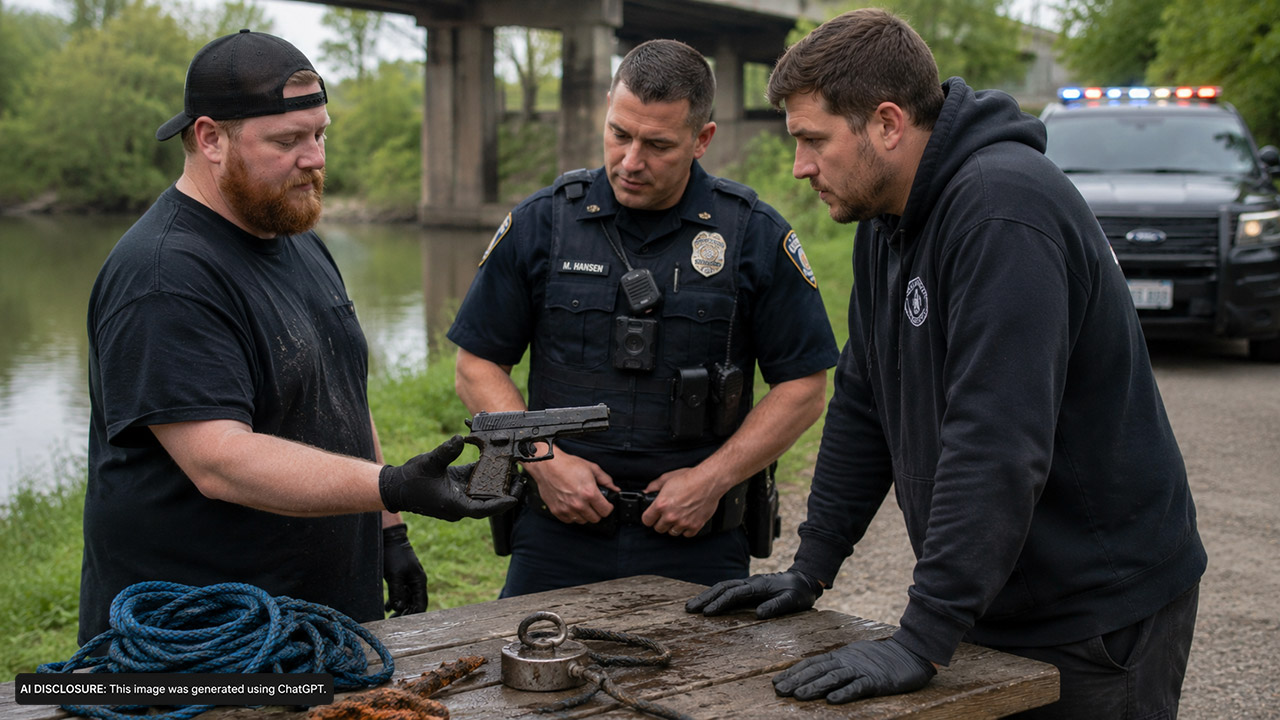
Photo credit: AI-generated image created using ChatGPT. Illustrative only
Most magnet-fishing days are about dragging up scrap metal, old lures, and the occasional oddball find that makes you shake your head. But one recent trip turned into something a whole lot heavier when a magnet fisher pulled a handgun frame from a river and realized it wasn’t just trash—it was evidence.
A tip from an officer turned into a real search
The magnet fisher said he’d met an officer about a month earlier and got a tip about a gun investigators believed had been dumped in a river. The officer gave a rough estimate of where it might be. So when the magnet fisher hit the water again, he wasn’t just hoping for a neat find—he had a specific area in mind.
That’s an angle a lot of outdoorsmen can understand. If you spend time on rivers and public access points, you learn quick that people use water like a trash can when they want something gone. Magnet fishing is basically proof of that.
The “find” wasn’t a complete pistol—just the part that matters
What came up wasn’t a clean, intact handgun ready for some YouTube thumbnail. It was an M&P EZ Shield frame. That matters because the frame is the controlled part of the firearm, and it’s where the serial number is typically located.
He also noted it wasn’t exactly where police thought it would be. He said he found it on the opposite side of the river, two bridges away from the location investigators believed it had been dumped. Anyone who’s watched how a river moves debris can tell you that doesn’t sound far-fetched at all.
He called non-emergency—then got told to call 911
Once he realized he had a firearm component, he did what most level-headed folks should do: he called the non-emergency number and explained what he’d found and roughly where it was recovered. According to his account, the non-emergency operator told him to call 911 after hearing the description and location.
That’s worth pausing on. A lot of people assume calling 911 over “just a gun” is an overreaction. But when you’re talking about a firearm pulled from water—unknown condition, unknown history, and possibly tied to something criminal—dispatch and responding officers are going to treat it differently than a pocketknife or an old anchor.
Police collected it quietly, and the story kept unfolding
He said police sent out an “undercover” officer who collected the firearm. After that, things moved like they usually do once evidence is in the system—slow, controlled, and not very chatty.
He later received an incident report card, and after about 45 days he called the number on it. The person he spoke with from unclaimed property told him the numbers were “obstructed,” but investigators were able to recover the serial number information. That’s a detail outdoorsmen should file away: water and corrosion can make markings hard to read, but that doesn’t mean they’re gone for good.
The frame reportedly tied back to a homicide investigation
The biggest detail came at the end of his follow-up call. He said he was told the gun was involved in an ongoing homicide “investigation,” and that the recovered information came back to a person they had in custody after being wanted for a homicide. He also said the person couldn’t disclose much more, and he didn’t get further updates.
That’s the reality with cases like this. Even when you do everything right, you’re not going to get a play-by-play. The find may be a big piece of a puzzle, but investigations stay tight-lipped for good reason.
For anyone wanting to read his full account and see what he shared about the recovery and follow-up, you can check out the original post.
What other outdoorsmen should learn from this kind of find
If you magnet fish—or you just spend time on riverbanks, boat ramps, and public access—you’re eventually going to run into something that isn’t just junk. Firearms, knives, and even safes come up more often than people think. When that happens, the smart play is to treat it like it could be loaded and like it could be evidence.
Calling it in was the right move here, and the sequence matters: he contacted authorities, described what he had, and followed the direction he was given. He didn’t try to “clean it up,” didn’t treat it like a trophy, and didn’t turn it into a science project. That’s not just about staying on the right side of the law—it’s about not contaminating evidence that might matter to a victim’s family.
He also asked others whether they’d found firearms linked to crimes or reported stolen. Even without a long thread of reactions included in the source material, it’s a fair question—and one that comes up in magnet-fishing circles for a reason. Guns dumped in water aren’t usually there by accident.
In the outdoors, you get used to dealing with what you find—fences down, trespass signs shot up, trash in the ditch. But a handgun frame in a river is different. This one went from a hunk of metal on a magnet to a piece of a serious investigation, and it’s a reminder that the right call in the moment can actually help close the loop on something that’s been hanging out there for a long time.
Like The Avid Outdoorsman’s content? Subscribe to our newsletter so you never miss an article.
Here’s more from us: