Photo credit: AvidOutdoorsman
The first week in a new house is always a mix of excitement and grit. You’re chasing paint touch-ups, figuring out which breaker controls the freezer, and pulling shelves out of closets that haven’t been moved in decades. In this case, a homeowner doing exactly that noticed a spot on an upstairs closet wall that didn’t sound right when it was tapped—more hollow than the studs around it.
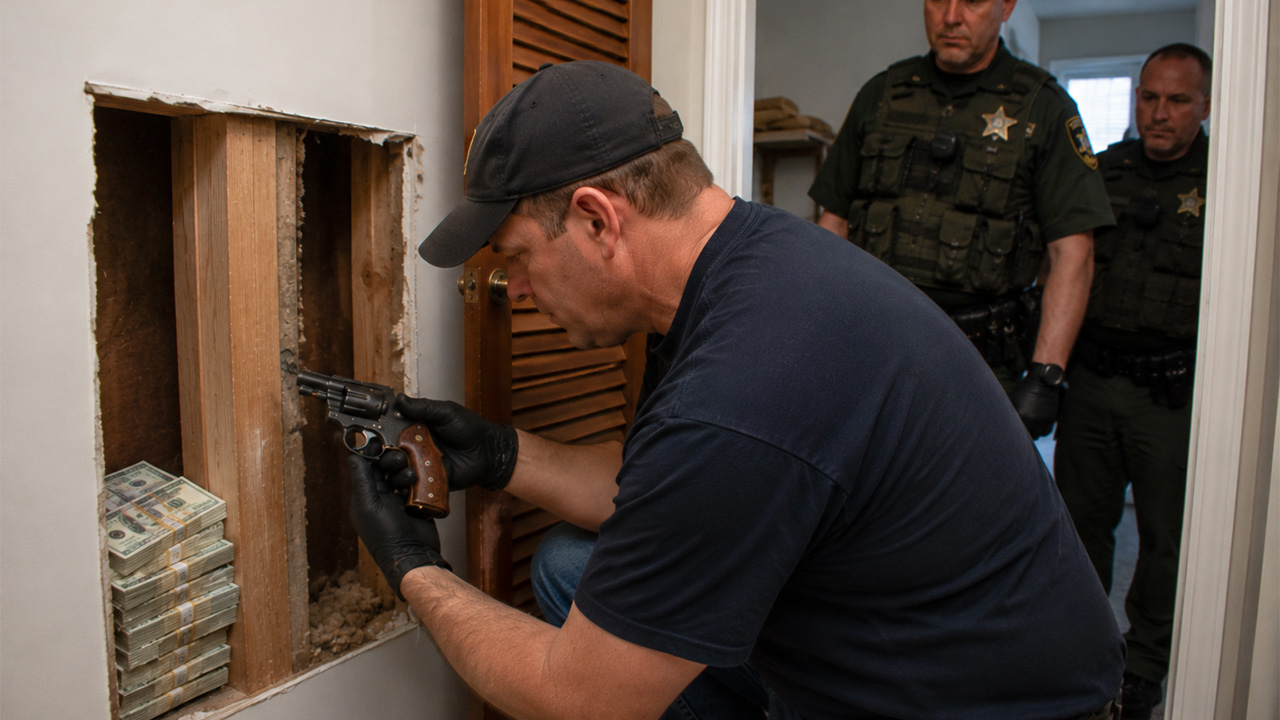
Behind a thin panel was a small void between framing members, the kind of shortcut you’d never catch unless you were replacing trim or running new wire. Stuffed inside were two things that don’t belong in any wall: a loaded revolver wrapped in an old cloth, and a bundle of cash—roughly $4,000—banded and tucked tight like someone meant to come back for it.
A hidden cache that turned a renovation into a safety problem
Anytime you find a firearm in a place like that, the first concern isn’t “what is it worth?” It’s “is it safe?” A revolver left for years in a wall cavity can be exposed to moisture, insulation dust, and temperature swings. Even if it looks clean, you don’t know if it’s been messed with, if the cylinder is partially out of time, or if corrosion has crept into places you can’t see.
The homeowner didn’t try to “make it safe” by unloading it on the kitchen table. Instead, they did the smart rural-living thing: cleared the area, kept the muzzle in a safe direction, and got it secured without handling it more than necessary. A lot of accidents happen not because someone is careless on purpose, but because they get curious and start fiddling with something they didn’t expect to find.
Cash in the wall raises questions, but the gun raises bigger ones
Folks stash money for all sorts of reasons—divorce, debts, paranoia, or just old-school habits from people who didn’t trust banks. But cash paired with a hidden, loaded handgun has a different feel. That combination suggests urgency, fear, or criminal intent, even if it turns out to be something else.
From a landowner and outdoorsman perspective, it also changes how you look at the property itself. If the previous owner was hiding a weapon and money inside a wall, what else is on the place? Old wells, buried trash pits, forgotten outbuildings, even unsafe wiring. A hidden cache is a reminder that you didn’t just buy land and lumber—you bought a history.
The background check that connected the dots to an old homicide
Once law enforcement got involved, the revolver’s serial number became the starting point. In most cases, a simple check tells you if a gun was reported stolen, tied to a previous case, or transferred through normal channels. This one didn’t come back clean.
The record attached to that revolver pointed to a homicide from 1987. It wasn’t just “suspicious” anymore—it was potentially evidence that had been missing for decades. A firearm like that isn’t just a gun; it’s a timeline, fingerprints, toolmarks, and unanswered questions that can reopen a case for people who have been living with it since the late ’80s.
That’s also where the cash becomes more than a weird bonus. Investigators will look at whether it’s connected, whether it was stashed at the same time, and whether any of it can be traced through old records or patterns. Even if cash is hard to prove, the context matters when you’re talking about a weapon tied to a violent crime.
What a new homeowner can do (and what not to do) when they find a gun
Every state is a little different, but the basics don’t change. If you find an unknown firearm hidden in a structure—especially one that’s loaded—treat it like it could be stolen or tied to a crime. Don’t take it to the range to “see if it works.” Don’t clean it. Don’t start swapping parts or trying to identify it by posting close-ups online.
From a practical standpoint, the best move is to limit handling and get it documented properly. If you’re a gun owner, you already know how quickly a simple situation can turn into a headache when a serial number pops. The homeowner in this situation avoided becoming part of the story by not trying to quietly claim it as “found property.”
There’s also the personal safety angle that doesn’t get talked about enough: if someone hid a loaded handgun and cash in that wall, there’s a chance someone else knows it’s there—or thinks it’s there. Once word gets out, you don’t want strangers showing up at your place, asking questions, testing door locks, or driving by too slow at night.
Commenters zeroed in on storage, property history, and “what would you do?”
Whenever a story like this makes the rounds, the same debates kick off. Some folks fixate on the money, like it’s a buried treasure find. Others immediately jump to the gun and start talking about what model it might be, what it’s worth, and whether “possession is nine-tenths of the law.” That kind of talk sounds tough until the serial number ties it to something ugly.
The more grounded comments usually come from people who’ve owned old homes, inherited farms, or cleaned out estates. They’ll tell you about finding rifles in attics, pistols in toolboxes, and coffee cans of ammo under workbenches. Most of the time, it’s just somebody’s forgotten hardware. But the point they keep coming back to is simple: you don’t know the backstory, so you don’t treat it like a normal gun transfer.
Another theme is documentation. Outdoorsmen tend to be practical about paper trails because we deal with tags, licenses, permits, and land lines. The same mindset applies here: if you ever have to explain how a firearm ended up in your possession, you want your actions to be boring, traceable, and unquestionably lawful.
The hard part: realizing a house can hold someone else’s secrets
There’s something unsettling about tearing into a wall and finding a piece of violence tucked away like it’s part of the framing. It puts a different weight on a place that’s supposed to be your family’s fresh start. A closet becomes more than a closet, and every odd patch job starts to look like it might be hiding another surprise.
For the homeowner, the best-case outcome is that they did everything right and the situation gets handled without dragging them into it. For investigators, a gun that’s been out of circulation since the late 1980s could be a key that finally fits a lock—one that hasn’t turned in a long time.
If there’s a lesson for the rest of us who buy old places, hunt around rural properties, or remodel houses with history, it’s this: treat unexpected firearms like potential evidence, not like loot. Secure it safely, make the call, and keep your hands clean. Sometimes the stuff hidden in the walls isn’t just old wiring and mouse nests. Sometimes it’s a past that’s been waiting on one tap in the right spot.