Photo credit: The Avid Outdoorsman
Most rural folks have dealt with a trespasser at some point. Sometimes it’s a kid cutting across a field. Sometimes it’s a hunter who “didn’t know” where the line was. And sometimes it’s a stranger close enough to your home that your stomach tightens and you start thinking about what your next move ought to be.
That’s the kind of night a Tennessee homeowner reportedly had when someone showed up where they didn’t belong. The landowner stepped outside, saw a figure lingering near the edge of the property, and made the decision a lot of people talk about but shouldn’t: they fired a shot to run the person off.
The trespasser did leave. But the bullet didn’t just disappear into the night.
The “warning shot” that turned into a real problem
According to investigators, the homeowner believed a single round into the air or “into a safe direction” would be enough to send a message without hurting anyone. It’s a common bit of country logic, usually built on years of shooting where the only backstop that mattered was a dirt bank on the back forty.
The issue is that warning shots are still shots. They’re still a projectile leaving a barrel at high speed, and they’re still your responsibility from the moment they break the muzzle until the moment they stop.
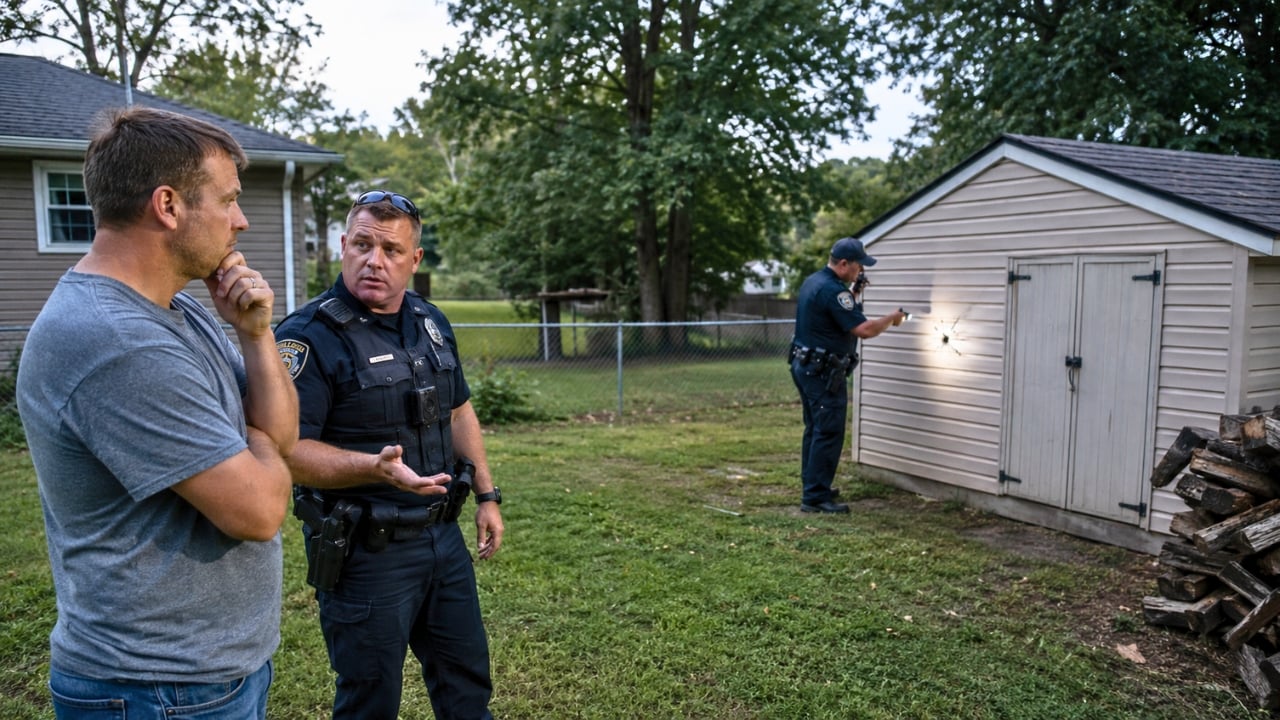
In this case, police later located the projectile lodged in a neighbor’s storage shed roughly 200 feet away. That’s close enough to make every homeowner on that road wonder what would’ve happened if someone had been walking to their truck, taking out the trash, or checking on livestock.
How police connected the shot to the shed
Once the neighbor discovered damage, it didn’t take long for the pieces to come together. A fresh hole in siding or sheet metal is hard to ignore, and it’s not the kind of thing you chalk up to “weather” when it’s clean and new.
Officers reportedly canvassed nearby homes and asked the simple questions they always ask after a gunshot call: who heard it, who fired, and where was the shooter standing. With properties packed close enough that 200 feet covers a couple of yards and a fence line, the likely direction of fire becomes pretty clear once you see the impact point.
Even without getting into the weeds of forensics, a recovered bullet and a known firing location can paint an ugly picture fast. And that’s before anyone starts talking about negligence, reckless endangerment, or property damage.
Two hundred feet is nothing in bullet distance
A lot of folks underestimate how little distance 200 feet really is for a firearm. That’s about 67 yards. If you can hit a paper plate at the range, you can send a round into a shed at that distance without trying.
And the bigger lesson is this: “I shot into the air” is not the safety blanket people think it is. Bullets that go up come down somewhere. Even if you don’t launch it straight up, a round fired at an upward angle can carry far beyond your property, especially with common rifle calibers. Handgun rounds can travel a long way too, and they don’t need much energy left to hurt someone.
The only truly “safe direction” is one with a reliable backstop—dirt, a hillside, a purpose-built berm—something that actually stops the projectile. If you can’t point to what stops the bullet, you don’t control where that bullet ends.
The trespass issue is real, but the response matters
None of this is meant to excuse trespassing. Rural homeowners deal with it constantly—folks cutting across posted land to fish a creek, someone checking trail cameras that aren’t theirs, or a hunter slipping in “just for the evening sit.” Those situations can escalate quickly, and you don’t always know whether the person is harmless or dangerous.
But firing a round to scare someone off tends to do two things. First, it shifts attention from the trespasser’s bad decision to your gun handling. Second, it increases the odds you’re the one explaining yourself to law enforcement, not the person who shouldn’t have been there.
There are better steps that still protect you: turn on lights, get family members secure, call police early, and use a phone camera from a safe position if you can. If you can safely do so, a loud verbal command from cover—without stepping into the open—does a lot more than people think.
What outdoorsmen and neighbors argued about afterward
When a story like this makes the rounds, the comment sections usually split into a few familiar camps. One group says the homeowner did what they had to do and the trespasser got what they deserved. Another group points out that “warning shots” are a good way to catch charges and lose your rights.
Plenty of experienced hunters land somewhere in the middle: they understand the fear and adrenaline, but they’ve also spent enough time on ranges, in tree stands, and around kids and neighbors to know that every bullet has to have a destination. They also know that once you press that trigger, you can’t take it back. You can’t call the bullet home.
There’s also usually a practical thread that pops up—folks recommending posted signage, fresh paint on trees, and trail cameras covering gates and common crossing points. That advice may not be flashy, but it’s the kind of boring prevention that keeps a situation from turning into a headline.
The hard truth: you can’t fire “just a little” recklessly
The homeowner likely thought they were choosing the lesser of two evils: a loud shot instead of a physical confrontation. But the moment that round ended up in a shed, the conversation stopped being about discouraging a trespasser and started being about endangering neighbors.
If you’re dealing with repeated trespassing, the best long game is documentation and deterrence that doesn’t involve bullets—clear boundary markings, cameras, locked gates where possible, and quick reporting. If you’re facing an immediate threat where deadly force is actually justified, that’s a different category entirely, and it’s not solved with a “scare shot” anyway.
Out in the country, we all like to think we’ve got room. But 200 feet is proof that none of us have as much room as we think when a gun goes off without a backstop. The safest shot is the one you don’t take unless you know exactly where it’s going to end up.
Like The Avid Outdoorsman’s content? Be sure to follow us.
Here’s more from us: