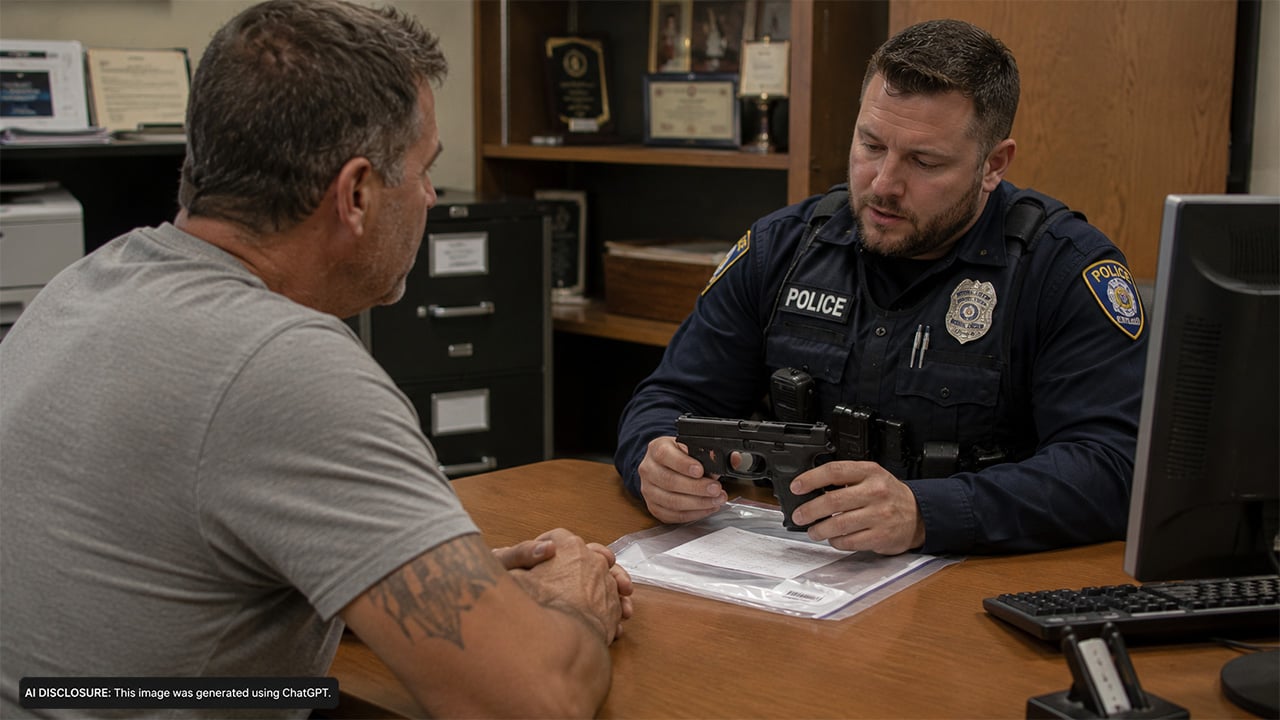
Photo credit: AI-generated image created using ChatGPT. Illustrative only
Ten years is a long time to figure a firearm is gone for good. But that’s exactly how long one owner waited before getting an unexpected call from local police: his stolen Glock 19 had been recovered. When he finally saw what came back, though, it wasn’t the complete pistol he remembered—just the serialized frame and an extended magazine, as detailed in the original post.
If you’ve ever had a gun stolen out of a truck, a house, or a shed, you know the feeling. You want it back, but you also know stolen guns tend to live hard lives. In this case, the “recovery” was real, but it came with a twist: everything that makes a Glock run—slide, barrel, and the rest—was gone.
What came home wasn’t a pistol, it was a paper trail
The gun in question was a Gen 4 Glock 19 in FDE that had been stolen about a decade earlier. When police finally recovered it, the only parts returned were the frame and an extended magazine. That’s still significant, because the frame is the controlled, serialized part—and it’s the part that ties back to the original owner.
But from a practical, “does it protect my family” standpoint, a bare frame is like finding your stolen pickup’s VIN plate and a tailgate. It confirms the story, but it doesn’t get you back on the road.
The hard reality of stolen guns: they usually don’t come back intact
Plenty of stolen firearms get passed around, stashed, traded, or stripped. Sometimes they’re used in crimes. Sometimes they’re just cannibalized for parts because parts are easy to move and hard to trace. A Glock is especially easy to part out because so many people run them, and there’s a huge aftermarket.
In this case, the fact that only the frame resurfaced tells you the pistol likely got separated somewhere along the line. Maybe it was deliberately broken down. Maybe parts were swapped. The “why” wasn’t explained, but the outcome is the same for the owner: he got the serialized shell back and had to decide what to do next.
Glock gave rebuild options—and then offered something better
Instead of trying to piece it together blindly, the owner contacted Glock and had extended conversations with customer service about rebuild options. At first, he planned to have Glock install a new slide and barrel. That would have made the gun functional again, but the replacement parts would carry different serial numbers than the frame.
After he shipped the frame off through a local FFL—his first time mailing a gun—Glock’s Warranty Department contacted him with another option. For $50 more than the slide-and-barrel plan, he could choose a brand-new Gen 4 or Gen 5 Glock 19, or even a Glock 48. That’s not a small upgrade, especially when you’re already paying to resurrect a gun you thought was gone forever.
Why he chose a Gen 5, and why “compatibility” still matters
The choice came down to the same things most of us consider when we’re buying a working gun, not a safe queen. He wanted an MOS slide option, wanted something other than plain black, and wanted to keep using the Gen 4 magazines and accessories he still had sitting around.
He ultimately went with a Gen 5 Glock 19 with a gray frame and had AmeriGlo sights added. The turnaround was quick—about five days to get it back to his FFL and into his hands. And even though he felt he paid about 1.5x what a Glock 19 might have cost him back when he first bought his original pistol, he also noted that prices appear to have climbed roughly $200 over the past decade. In other words, it wasn’t just a “feel good” fix—it penciled out better than it might seem at first glance.
The extended magazine raised a caliber question that gun owners should understand
After getting everything squared away, the owner noticed something strange when he looked closer at the extended magazine that came back with the frame: it appeared to be a .40 caliber magazine. That sent his mind down a path a lot of shooters have traveled—if the mag is .40, does that mean the frame could run .40 parts?
Here’s the practical way to think about it without getting into backyard-gunsmith territory: Glock models in similar sizes can share certain dimensions, and magazines can sometimes be inserted across related models, even if they aren’t the “right” match for the original caliber. None of that automatically means a safe, reliable, or appropriate setup. If anything, it’s a reminder that stolen guns often get mixed-and-matched, and when a gun comes back as a partial, you should treat every leftover part like a question mark until it’s identified and verified by someone qualified.
A few lessons worth taking to the range—and to the gun safe
The owner came away a “fan for life,” and it’s easy to see why. Glock could have told him there was nothing they could do, but instead they laid out options and helped him land on a workable path that ended with a brand-new pistol configured the way he wanted.
There are some clean takeaways for the rest of us, too. First, record your serial numbers and keep purchase paperwork where you can find it—because a recovery ten years later is only helpful if you can prove it’s yours. Second, if a stolen gun ever does come back in pieces, resist the temptation to throw random parts at it. Go through the proper channels, use an FFL when required, and let the manufacturer or a competent armorer guide the process.
Most of all, this is one of those rare stories where persistence and a little luck actually paid off. The owner didn’t just get a relic of an old loss—he ended up with a current-production Glock he can carry, train with, and trust, instead of a stripped frame that would’ve sat in the back of the safe as a reminder of what happened.
Like The Avid Outdoorsman’s content? Be sure to follow us.
Here’s more from us: