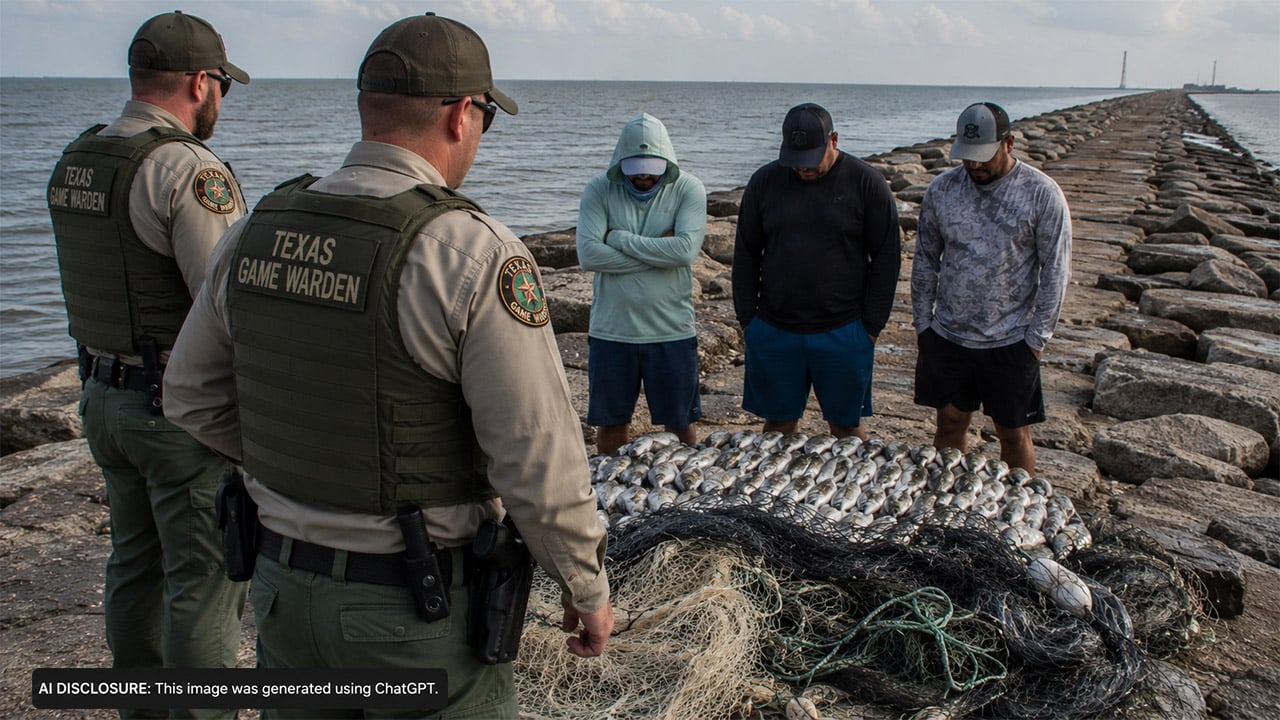
Photo credit: AI-generated image created using ChatGPT. Illustrative only
Walking a mile down a pitch-black dike isn’t most folks’ idea of a relaxing night on the coast. But that’s exactly what Texas Parks and Wildlife Department game wardens did at the Texas City Dike, and what they found at the end of that long walk was the kind of illegal netting operation that wipes out fish fast.
Working off a tip, wardens slipped in “under cover of darkness,” pushed more than a mile onto the five-plus-mile dike, and watched three men actively running nets and loading up a cooler. Details of the case were shared in the source post that summarized the agency’s account of the bust.
A long walk and a quiet stakeout on the Texas City Dike
The Texas City Dike is famous in Texas fishing circles because it’s long—more than five miles—basically a highway out into the bay. During daylight, it’s a busy place. At night, especially away from the crowds, it can also be the kind of place where someone thinks they can get away with things they wouldn’t try at a public boat ramp.
That’s why the “mile walk” detail matters. It tells you the wardens didn’t just roll up, flip on a spotlight, and get lucky. They covered ground, got eyes on what was happening, and watched long enough to document the pattern: nets going in, nets being tended, fish getting stacked.
Illegal nets in the water and a cooler getting heavy
According to the account, wardens observed the suspects “actively deploying and tending multiple nets and repeatedly filling a cooler with aquatic resources.” That’s about as clear as it gets: this wasn’t one accidental fish in the wrong slot limit. It was a system.
When the wardens moved in and inspected what was being taken, they found 137 saltwater fish of various species, along with three stone crabs and one sponge crab. They also seized four gill nets and an oversized cast net—more than 700 feet of illegal gill netting total.
Why gill nets are a big deal in Texas saltwater
If you’ve spent much time around saltwater, you already know why this kind of gear gets people fired up. Gill nets are essentially walls of webbing set in the water column. Fish push through, get gilled, and don’t come out. And it’s not just “keeper” fish—anything moving through that zone can end up dead or dying.
Texas Parks and Wildlife flatly prohibits gill nets because they “indiscriminately kill marine life.” That’s the heart of it. A rod and reel is selective. Even legal cast-netting has boundaries. A gill net left to soak is the opposite of fair chase and the opposite of conservation.
Licenses, legal nets, and the rules most anglers already follow
One detail in the case that ought to make any honest angler shake their head: only one of the three suspects had a valid fishing license. It’s hard to square that with the amount of effort and planning involved in hauling nets onto a dike at night.
Texas does allow cast nets, but with limits. The material notes that weighted and conical cast nets are legal if they’re under 14 feet in diameter and used only to take nongame fish. Oversized nets and gill nets aren’t “creative fishing”—they’re violations that can turn a public fishing spot into a dead zone.
In this bust, wardens documented 160 violations between the three individuals. They also seized the nets and the “edible aquatic resources,” which is exactly what you want to see: take away the gear and the payoff.
A tip to Operation Game Thief put wardens in the right place
This case didn’t start with a random patrol stumbling into a crime scene. Wardens were alerted by a tip to Operation Game Thief, a program tied to an affiliated nonprofit that has paid out more than $100,000 in rewards and helped secure more than 600 poaching convictions since 2014.
That’s the part everyday outdoorsmen can actually do something about. If you see suspicious activity—especially repeated, patterned behavior like someone running nets at odd hours—report it. Not by confronting people on a dark pier, not by trying to play hero, but by getting good information to the folks who can act on it safely.
The other practical point: the time to call is when it’s happening, not the next morning after you’ve stewed over it. A real-time report is what lets wardens set up the kind of quiet approach that preserves evidence and keeps everyone safer.
What this means for regular anglers who fish that dike
There’s always a ripple effect after a big netting case at a high-traffic public spot. Honest anglers end up wondering what got taken that didn’t need to be taken—and what it does to bite quality, keeper ratios, and even the public perception of the area.
For the folks who fish by the book, it’s also a reminder to keep your own house in order. Have your license. Know your legal gear. Know what’s legal to keep and how. When wardens are working a problem area, they’re going to notice everything around them, and the last thing you want is to be the guy who’s legal on fish but forgot the basic paperwork.
On the enforcement side, this was a clean example of how these cases should go: a tip, a patient approach, observed behavior, illegal gear seized, and the resource recovered. It’s not flashy. It’s just solid work—and it protects the fishing for everybody else who walks that dike with a rod in hand instead of a net over their shoulder.
Like The Avid Outdoorsman’s content? Subscribe to our newsletter so you never miss an article.
Here’s more from us: