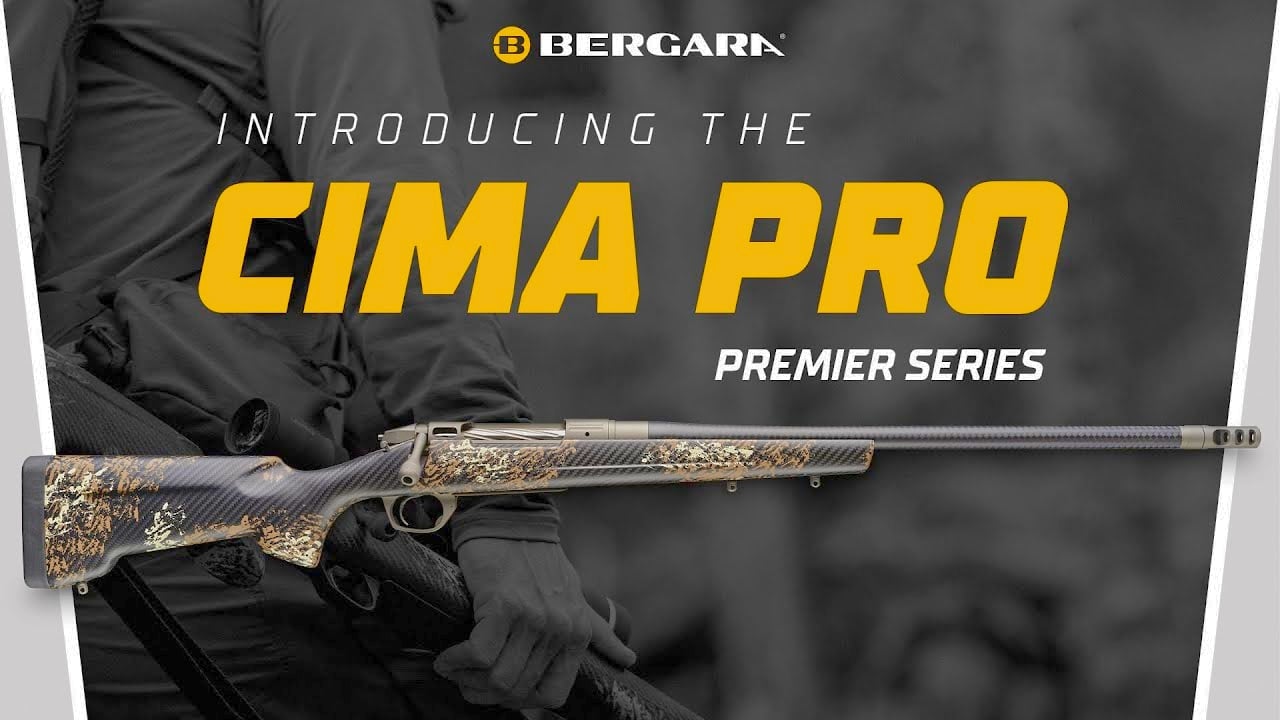
Photo credit: Bergara/YouTube
We may earn revenue from products featured on this page through affiliate links.
The Bergara Premier CIMA Pro is aimed at a very specific buyer: the hunter who wants a true mountain-weight rifle without accepting the usual mountain-rifle compromises. Plenty of “lightweight” rifles feel great on the shoulder and then get weird when you actually shoot them—sharp recoil, wandering point of impact, finicky balance once you add a scope, and that vague “this thing just doesn’t feel settled” problem. The CIMA Pro’s whole pitch is that you can go light and stay rigid and consistent because Bergara went all-in on carbon tech from the barrel to the stock using an autoclave curing process. It’s also built on the Premier side of Bergara’s lineup, which matters because the Premier action and component choices are where Bergara tries to separate “nice hunting rifle” from “serious build you can trust.”
It goes “ultralight” without turning into a noodle
Most rifles that get into the 5-to-6 pound range do it by cutting everything down to the bone, and that’s where you start seeing flex, weird harmonics, and a rifle that’s too sensitive to how you rest it. The CIMA Pro’s standout move is that it uses carbon construction in a more complete way than most “lightweight” rifles, with Bergara describing carbon tech extended from the stock to the barrel via an advanced autoclave curing process meant to keep strength and rigidity while dropping weight. In plain terms, they’re trying to keep the rifle from feeling like a featherweight that only shoots well under perfect range conditions. That idea lines up with the published specs floating around the launch coverage: a CURE carbon barrel, an autoclave carbon stock, and a listed weight right around 5.7 pounds. The reason this matters is simple—stiffness is what keeps a light rifle from changing personality every time you sling up, lean into a rest, or shoot when you’re cold and shaky.
The weight-to-feature ratio is what makes it different
A lot of ultralight rifles hit a low weight number by being barebones, and then the owner has to “build it back up” to be practical. The CIMA Pro is interesting because the feature set doesn’t look like a stripped-down budget mountain gun. Launch coverage lists a Premier skeletonized action, a CURE carbon barrel, and a titanium muzzle brake, with a stated 5.7-pound weight and 3–4 round capacity depending on caliber. Bergara’s own materials frame it as a Premier-level rifle built for lightweight performance, not a compromise gun. That’s the “better than most” piece: a lot of rifles that weigh this little ask you to accept a skinny barrel with questionable consistency, a bargain stock, and a general “it’s fine” feel. This one is trying to keep it premium and still hit an honest carry weight.
The caliber lineup shows what Bergara thinks it’s for
You can tell what a rifle is meant to do by the cartridges it’s offered in. Coverage of the CIMA Pro lists options ranging from mainstream deer rounds like .308 and 6.5 Creedmoor to modern do-everything hunting rounds like 7 PRC, plus magnums like .300 Win Mag and .300 PRC, and even newer entries like .22 Creedmoor and .25 Creedmoor. That’s a pretty clear signal Bergara sees this as a “one rifle that can travel” platform—something you can set up for mule deer and elk trips, not just a whitetail stand gun. The flip side is that recoil management and balance become real conversations when you start pairing a 5.7-pound rifle with magnum cartridges. It’s not that it can’t work, it’s that you’ll want to choose your setup intelligently—scope weight, mount weight, brake use, and how much you actually practice from field positions all matter more as the rifle gets lighter.
The Premier build focus is about consistency, not marketing accuracy
A lot of rifles win sales by screaming “sub-MOA,” but the field problem isn’t usually whether a rifle can shoot a good group on a calm day. The field problem is whether the rifle stays consistent when you carry it hard, bump it around, and then ask for one clean cold-bore shot. Bergara positions the CIMA Pro as a Premier rifle built around performance and durability, with the carbon build process being the headline reason it can stay light without giving up rigidity. That’s a different claim than “we shot a tiny group once.” It’s basically saying, “this rifle should behave like a serious rifle even though it’s light.” If you’ve lived through the classic ultralight disappointment—great carry, frustrating shooting—you understand why that’s the point that matters more than a single range day.
How to set it up so it stays a lightweight rifle in real life
This is the part that separates guys who love lightweight rifles from guys who regret them: you can’t throw a boat-anchor scope on a mountain rifle and then act surprised when the balance gets weird. If you’re building a CIMA Pro the way it’s intended, keep the optic in the light-but-serious category and don’t sabotage the whole concept. A clean match for this kind of rifle is something like the Leupold VX-5HD CDS-ZL2 3-15×44, which gives you a useful magnification range without forcing a giant tube and huge weight penalty, and it’s a scope line that’s been used on a lot of real hunting rifles for a reason. (Bass Pro product reference) You’re not trying to build a benchrest toy here—you’re trying to keep the rifle handy, fast to shoulder, and stable enough to make the first shot count when you’re breathing hard and shooting off something imperfect.
What it does “better than most” in one sentence
The CIMA Pro’s real advantage is that it’s trying to solve the hardest lightweight-rifle problem: staying rigid and consistent while living at true mountain weight. Bergara is betting on full carbon construction—stock to barrel, autoclave cured—paired with the Premier-level build approach to keep the rifle from feeling twitchy or fragile in the field. The specs being reported back that up: around 5.7 pounds, carbon barrel, carbon stock, premium action features, and a caliber menu that clearly targets real hunting rather than safe-queen bragging. If you’ve been chasing a lightweight rifle that doesn’t make you pay for the weight savings with inconsistency, this is exactly the kind of rifle concept that deserves a serious look.
Like The Avid Outdoorsman’s content? Be sure to follow us.
Here’s more from us: