Photo credit: AI-generated image created using ChatGPT. Illustrative only
Most folks who spend time outside have seen geese in the road and had to make a quick decision. Ease off the throttle, steer around them if it’s safe, maybe give the horn a tap and hope they hustle. What federal prosecutors laid out in an Iowa case this spring was something else entirely: a deliberate move with a pickup truck that ended with two dead birds and a federal conviction.
In Ankeny, a 19-year-old man was found guilty in federal court of violating a long-standing wildlife law after intentionally striking Canada geese with his truck. The details of the case were summarized in the source post, citing the U.S. Attorney’s Office for the Southern District of Iowa.
What prosecutors say happened on N.E. 70th Avenue
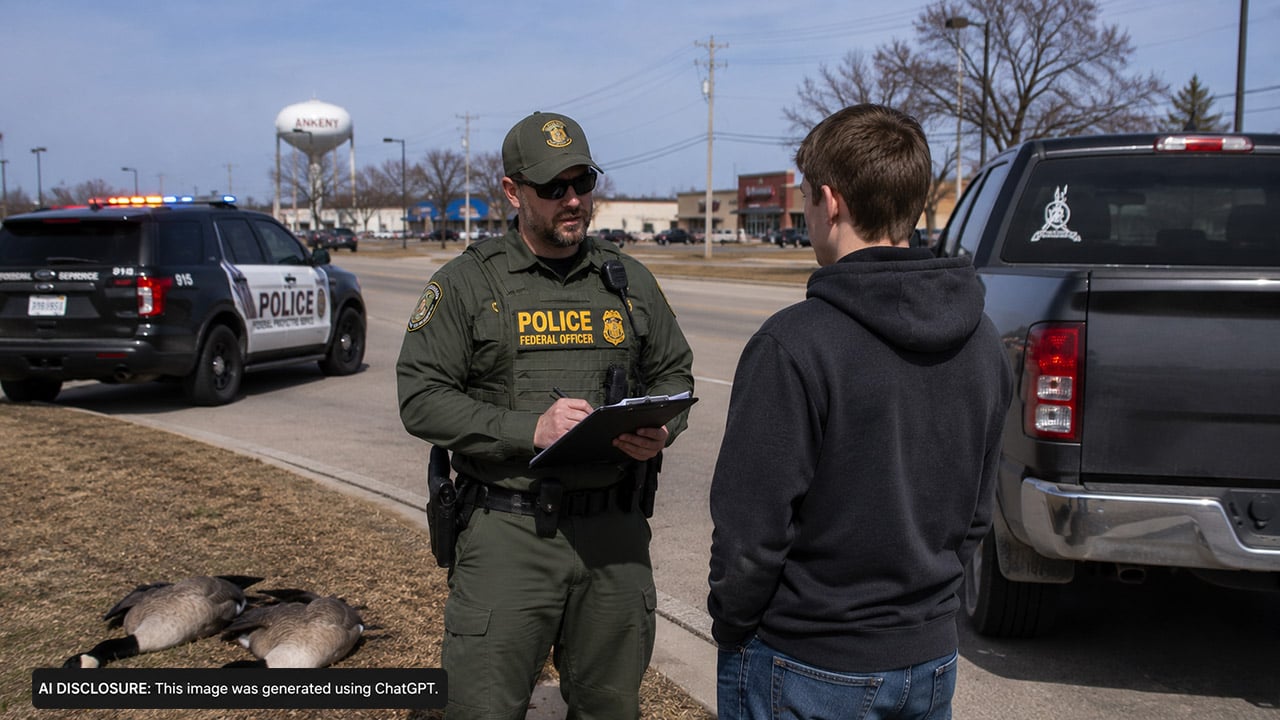
Court documents and evidence presented at a bench trial described the incident as happening on March 3, 2026. Prosecutors said Wyatt Christian Greenfield, 19, of Huxley, was driving east on N.E. 70th Avenue in Ankeny when he accelerated and swerved into the westbound lane to hit one Canada goose.
They didn’t describe it as a single bad decision or a last-second mistake. The allegation was that after striking the first goose, Greenfield swerved back into the eastbound lane and struck a second goose as well. That sequence matters, because it goes straight to intent, not accident.
Why this became a federal wildlife case
Canada geese may be common, and in a lot of places they’re a nuisance on golf courses, parks, and farm fields. But “common” doesn’t mean unprotected. Canada geese fall under the Migratory Bird Treaty Act (MBTA), a federal law that prohibits the unauthorized taking, killing, or possession of protected migratory birds.
In the hunting world, most people run into the MBTA through seasons, bag limits, and licensing. You can hunt geese legally when the framework is open and you’re following the rules. Outside of that, intentionally killing them—whether it’s with a firearm, poison, or a vehicle—can bring real consequences. This case is a reminder that the “tool” doesn’t change the law.
The conviction and what he could be sentenced to
A federal magistrate judge in Des Moines found Greenfield guilty of violating the MBTA, according to the U.S. Attorney’s Office for the Southern District of Iowa. The story doesn’t indicate a sentencing date has been set yet, but it does spell out the possible maximum penalties.
Greenfield faces up to six months in prison, up to five years of probation, up to one year of supervised release, and a $15,000 fine. That’s a steep price tag for something that could’ve been avoided by doing what any careful driver does—slow down and pass safely, or stop if conditions don’t allow it.
The piece outdoorsmen should not gloss over: it’s also a road-safety issue
Even if you strip out the wildlife-law part for a second, the driving described in court is the kind of thing that gets people hurt. Swerving into an oncoming lane to hit an animal isn’t just reckless toward wildlife; it risks a head-on collision with another driver who’s doing nothing wrong.
Most rural folks have had close calls with deer, turkeys, dogs, even coyotes. The hard truth is you can’t always miss an animal safely, and sometimes the safest move is to maintain control and ride it out. But intentionally crossing the centerline to make contact is the opposite of defensive driving. It turns a moment into a weapon.
Common-sense options he had instead
You don’t need a hunter safety card to know what the normal choices look like when birds are in the roadway. Reduce speed. Keep your lane. If it’s safe and legal, go around them with plenty of room. If traffic is tight, stop and wait them out.
If geese are causing repeated problems in a specific spot—blocking an entrance, fouling a lot, or creating hazards—there are lawful routes that involve local authorities or wildlife agencies. The key is that “fed up” doesn’t translate into “free to kill.” Under laws like the MBTA, that’s where people get themselves into trouble fast.
The outdoors has enough gray areas—property lines that aren’t marked, confusing access points, season dates that change. This one isn’t gray. Two deliberate strikes with a truck is the kind of decision that brings law enforcement, court dates, and a record, and it doesn’t do hunters and landowners any favors in the public eye.
Like The Avid Outdoorsman’s content? Subscribe to our newsletter so you never miss an article.
Here’s more from us: