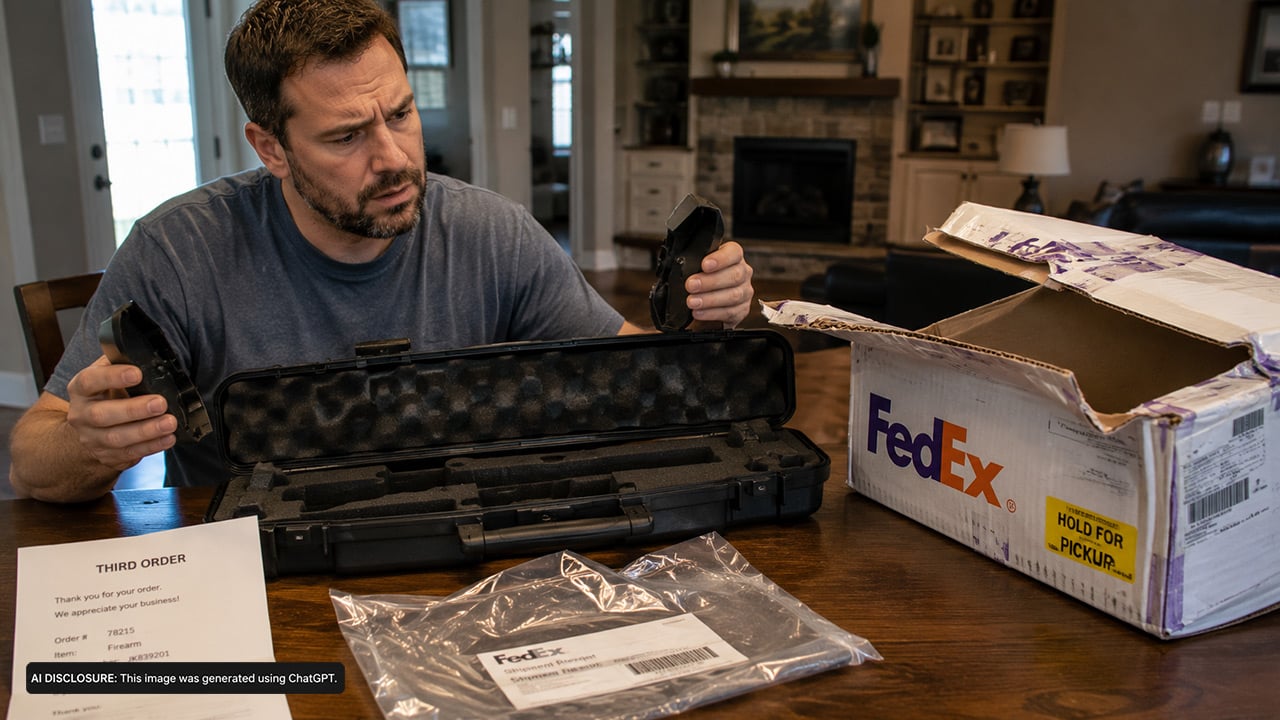
Photo credit: AI-generated image created using ChatGPT. Illustrative only
Most gun guys expect a little cardboard scuffed up when a firearm ships across the country. What they don’t expect is to open a “sealed” factory case inside two boxes and find an empty spot where the gun should be.
That’s the situation one buyer described in the original post: an AP5-P ordered from Family Firearms—his third order from the same dealer—arrived at his local FFL by FedEx, double boxed, but missing the firearm from the case inside.
A routine transfer turned into an empty case
The buyer said the AP5-P was shipped to his FFL “double boxed,” which is pretty common when dealers are trying to keep the contents discreet and reduce damage in transit. On the outside, it sounds like the shipment showed up looking normal enough to get signed in and opened for the transfer.
But once they got into it, the factory case inside didn’t match the expectation. The case was there, but the gun wasn’t. For anyone who’s ever done a transfer, that’s an immediate stop-what-you’re-doing moment—because now it’s not just missing merchandise, it’s a missing firearm with a serial number and paperwork attached to it.
The packaging details were the red flag: end caps removed
What made this story stand out was the description of the packaging. The buyer reported that both boxes had their end caps removed. That’s not a typical “tape got torn” or “corner got crushed” shipping issue. End caps being removed implies somebody got deliberate access from the end, where it’s easier to slide a case out, open it, and slide it back in.
In other words, the package could look mostly intact from the broadside while still being compromised. That’s the kind of thing that can slip by if the receiving shop is busy and the box doesn’t look like it went through a wood chipper.
Why the buyer didn’t suspect the FFL
Any time a firearm goes missing during shipping, folks immediately start looking at the handoff points: the seller, the carrier, and the receiving dealer. In this case, the buyer went out of his way to say he didn’t believe his FFL was involved. He described the FFL as a family friend of roughly 15 years.
That detail matters for two reasons. First, it shows where the buyer’s head was—he wasn’t looking to throw blame at the shop that was doing the transfer. Second, it hints at a reality many rural gun owners already understand: you pick your FFL partly on trust, and when something goes sideways, that trust affects how quickly you can work together instead of arguing.
Insurance and the “easy fix” hope
The buyer also noted they had purchased optional insurance offered by Family Firearms. If you’ve ever debated whether shipping insurance is worth it, this is the exact scenario it’s for: a high-dollar item that can’t just be replaced with a refund and forgotten about—because the legal and safety implications stick around.
Insurance doesn’t magically make the stress disappear, but it can keep you from getting trapped in a three-way finger-pointing contest between dealer and carrier. The buyer’s post framed it the same way most of us would: hopefully it’s an easy fix, assuming the paperwork and claim process goes the way it should.
What happened next: a replacement AP5-P was sent
In an update, the buyer said Family Firearms sent another AP5 with a new order number. That’s the most practical outcome a customer can hope for in a mess like this—especially when the original shipment is now a potential theft case and not just a simple “lost package.”
It also suggests the dealer treated the situation seriously and moved to make it right for the buyer, rather than dragging things out. Even so, a replacement gun doesn’t erase the uncomfortable part: somewhere along the line, an AP5-P apparently got separated from its shipment and the case still made it to the receiving end.
The practical lessons for gun owners and FFLs receiving shipments
This kind of story is a good reminder that “sealed case” doesn’t mean “secure case,” and “double boxed” doesn’t mean “tamper-proof.” If you’re the buyer, it’s worth having a quick conversation with your FFL ahead of time about how they prefer to handle inbound firearm packages—especially higher-dollar guns. Some shops already photograph incoming boxes and any visible damage before opening, which can be helpful documentation when there’s a claim.
If you’re the FFL or you receive guns regularly, pay attention to the ends of boxes and the condition of tape. A cleanly opened and re-taped end can be harder to notice than a ripped side panel. And once something looks off, the best move is to slow down: document the condition, keep everything, and don’t throw away packing material that might matter later.
It also reinforces why good records matter. Serial numbers, order numbers, shipping labels, and transfer paperwork aren’t just bureaucracy—they’re what separates an honest mistake from a full-on headache. In this case, the buyer mentioned the replacement came with a new order number, which is the kind of detail that can help keep the original incident straight while the dealer and carrier sort out the missing firearm.
At the end of the day, most of us aren’t worried about a dented box. We’re worried about a gun that’s out in the wind when it should’ve gone straight from a dealer to a licensed shop. The encouraging part here is that the seller reportedly stepped up quickly with a replacement—but the story is still a sharp reminder to inspect packages carefully, document everything, and take shipping insurance seriously when the stakes are this high.
Like The Avid Outdoorsman’s content? Be sure to follow us.
Here’s more from us: