Photo credit: AI-generated image created using ChatGPT. Illustrative only
Buying a chunk of rural ground is supposed to buy you breathing room. For one Alabama homesteading family, it’s turned into a safety problem that won’t go away, thanks to a next-door group that keeps sending rounds across a fence line.
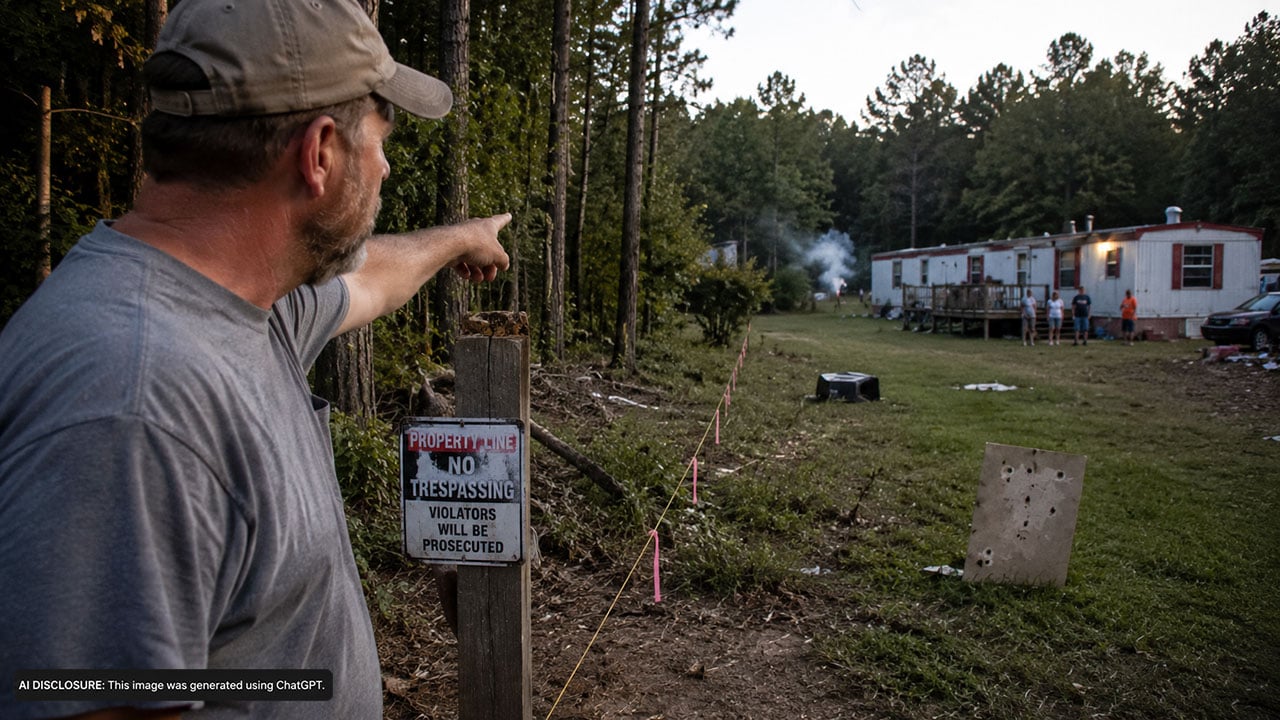
In the original post, the landowner said they bought roughly 40 acres about four years ago. The only occupied neighboring residential property borders them through a wooded edge and consists of two trailer-park lots with three or four trailers—described as a multigenerational family unit.
A fence line, a pasture, and bullets that don’t stay put
The complaint isn’t about hearing gunfire in the country. It’s about direction and backstop—shooting from a backyard and having bullets cross onto someone else’s land. The landowner said it’s happened numerous times, enough that her husband has spoken directly to the neighbors at least three times in the past two years.
After a survey, the family marked the boundary and put up a wire fence. Even with that clear line in place, the shooting reportedly continued, and the conversations didn’t change behavior.
The moment that removed any doubt
A few weeks before the most recent incident, the husband reportedly caught the neighbors with a small-caliber rifle, shooting through the fence at a log. That’s the kind of detail that makes rural folks sit up straight, because it means the shooter isn’t just “close to the line”—they’re sending rounds through a boundary marker.
He told them plainly they couldn’t shoot onto their property. The landowner also suspects it may be happening more often than they know, simply because they work and aren’t home all day to hear every shot or see where every muzzle is pointed.
When kids and cattle are in the picture, it’s no longer just annoying
The incident that pushed the family to the edge, according to the post, happened recently when the landowner was farther out on the property. She said she had walked through the area with her children not five minutes before.
Then, she heard what she believed were larger-caliber bullets and their approximate direction—across a pasture the family owns. The cattle in that vicinity were spooked and started running and panicking. She even wondered if the shots were intended to be close to the cattle, or possibly at them.
Her husband went to confront the issue immediately, but by the time he got there—about a minute’s walk from their backyard—the neighbors had already gone back inside.
Law enforcement contact didn’t bring the response they hoped for
The family contacted law enforcement and filed a report. What they were told, according to the post, is a frustrating reality in some county settings: until there are damages—an injured person, hit livestock, or other tangible loss—the situation is treated as a civil dispute.
The landowner said she doesn’t think officers even spoke with the neighbors. She described patrol as a quick drive-by of the loop before leaving. And because the shooters aren’t physically trespassing, she was told they can’t be charged with trespass either.
That leaves the family in a spot a lot of rural landowners recognize: you’re trying to prevent the worst-case scenario, but the system often reacts hardest after something bad has already happened.
Looking for proof: cameras, recordings, and staying on the right side of the line
The landowner’s next question was practical: how do you document this without making it worse or getting yourself in trouble? She asked about putting up game cameras to collect evidence, but worried about filming the neighbors in their yard since they wouldn’t be on her property.
She also noted they discussed recording any future conversations when they go to speak with the neighbors, and that her state is a one-party consent state. Along with the fence they already installed—replacing a bad, old wire fence at their own cost—she’s considered adding something more solid, like tin, to help prevent rounds from coming through. But she’s worried that would be expensive, aggravate tensions, and potentially become a target itself.
From an outdoorsman’s standpoint, the core issue is still the same: bullets need a safe backstop, and nobody has the right to use your land—intentionally or carelessly—as part of their “range.” If you’re in a situation like this, documentation tends to be the difference between “he said, she said” and a record that shows frequency, direction, and risk.
A rural reality: you still have to live next to them tomorrow
One detail that matters is history. The landowner believes there are negative feelings because the property was uninhabited for over 10 years before they bought it, and the neighbors may have gotten used to doing whatever they wanted along that edge. That’s a common flashpoint in the country—new owners show up, set boundaries, and suddenly old habits turn into conflict.
But the practical problem isn’t hurt feelings. It’s that a pasture with kids and livestock is not a safe place for rounds to be skipping through, and a wire fence is not a backstop. If someone is truly shooting “through the fence,” that’s a sign they either don’t understand what safe shooting looks like—or they don’t care.
At that point, most folks start thinking in layers: keeping family members out of that line-of-fire area when possible, documenting every event with dates and times, continuing to report it, and considering professional advice if it keeps happening. Nobody wants to “lawyer up” as a first move, but nobody wants to gamble with a stray round either.
It’s a hard situation because the family is doing what responsible landowners do—surveying, fencing, speaking directly, and trying to handle it calmly—while the risk keeps showing up anyway. In rural America, good neighbors make life easy. The wrong kind can make you feel like you’re stuck on watch in your own backyard.
Like The Avid Outdoorsman’s content? Be sure to follow us.
Here’s more from us: