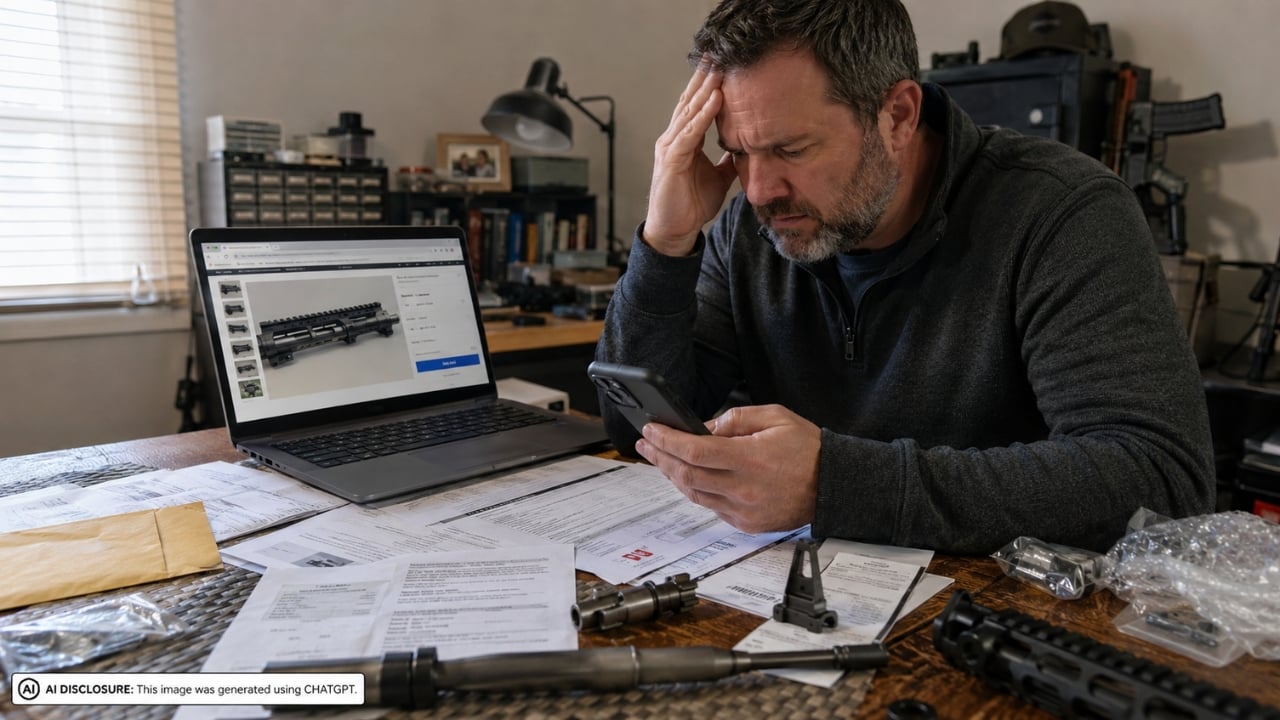
Photo credit: AI-generated image created using ChatGPT. Illustrative only
Most folks who’ve paid a gunsmith for specialty work understand two things going in: good craftsmanship takes time, and small shops can get backed up fast. But there’s a difference between a backlog and feeling like you’ve been put on the back burner while your exact order gets sold out from under you.
That’s the corner one gun owner says he got painted into in the original post, describing a nearly two-year wait for a rifle conversion kit that was quoted at three to six months—followed by the frustration of seeing similar completed kits being sold elsewhere while his stayed unfinished.
A straightforward order turned into a long, quiet wait
According to the account, the buyer paid for a conversion kit from a gunsmith/FFL known for producing those kinds of kits and carrying a “fairly good reputation” from what the buyer could gather. The quoted build time was three to six months, which is a normal-enough window in the custom world if you’ve been around rifles, triggers, or barrel work.
Then the months stacked up. The buyer said he called and emailed repeatedly, only to get a steady stream of excuses and what he described as “the run around.” Communication was slow, with replies sometimes taking about a month.
The moment that changed everything: watching similar kits get sold
The part that would make most gun owners see red wasn’t just the delay—it was what the buyer noticed during that delay. He said he saw the same type of completed kits he had ordered being sold on GunBroker.
From the buyer’s perspective, that looks like the worst-case scenario: a shop taking payment, not delivering on the promised timeline, and still finding time to sell comparable work to somebody else. Whether it was the exact kit or another of the same type isn’t spelled out, but the buyer’s point was simple—completed kits were leaving the shop while his order dragged into year two.
What the gunsmith had in hand, and what the buyer was still owed
This wasn’t described as a simple “send money, wait for box” deal. The buyer clarified that he had sent parts to the gunsmith: a front sight blade, and payment for a new bolt head. The gunsmith was supposed to manufacture a barrel and a magwell adapter, and also modify the sight and bolt head.
That matters because once you mail parts off, you’re not just waiting on a product—you’re separated from pieces you may not be able to easily replace. For hunters and shooters, that can mean an entire rifle sidelined for a season or two, not to mention the headache of trying to track what’s been shipped, what’s been altered, and what condition it’s in.
The refund request got a fast response—followed by a refusal
After almost two years, the buyer said he’d had enough and asked for a refund. Interestingly, he claimed the gunsmith responded within minutes—after taking much longer to answer other emails.
The response, as described, leaned on personal problems and how the gunsmith’s life was in rough shape. The buyer wasn’t buying it as a reason to hold money indefinitely, and he believed the gunsmith was in breach of contract by refusing the refund. He also suggested there “may be” other illegal acts involved with the practice, though he didn’t lay out specifics beyond the pattern he was seeing.
He also said he’d talked with other people who reported the same issues with the same gunsmith—long delays, poor communication, and similar complaints—adding to the sense that this wasn’t a one-off misunderstanding.
When the problem is out of state, the “easy” options don’t feel so easy
One of the most practical details in the account is the buyer’s hesitation about small claims court. The gunsmith is out of state, and the buyer noted that jurisdiction can get messy when you’re trying to file from your home state against somebody across a border.
That’s a real-world snag that hits gun owners more often than people think, especially with specialty work. The best shotgun smith might be three states away. The one guy who still does that obscure conversion might be on the other side of the country. When things go well, it’s great. When they don’t, you quickly learn that “just take him to small claims” isn’t always as simple as it sounds.
The buyer also mentioned he didn’t want to “start a witch hunt,” even though he considered sharing the correspondence. That’s another common fork in the road: you want accountability, but you don’t want to set off an internet pile-on that muddies the water or creates new problems.
What gun owners tend to focus on in situations like this
The post itself asked whether anyone had pursued legal action for services not rendered by a gunsmith/FFL who wouldn’t complete the work. While the pasted material doesn’t include the replies, the questions being asked tell you what experienced gun folks usually zero in on: documentation, paper trails, and the status of any parts in the shop’s possession.
In practical terms, situations like this usually come down to a few basics. Do you have a written invoice, a quoted timeline, and proof of payment? Do you have shipping records showing what you sent? Are the parts serialized or otherwise identifiable? And can you show a clear record of attempted contact and the shop’s responses?
None of that magically produces your kit, but it’s the difference between a clean, factual dispute and a he-said/he-said mess. It also helps you keep your own emotions in check—because once you start feeling burned, it’s easy to send a message you wish you hadn’t later.
Most importantly for everyday gun owners: if a shop has your parts, the priority isn’t arguing online—it’s getting your property back in known condition. Even if the smith is overwhelmed, even if there are personal issues, your rifle parts shouldn’t be held hostage indefinitely.
Custom work is part of gun culture, and plenty of small shops do honest, top-shelf work. But this is a good reminder that “good reputation” isn’t a contract, and a long wait isn’t automatically proof of quality. If you’re putting money down and mailing parts off, treat it like any other serious transaction: get it in writing, keep your records, and don’t let months turn into years without a clear plan for getting either the finished work or your money and parts back.
Like The Avid Outdoorsman’s content? Be sure to follow us.
Here’s more from us: