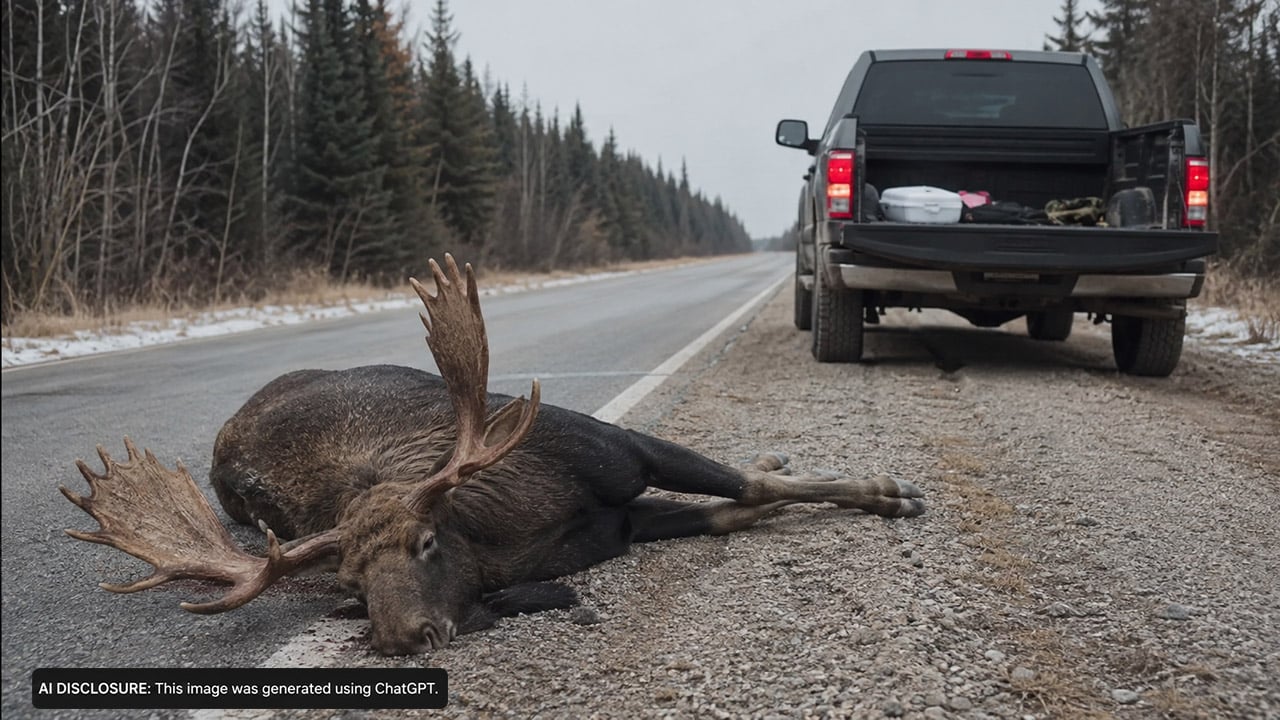
Photo credit: AI-generated image created using ChatGPT. Illustrative only
Road hunting stories usually have a familiar set of ingredients: a truck on the shoulder, a rushed shot, and a mess that didn’t need to happen. In this case, it ended with a major fine and a long ban after a Wisconsin man killed a moose from the roadway near Pickle Lake, Ontario, without having the required paperwork.
Details shared in the source post say the man was found guilty of discharging a firearm down the travelled portion of a roadway, hunting moose without a licence, and possessing illegally killed wildlife. The penalties added up to nearly $29,000, along with a 10-year Ontario hunting ban.
A bad decision in a place where the rules are clear
Most hunters understand the basics before they ever head north: tags and seasons matter, and big game paperwork isn’t optional. Moose are one of those animals that come with tight controls for a reason—limited opportunities, real management needs, and a lot of eyes on the system.
When someone shoots a moose without a licence, it isn’t a “forgot my license in the glovebox” problem. It’s a straight-up illegal kill. And in Ontario, like most places with a strong conservation culture, the consequences can be stiff.
The roadway part is more than a technicality
The charge about discharging a firearm down the travelled portion of a roadway is the kind of thing non-hunters sometimes shrug off—until you put yourself in the shoes of a family coming around a bend, or a truck driver topping a hill. Roads are shared spaces. Bullets don’t care about intentions.
Even in remote country where traffic is light, the risk is still real. Shooting “from the road” or “across the road” has been a quick way to lose hunting privileges for decades, and for good reason. It’s not just about fair chase. It’s public safety, plain and simple.
No licence, no moose—possession makes it worse
Another key detail here is the possession charge tied to illegally killed wildlife. Some folks don’t realize how quickly trouble stacks up once an animal is down. The act of taking the animal is one problem. Keeping it, transporting it, or otherwise possessing it adds another layer.
In practical terms, the law is set up to remove any benefit from the illegal kill. If you weren’t allowed to take it, you don’t get to keep it, and you don’t get to treat it like a trophy or a freezer-filler. That’s part of why penalties can climb so fast.
The real cost: money, time, and losing years of hunting
Nearly $29,000 gets your attention whether you’re a resident hunter or a visitor. That’s not “pay the ticket and move on” money for most working people. It’s the kind of hit that can wreck a season, strain a household budget, and follow you for a long time.
But the 10-year Ontario hunting ban is the part that should make any hunter pause. A decade is a long time to sit out. It means no fall trips, no once-in-a-lifetime draws, no opportunities to do it the right way—even if you learn your lesson the day after it happens.
What people latched onto: safety and the avoidable nature of it
When stories like this make the rounds, hunters tend to focus on the same two points. First, the roadway shot. That’s the kind of decision that gives the public—and anti-hunting voices—easy ammunition. It’s hard to defend, and it doesn’t reflect how most hunters operate.
Second, the licence issue. There’s no mystery here: if you don’t have the proper licence, you don’t squeeze the trigger. It’s as basic as verifying your target and what’s beyond it. The frustration, for many, is that legal hunters pay for tags, follow seasons, and do the work—then somebody blows it up with one reckless moment.
How to keep a hunting trip from turning into this
You don’t need to be a lawyer to avoid this kind of outcome. If you’re crossing borders to hunt, make “paperwork and rules” part of the same checklist as fuel, boots, and ammo. Know what species you’re licensed for, where you can hunt, and what the regulations say about roads and firearms discharge.
And if an animal steps out near a roadway, the right move is boring: let it walk. Get off the road legally, get onto a legal hunting area, and take the shot only if you can do it safely and within the rules. Passing up an opportunity stings for about five minutes. A huge fine and a decade-long ban sticks around a lot longer.
Most of us want hunting to stay strong—socially, legally, and culturally. That only happens when the basics are respected: licences in hand, safe shots, and no shortcuts. This case is a hard reminder that the cost of ignoring those basics can get steep in a hurry.
Like The Avid Outdoorsman’s content? Subscribe to our newsletter so you never miss an article.
Here’s more from us: