Photo credit: The Avid Outdoorsman
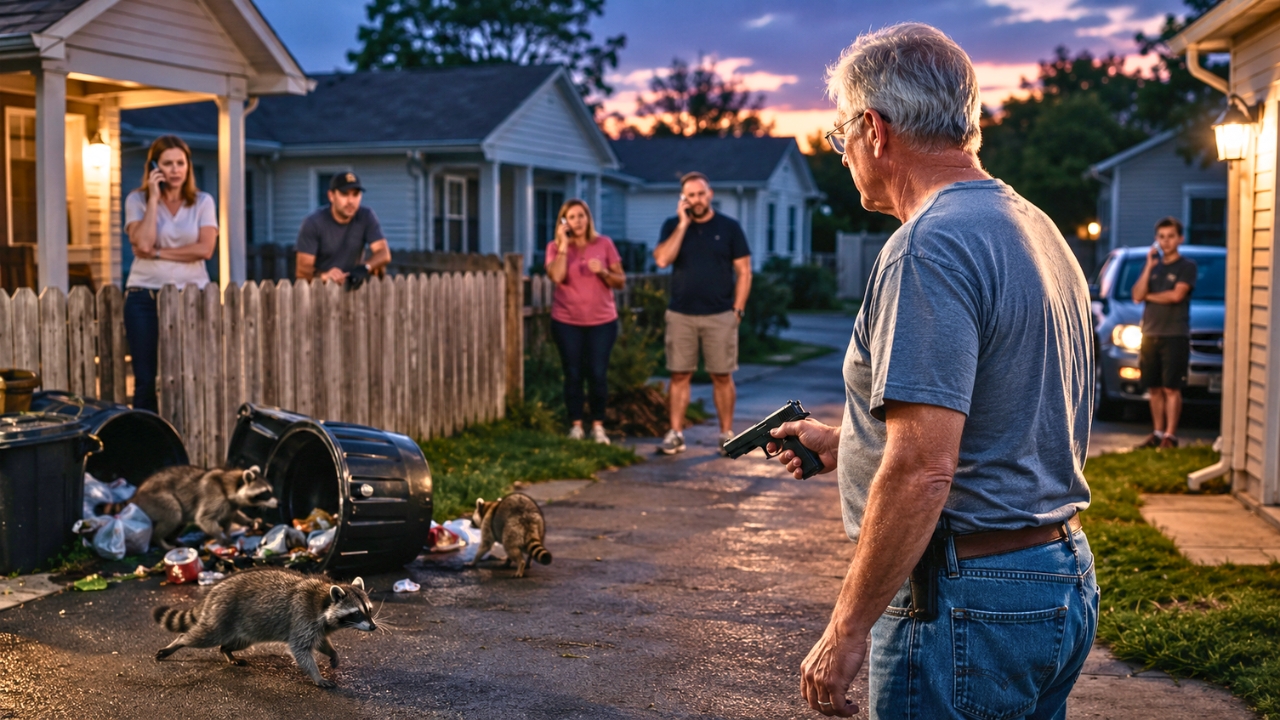
A couple of quick pops in the dark can change the mood of a whole subdivision. That’s exactly what happened when a retired cop stepped out behind his house to deal with a pair of raccoons that had been tearing up trash cans and showing up too close to pets. He’d seen the mess for weeks, and that night he decided he was done with it.
The problem wasn’t just the raccoons. It was the setting: close fences, tight backyards, and houses stacked in every direction. Within minutes, porch lights came on, phones came out, and the first 911 call hit dispatch. Before it was over, there were 11.
The raccoons weren’t new, but the gunfire was
Neighbors had been grumbling about the masked bandits for a while. Overturned bins, ripped bags, and the occasional “something got in the garage again” story had become normal. A few folks tried bungee cords and heavier lids. Some left lights on. Some set out motion sprinklers. Nothing really stuck.
That’s when the retired officer decided to handle it like a nuisance critter problem instead of a neighborhood annoyance. He’d reportedly seen raccoons out near the back fence line after midnight, grabbed a firearm from inside, and fired multiple rounds toward the animals.
In a subdivision, every shot sounds like it’s in your yard
If you’ve ever lived where houses sit 20–30 yards apart, you know this part. One shot echoes off vinyl siding, fences, and garages, and it’s hard to tell direction or distance. To the neighbor two doors down, it might as well be coming from their patio.
That’s why the phone lines lit up. Some callers reported “someone shooting at animals.” Others just said “gunshots behind the houses.” In that environment, dispatchers and responding officers have to treat it like a safety issue first and a pest-control issue second.
Police response centered on safety, not the raccoons
When officers arrived, they didn’t roll up looking for a wildlife violation. They were trying to figure out who fired, what direction the rounds went, whether anyone was hurt, and whether there was an immediate threat.
The retired officer reportedly made contact quickly and explained what he’d done. Being former law enforcement doesn’t give anyone a free pass, but it does mean he understood what questions were coming and why. Officers checked the area for damage, looked for impacts, and worked to confirm that rounds hadn’t crossed property lines into a home, fence, or vehicle.
That last part matters. In most places, the difference between a stern warning and a citation is whether there was a clear violation like firing within restricted limits, reckless discharge, or property damage. If there’s no damage, no injuries, and no obvious criminal intent, some departments lean toward documenting the incident and moving on.
Why nobody got cited (and why that frustrates people)
In many suburbs, there are overlapping rules: city ordinances about discharging firearms, state laws about reckless endangerment, and sometimes exceptions for lawful defense of people or property. Then there’s the messy reality that not every neighborhood is inside city limits, and some “subdivisions” sit in county pockets where rules are different.
In this case, the responding officers reportedly didn’t issue a ticket. That doesn’t automatically mean the shooting was “legal” in the way most folks mean it. It can also mean the elements of a specific charge weren’t met, there wasn’t enough evidence to prove where rounds went, or the local ordinance had gray areas—especially if the officer was on his own property and there was no proof a round left it.
To the neighbors who called 911, that feels like nothing happened. To the officers, it can be a practical decision: stop the behavior, document the call, and prevent the next round of shots. That’s often the goal at 1 a.m. in a neighborhood where everyone’s on edge.
What neighbors and gun owners argued about afterward
When word spreads in a neighborhood like that, two camps form fast. One side says, “Raccoons are a problem and he handled it.” The other side says, “You don’t touch off rounds behind a fence line with kids sleeping 30 feet away.”
Plenty of gun owners land in the middle. They understand nuisance wildlife and they also understand backstops. A fence is not a backstop. A row of shrubs isn’t either. If you can’t guarantee where every round goes, you’re gambling with somebody’s kitchen window.
There’s also the animal side of it. Raccoons can carry rabies, and an aggressive or oddly fearless raccoon isn’t something you shrug off. But there are better ways to handle that than turning a cul-de-sac into an impromptu range.
The practical options that would’ve caused less trouble
If you’re dealing with raccoons in tight quarters, the “right” answer depends on local laws and your property layout. But there are a few options that usually keep you out of trouble.
First is prevention: locking lids, securing feed, cleaning grills, and not leaving pet food out. It’s boring, but it works more often than people want to admit. Second is calling animal control or a licensed nuisance wildlife trapper. If the critters are bold, active during daylight, or acting sick, that call is even more important.
Third is understanding what you can legally do yourself. Some states allow landowners to take nuisance raccoons under certain conditions; others require permits or prohibit certain methods inside municipal limits. Even where it’s allowed, discharging a firearm can still be illegal due to local ordinances. The critter rules and the gun rules are not the same thing.
If lethal removal is on the table, many folks use tools and methods that don’t send projectiles sailing through a neighborhood. That’s not about being squeamish—it’s about controlling risk in a place where your “miss” becomes somebody else’s emergency.
This whole situation is a good reminder that suburban wildlife problems can turn into law enforcement problems in a hurry. The raccoons may have been the reason, but the real issue was rounds being fired where people don’t expect them. When you live stacked together, you don’t just have to be right—you have to be safe, smart, and clearly inside the lines of your local rules.