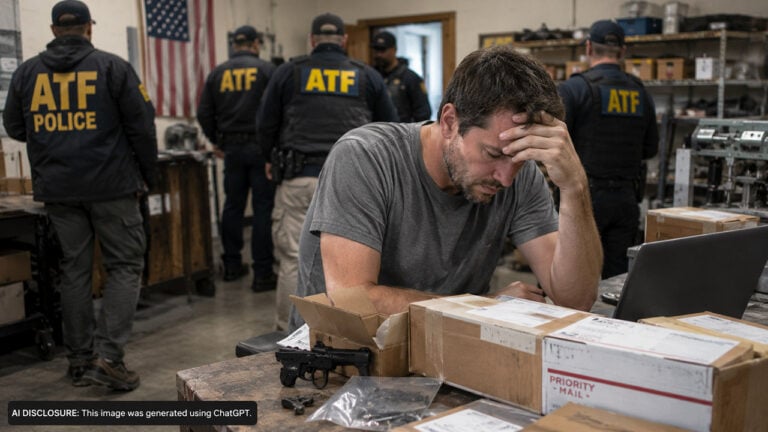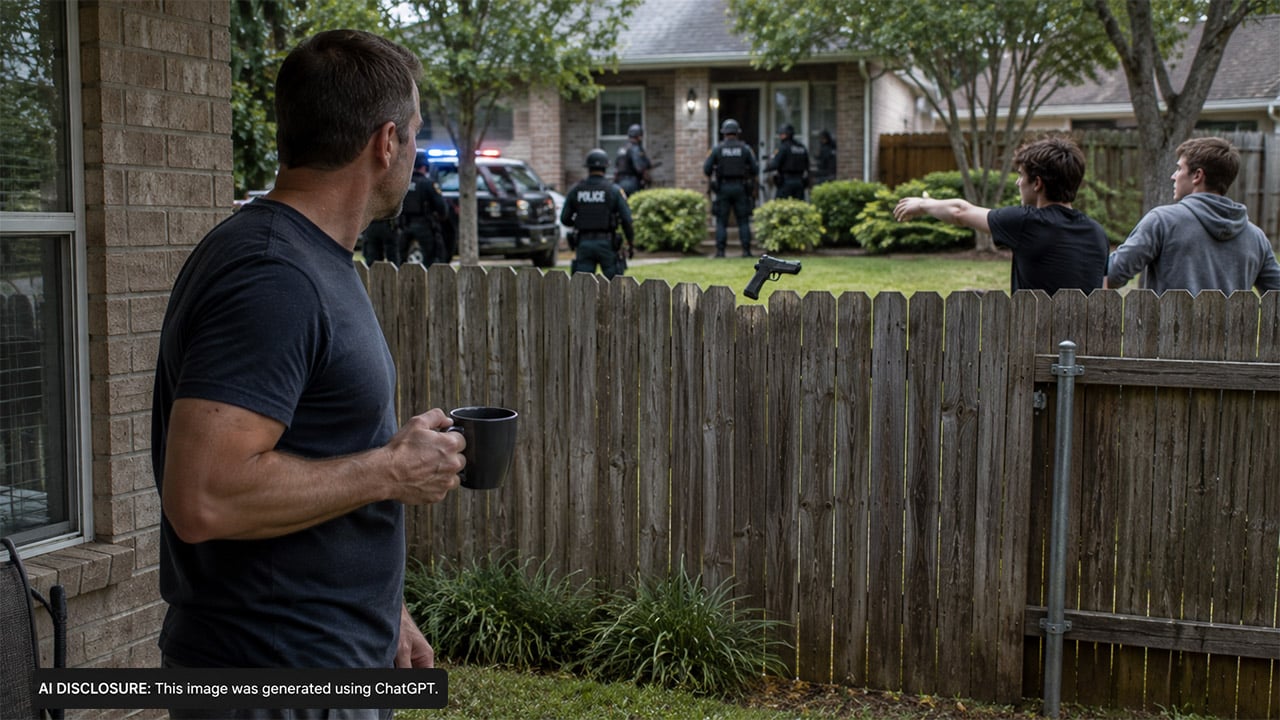
Photo credit: AI-generated image created using ChatGPT. Illustrative only
When the cops hit a house in your neighborhood, most folks watch from the porch, shake their head, and get back to their own business. But one Arlington, Texas man says the raid next door didn’t end when the squad cars pulled away—it spilled right into his backyard and freezer. In the original post, he described waking up to a situation that can put an innocent person in handcuffs fast: other people’s illegal items sitting under his roof.
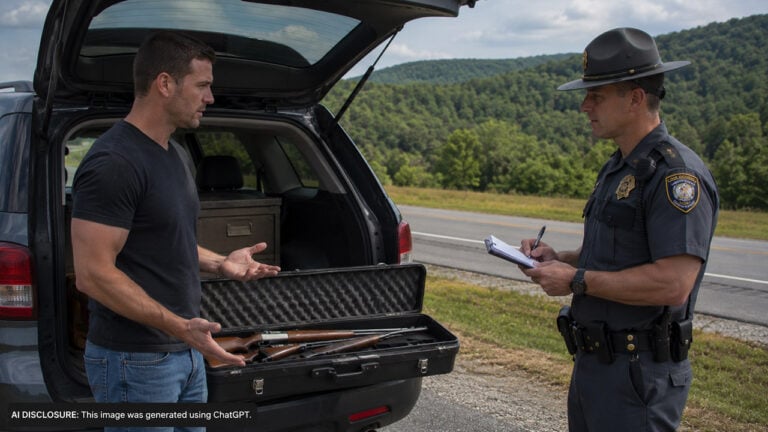
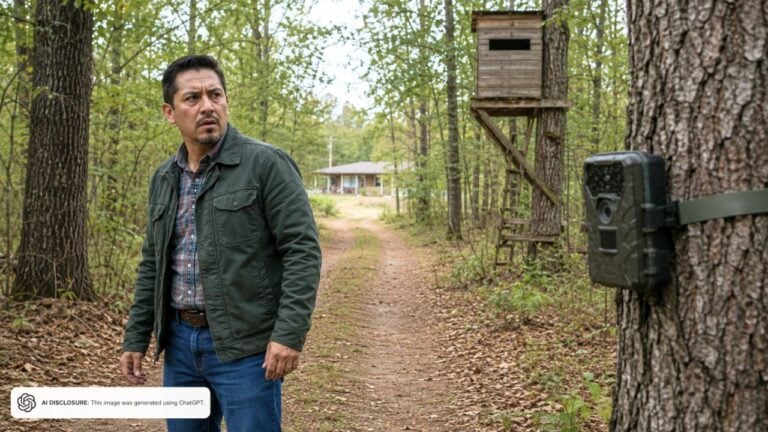
According to the man, his neighbors—teenagers—had recently been the target of a police raid that involved multiple marked vehicles and unmarked units. He said officers took “a lot of guns” and arrested the neighbors’ dad. Two days later, he claims the same teens started using his place as a stash spot, including tossing an unserialized pistol over the fence into his backyard.
A bad arrangement turned into a real-world liability
The man said he’s staying with a friend and another roommate who owns the home while he tries to get his own apartment. That kind of temporary setup is common—couch for a while, help with bills, keep your head down. But it gets complicated when the homeowner’s habits bring trouble to the property line.
He wrote that the homeowner used to buy marijuana from the teenagers next door. He didn’t like it, but he also didn’t feel like he had much leverage. That’s the part a lot of folks recognize: you can be making good choices personally, but still get dragged into someone else’s mess when you share a driveway, a lease, or even just a fence line.
The raid next door raised the stakes
The story takes a sharper turn after the police raid. The man said the neighbors’ dad was arrested and guns were taken from the raided home. Whether that raid was drug-related, gun-related, or both, the practical takeaway is simple: law enforcement already had eyes on that house.
When a place gets hit like that, the people left behind sometimes panic. They dump property. They move contraband. And they look for the easiest “not my house” option around—which can mean the closest buddy, the closest shed, or the closest neighbor who won’t make waves.
An unserialized pistol over the fence is not a “finders keepers” moment
The man said the teens placed a pistol and a shotgun that were missing serial numbers, and that one of them tried to sell him a gun. He said he told the teen plainly, “I don’t want a gun,” but later the pistol still ended up in his backyard after being tossed over the fence.
If you’re a gun owner, you already know how ugly that looks from the outside. A gun with no serial number is the kind of thing that doesn’t get treated like a misunderstanding during a contact with police. Even if a person never touched it, a firearm sitting on their property can become a “possession” question in a hurry—especially if it’s discovered during a search tied to some other investigation.
There’s also the safety side. A mystery gun dumped in a backyard isn’t just a legal hazard; it’s a physical one. Kids play in backyards. Dogs find things. A roommate might pick it up, handle it wrong, or try to hide it in a closet. The longer it sits there, the more chances something goes sideways.
It wasn’t just guns—there was reportedly drugs in the freezer
As if the backyard gun wasn’t enough, the man said the teens also left “lean” in the home’s freezer. That’s where the situation shifts from a neighbor problem to a household emergency, because now it’s not a single dumped item outside—it’s contraband stored inside the residence.
When illegal substances are in a common area like a kitchen or garage freezer, the “who knew what” questions get messy. Roommates start pointing fingers. Everyone suddenly claims they were “barely home.” And if police return to the neighborhood—especially if they’ve seen the teens coming and going—an innocent person can still end up spending a long night explaining their life choices.
The fear was calling police too late—or getting blamed anyway
The man’s biggest question wasn’t whether the situation was bad. He knew it was. He said he wants to reach out to police but worries about being profiled, and he worried about how to explain knowing the information for two days without acting.
That hesitation is common. Folks imagine that making the call automatically makes them the suspect. Or they picture their home getting torn apart in a search. Or they’re worried the neighbors will retaliate if they find out who called. None of those fears are imaginary, especially when the people involved are already acting reckless.
But there’s another truth most outdoorsmen understand: problems don’t improve on their own. A dumped gun doesn’t turn into a clean conscience. And drugs in your freezer don’t become “not your problem” just because you ignored them long enough.
The man said nobody else in the house wanted to stand up for the home but him, and he didn’t want to “go to prison over this.” That’s the right instinct. You don’t play tough guy with armed teenagers, and you don’t try to “store” questionable items until it blows over.
The practical approach in a situation like this is about two things: safety and distance. Safety means not handling items unnecessarily, not escalating a confrontation, and not letting roommates treat it like a joke. Distance means making it clear—to the people dumping items and to law enforcement—that you are not participating, not consenting, and not covering for anybody.
In plain outdoorsman terms: if someone tosses a hot gun over your fence, you don’t hang it in the safe like it’s found treasure. And if someone puts illegal drugs in your freezer, you don’t “wait and see” if they come back for it. You take steps to protect yourself and your household before that problem gets upgraded by a badge and a warrant.
For the guy in Arlington, the clock was already running. He said he believes the neighbors “WILL get raided again” and worried police may have seen the teens coming over. That’s not paranoia—that’s pattern recognition. When law enforcement has already hit a house, the return trip is always possible, and the people nearby are the ones who get caught up in the blast radius.
In the outdoors, you learn early that you can’t control the weather, but you can control whether you’re prepared when it hits. This situation is the same. The man may not be able to control what the teens do next door, but he can control what sits in his backyard and freezer—and how quickly he separates himself from it.
Like The Avid Outdoorsman’s content? Subscribe to our newsletter so you never miss an article.
Here’s more from us: