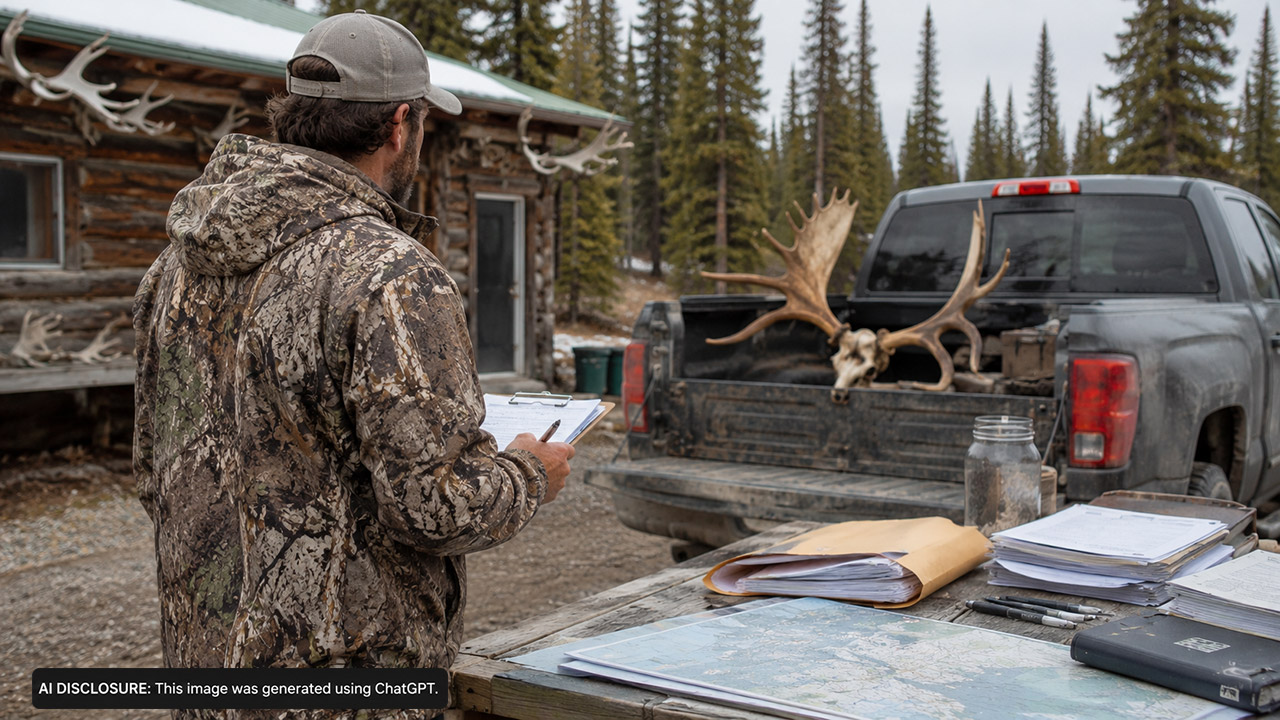
Photo credit: AI-generated image created using ChatGPT. Illustrative only
Most nonresident hunters only get so many big trips in their lifetime. You save money, burn vacation days, book flights, ship gear, and picture that first cold morning in moose country. That’s why a fake outfitter can do more damage than just the dollars—they can wipe out a season.
Federal prosecutors say that’s exactly what happened in western Alaska, where a St. Mary’s man collected deposits from dozens of hunters while never holding the licenses needed to guide, outfit, or transport big game hunters in the state. The details were laid out in the original post, along with the sentence and restitution order.
Alaska says he was never licensed, but he advertised anyway
According to court documents, Michael Beans began advertising guide-outfitter and transporter services for bull moose seasons in October 2021. Prosecutors say Alaska had never licensed him as a big game guide, outfitter, or transporter.
The way it was described, the sales pitch wasn’t happening through a storefront or a booth at a sports show. It was direct contact—texts, phone calls, and social media messaging—where it’s easy to make things sound legitimate and hard for a hunter to “read the room” like you can in person.
Discounts for paying early turned into a pipeline of deposits
One of the oldest tricks in the book is using a “discount” to speed up a decision. Prosecutors say Beans promised discounts to hunters who paid upfront, sometimes months before the hunt.
Between October 2021 and December 2022, he allegedly collected more than $59,000 in deposits, advance payments, and other funds from roughly 37 nonresident hunters. These weren’t just casual inquiries—these were people putting real money down for guided and/or transported bull moose hunts.
Hunters flew into St. Mary’s, and then the wheels came off
The story takes a hard turn in early September 2022. Prosecutors say the first group of hunters arrived in St. Mary’s on Sept. 1 after traveling in from across the country.
Instead of meeting them and starting a hunt, Beans allegedly canceled every contracted hunt and never met a single hunter face-to-face. If you’ve ever coordinated bush travel, gear, meat care, and the timing of a rut hunt, you know how serious that is. When a hunt gets canceled at the last minute in Alaska, you don’t just “pivot”—you’re stuck holding airline tickets, freight costs, lost time, and a season that doesn’t wait.
Refunds didn’t come, except for one small payment
After the cancellations, prosecutors say no refunds were provided to the hunters—except for $700 returned to one hunter.
That’s a brutal detail because it’s the part that turns a “bad operation” into something that looks like straight fraud. A legitimate outfitter can have a wrecked season from weather, aircraft problems, mechanical issues, or family emergencies. But reputable outfits communicate early, put terms in writing, and handle money in a way that doesn’t leave clients twisting in the wind.
Three hunters tracked him down and still went hunting
There’s one episode that stands out because it shows how far some hunters will go to salvage a trip once they’re already on the ground. From Sept. 19 to Sept. 24, 2022, three hunters arrived in St. Mary’s to hunt with Beans.
Prosecutors say he tried to cancel, but the hunters tracked him down. He took them out anyway and helped them kill three bull moose. That single detail matters for two reasons: it shows the hunters weren’t just sending money into the void—they were actively trying to make the trip happen—and it’s also where the legal problems tied to wildlife took a different shape.
The case ended in prison time and restitution, plus a warning shot to the industry
In April 2023, Beans was arrested and charged with two felony counts for violations of the Lacey Act and 19 felony counts for wire fraud connected to the sale of the illegal moose hunts. On Oct. 1, 2024, he pleaded guilty to one count of Lacey Act violations and one count of wire fraud.
A federal judge sentenced him to three years in prison, followed by three years of supervised release. He was also ordered to pay $64,110 in restitution, broken out to each victim.
U.S. Attorney Michael J. Heyman said Beans “egregiously exploited unsuspecting hunters” and that the conduct was “an affront to the law-abiding guide-outfitters who respect Alaska’s wildlife community,” adding that the office is committed to enforcing hunting regulations and holding violators accountable.
What hunters can take from it before booking a big trip
Most hunters already know the basics—get things in writing, ask questions, and don’t let excitement override common sense. But this case is a reminder that the “legit check” has to happen before the first deposit leaves your account, especially for nonresident hunts where guides, outfitters, and transporters are tightly regulated.
At a minimum, hunters should verify that whoever is selling the hunt actually holds the right Alaska authorizations for what they’re offering. A person can sound credible on the phone and still be operating outside the law. And once the season hits and you’ve traveled, your options get expensive fast—because the moose woods don’t care that somebody on the other end of a text thread promised a discount.
The outdoor world runs on trust, reputation, and word-of-mouth. Cases like this don’t just hammer the hunters who got taken—they also drag honest guide-outfitters into a cloud of suspicion they didn’t earn. The best protection is doing the homework early and treating licensing and payment terms like critical gear, not afterthoughts.
Like The Avid Outdoorsman’s content? Subscribe to our newsletter so you never miss an article.
Here’s more from us: