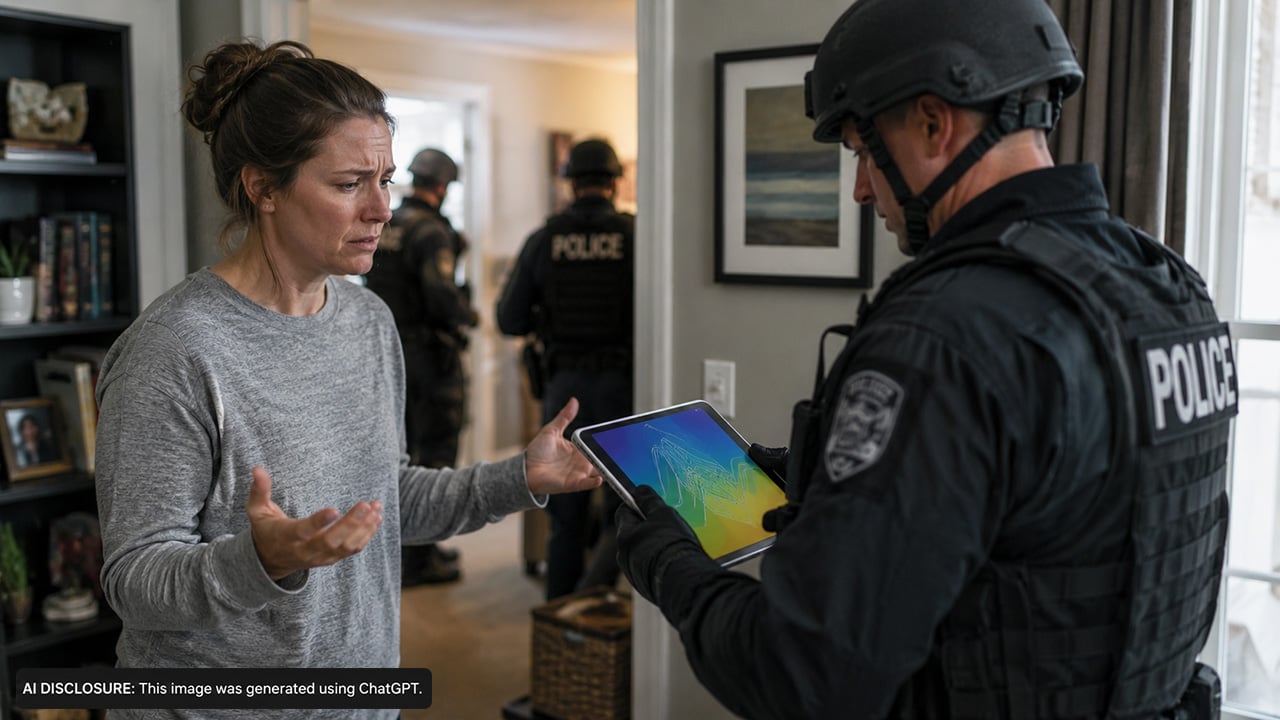
Photo credit: AI-generated image created using ChatGPT. Illustrative only
A duplex can feel like the best of both worlds: your own four walls, but a shared footprint that keeps costs down. The downside is you’re only as quiet as the unit next door—and when law enforcement shows up looking for guns and narcotics, that shared footprint can turn into a long morning in handcuffs.
That’s the situation a Minnesota couple described in the original post, after a SWAT-backed search warrant aimed at their downstairs neighbors expanded into their upstairs unit. They say they weren’t suspects, had no connection to the neighbors beyond passing greetings, and still watched officers walk out with an iPad used for artwork that helps pay the bills.
A 7 a.m. raid, a shared entryway, and two different addresses
The couple lives in the upstairs unit of a duplex with separate house numbers, separate front doors inside the entryway, separate mailboxes, and separate utility meters. The only shared spaces they described were the entryway, a garage, and basic things like trash cans. In other words, it’s not one big “family home” with a bedroom upstairs—it’s two distinct residences under one roof.
According to the account, Minneapolis police arrived at 7 a.m. with multiple officers and SWAT, blocked off the street, and forced entry through the shared entryway door. They then breached the downstairs unit’s door and also hit the garage man door hard enough to leave a small dent in the couple’s car parked inside.
The upstairs residents say their own unit door was the only exterior door still working afterward—because they opened it themselves when told to come out with their hands up.
Rifles up, cuffs on, and two hours in the back of a squad car
Most outdoorsmen I know don’t panic around guns, but there’s a big difference between a buddy showing a new rifle and a team pointing rifles in your face before you’ve had coffee. The couple says officers shoved rifles toward them, cuffed them, and placed them in the back of a squad car for about two hours while the search played out.
They were uncuffed after roughly an hour, but still weren’t allowed to leave the vehicle. The writer also noted being disabled, and said the tight cuffing and extended time in that position caused significant pain.
Early on, officers reportedly told them the warrant was for the downstairs address and asked repeatedly if they lived there. The couple says they told police they lived upstairs, had moved in less than six months prior, and had no real relationship with the downstairs tenants.
How the search widened to the upstairs unit
This is where the situation starts to feel like the kind of “property line” confusion hunters and rural landowners know too well—except the stakes are higher when it’s a warrant. The couple says officers asked whether the apartments connected beyond the interior doors. They do not, according to the post.
They also say police repeatedly asked the wife if she was a specific downstairs neighbor, which she wasn’t. The writer noted both women are Black, suggesting the questioning may have included mistaken identity in the heat of the operation.
After initially framing the warrant as targeted at the downstairs unit, the couple says officers later told them the warrant covered “the entire building” and the garage. Then, after the searches were done, police printed a second warrant on the spot that included the upstairs address and provided it to them only afterward.
An apologetic sergeant reportedly told the couple the raid “had nothing to do” with them and that they were “just caught in the crossfire.” The couple also stated that no arrests were made and they assumed nothing illegal was found downstairs, though they didn’t claim to know that for certain.
Why take an art iPad and leave everything else?
The item that really hit home for them wasn’t a broken door—it was the iPad. During the upstairs search, officers seized the wife’s iPad, which the couple says is used only for her artwork and is part of their income. They emphasized that nobody else uses it, and that police left other electronics alone in their unit, including another iPad and laptops.
Downstairs, they said officers took “every single electronic device” from the neighbors, including phones and work computers. Upstairs, it was just that one iPad, which makes it feel targeted and confusing from the outside looking in.
The wife signed a document allowing officers to search the iPad. The reason was practical: they were told it could take a month or more if she didn’t consent, and they couldn’t afford to lose the device that long. They did receive a receipt for the seizure, and the writer said the iPad was backed up to iCloud, though they can’t afford a replacement device right now.
They also described having nothing illegal in the unit—no firearms, no narcotics sales—just legal marijuana, prop swords, prescribed medication, and “angry cats.” Those items were left alone.
What people tend to focus on in situations like this
When regular folks get pulled into a high-risk warrant like this, the practical questions come fast: was it legal to search both units, can they “add” an address midstream, and how do you get property back when you aren’t charged with anything?
In the post, the couple’s main concerns were the scope of the warrant (a duplex with separate numbers and locked doors), the legitimacy of a new warrant printed during the operation, and the logic behind taking a single device from an uninvolved unit. They also wondered whether they needed a lawyer—even though they weren’t charged—because they don’t have “lawyer money” and don’t know how this process works when you’re not the target.
One detail that matters in the real world: they kept an eye on the iPad using Find My. That’s not about playing detective; it’s what most people do when something essential to their work disappears into evidence lockers and processing rooms.
Common-sense next steps when your property gets swept up anyway
This kind of mess is exactly why hunters document property lines and why landowners keep records—because once an official process starts moving, you want receipts, dates, and names. The couple already has a few important pieces: a property receipt for the iPad, the second warrant paperwork they were given, and a clear timeline of what happened.
The next steps people usually look at in situations like this are straightforward: follow the property return process tied to the receipt, keep communications polite and in writing when possible, and consider a consult with an attorney if the agency won’t return the device promptly or if the warrant scope looks questionable. Even without criminal charges, it’s hard to “DIY” your way through evidence procedures when your livelihood tool is sitting on a shelf.
For outdoorsmen, there’s also a hard lesson here about shared structures: a duplex, shared garage, shared entry—those aren’t just convenience features. In a high-risk search, they can collapse the practical boundary between “their place” and “our place” in a hurry, even when you’ve done nothing wrong.
If nothing else, this Minnesota couple’s experience is a reminder that being law-abiding doesn’t always keep you out of the blast radius. Sometimes all it takes is the wrong neighbor and one knock at 7 a.m. that isn’t a knock at all.
Like The Avid Outdoorsman’s content? Subscribe to our newsletter so you never miss an article.
Here’s more from us: